
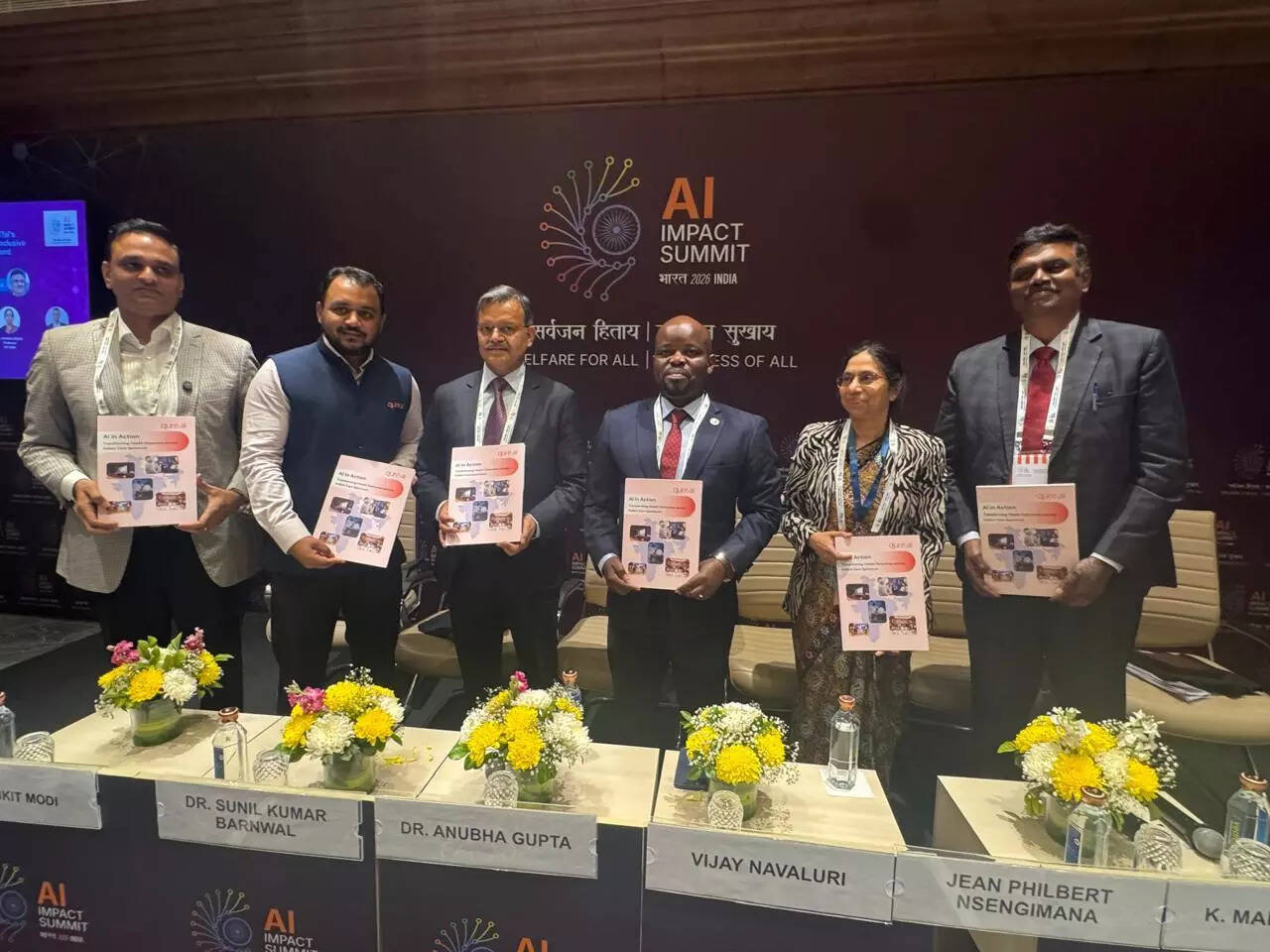
New Delhi: Health-tech company Qure.ai unveiled its report titled ‘AI in Action: Transforming Health Outcomes Across India’s Care Spectrum’ at the India AI Impact Summit, highlighting the growing integration of artificial intelligence (AI) across India’s public healthcare system.
The report documents how AI is being deployed at scale to address key public health challenges such as tuberculosis (TB), lung cancer and acute neurological conditions, drawing on evidence from state-level programmes, large public health initiatives and multi-country clinical studies.
According to the findings, embedding AI into existing healthcare workflows has helped accelerate diagnosis, reduce systemic delays and improve access to timely care without adding operational complexity or additional costs for patients and providers.
The report underscores the role of state-level partnerships in mainstreaming AI adoption. In Maharashtra, AI-enabled incidental screening across public and private facilities contributed to an estimated 35 per cent increase in TB detection, including among asymptomatic individuals undergoing X-rays for unrelated conditions.
In Karnataka, a government-led initiative facilitated the incidental detection of over 6,400 TB cases along with high-risk lung nodules through a single AI-driven workflow, the report said.
Goa’s statewide deployment screened more than one lakh routine chest X-rays, resulting in 20 confirmed lung cancer diagnoses through structured referral pathways. In Punjab, a state-supported hub-and-spoke stroke network reduced diagnostic turnaround time by up to 85 per cent, helping preserve the critical “golden hour” in district hospitals.
The report also highlights AI’s application in large-scale disease surveillance. During the Maha Kumbh Mela, AI-powered chest X-ray analysis was deployed for rapid TB surveillance in a high-density setting. The system flagged abnormalities in 36 per cent of X-rays, enabling early identification and triage of presumptive TB cases.
Speaking at the launch, Ankit Modi, Founding Member and Chief Strategy & Growth Officer, Qure.ai, said the findings indicate that AI is moving beyond pilot projects to becoming embedded within public healthcare systems.
“Through state partnerships, AI is becoming part of how screening, surveillance and emergency care are delivered. As these models scale, AI has the potential to shift detection earlier, reduce delays across care pathways and make continuity of care the default using existing infrastructure,” he said.
The report also draws on independent Health Technology Assessment (HTA) evaluations conducted under the Government of India, which found AI-powered chest X-ray screening for TB to be clinically effective and cost-saving. The assessments indicated a reduction of approximately Rs 10,000 per TB case detected compared to conventional diagnostic pathways.
Qure.ai said the evidence signals a shift towards embedding AI as a foundational layer across screening, surveillance, care coordination and emergency response, with the potential to strengthen resilience and enable more proactive healthcare delivery across India.


Leave a Reply