

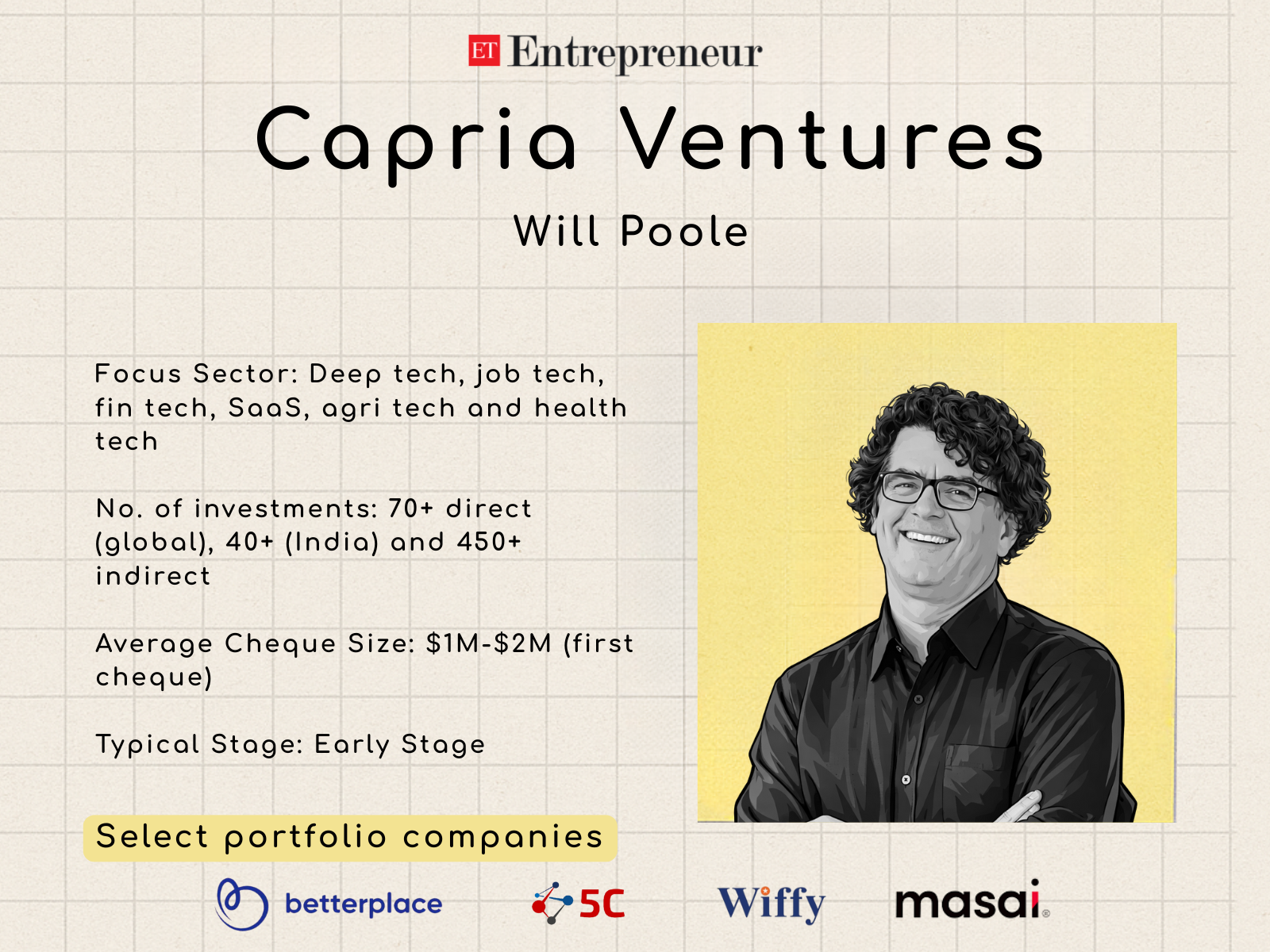
 Long before ‘Bharat’ became a VC cliché, Capria Ventures had already committed to a thesis that most investors then ignored: India’s rising middle class, underserved by financial services, education, healthcare, and job mobility.
Will Poole likes to joke that he picked the wrong time to leave Microsoft.
It was 2008, the global financial crisis was beginning to bite, and the world’s most profitable business, Windows, was the last thing anyone would walk away from.
But Poole had seen this cycle before. Downturns, he believed, were not moments to retreat.
He had lived this playbook as a young founder in the early 90s, selling his first startup at 23, then again during Netscape-era browser wars, and later while running a $13-billion division at Microsoft.
Each chapter reinforced the same truth: inflection points reward those who can pick the right hard problem and stay with it long after everyone else gets distracted.
India, he realised, was exactly that kind of problem.
Cows, mobile phones and the inflection point
Poole first arrived in India in 2003, as part of Microsoft’s push to understand emerging markets. Back then, his way of measuring technological adoption was unusual: he counted cows and mobile phones.
“For years, cows outnumbered mobile phones on Bangalore’s streets,” he recalled, laughing. “Then one day, the ratio flipped. That’s when I knew something fundamental was changing.”
The speed at which mobile adoption took off and the leapfrogging it enabled convinced him that India would soon be a hotspot for technology built under constraints that did not exist in Seattle.
A rising middle class
That thought shaped Capria Ventures, the early-stage venture capital firm Poole co-founded in 2012 alongside partners in Bangalore and Seattle.
Long before ‘Bharat’ became a VC cliché, Capria had already committed to a thesis that most investors then ignored: India’s rising middle class, underserved by financial services, education, healthcare, and job mobility.
These problems were operationally messy, regionally fragmented, and deeply multilingual, or areas where capital-light founders struggled to raise early cheques.
“We didn’t want to chase the ‘e-commerce for rich people’ playbook,” Poole said. “We wanted the hard businesses. The ones that bend to reality, not pitch decks.”
In Fund I and II, Capria backed companies such as BetterPlace, which built digital infrastructure for India’s frontline workforce, and 5C Network, which operates a cloud-based radiology service that uses AI and on-demand specialists to speed up scan reporting for hospitals.
India’s advantage
Poole is interested in AI as infrastructure, something that improves unit economics, compresses training timelines, and enables frontline workers to move up the value chain.
“In India, intelligence is evenly distributed. Opportunity is not,” he said. “AI can fix that asymmetry.”
The example he returns to often is BetterPlace’s training engine, which converts instructional content into a dozen Indian languages at a fraction of the earlier cost.
Or Wiffy, whose technicians use AI-guided video workflows to assemble appliances and furniture in customer homes. If a worker is installing a TV wall mount, their phone can analyse the product, the wall, and the required steps, delivering just-in-time upskilling that would be economically impossible to provide manually.
This is not Silicon Valley’s version of AI, he said, where the objective is to replace people.
Poole’s thesis is fundamentally different: AI plus people is better than AI alone.
It is a worldview born out of India itself, a country where labour is inexpensive but aspiration is abundant, and where training millions of workers quickly and consistently is still an unsolved problem.
The cost trap
But Poole is equally clear-eyed about India’s limitations.
In an ecosystem obsessed with ‘AI SaaS for India’, he thinks many founders underestimate a single brutal truth: Indian promoters have a low willingness to pay. Labor is cheap. Efficiency, historically, has not been valued.
One of Capria’s own portfolio companies once unplugged an AI chatbot because OpenAI’s API bills exceeded the cost of hiring more customer-support staff. The message from Poole’s team was blunt: don’t turn it off; optimize it.
To solve this gap, Capria has taken an unusual step: building an in-house AI development team to help portfolio companies reduce model costs, design caching strategies, and integrate smaller, open-source models where possible.
Defensibility in an AI-saturated world
If every startup can access the same foundational models, what creates a moat?
For Poole, the answer is simple: proprietary data, deep domain expertise, and operational complexity that compounds over time.
His favourite example is 5C Network, which now holds 20 million labelled radiology cases and processes 10,000 new scans each day. Its AI models get better daily. Its radiologists become more efficient. And every new hospital onboards because the software improves outcomes.
“You can’t replicate that with a weekend hackathon,” he said.
Defensibility comes from doing work others are unwilling to do.
What Capria wants to build next
Capria’s current fund is only halfway deployed. At least 20 new investments remain. The goal is not to chase the shiniest AI ideas, but to find founders who understand the messy, multilingual, multi-sector reality of India and who can build products that scale both locally and globally.
“These are not sexy businesses,” Poole said. “But they print money. And they solve real problems.”
It’s a philosophy rooted as much in India’s traffic jams as in Silicon Valley’s technical literature.
AI, for Poole, isn’t magic. It is a tool, powerful only when applied to operational depth, patient founders, and the ambition to build businesses that endure long after hype cycles fade.
And that is why he came to India in the first place.


Leave a Reply