
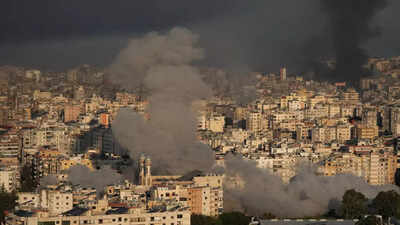
What began as coordinated and carefully planned strikes by the United States and Israel on Iran, targeting the regime of its longest-serving Supreme Leader Ayatollah Ali Khamenei, has now spiralled into a full-blown military crisis across the Middle East. The region’s skies are crowded with drones and missiles, with Tehran showcasing its ballistic capabilities by striking targets across the region, challenging both Israel and US President Donald Trump’s ambitious military posture alongside close ally Israel.Following the death of Khamenei, Iran’s leadership moved swiftly to appoint his son, Mojtaba Khamenei, as the new Supreme Leader. Under his leadership, Tehran has intensified retaliatory strikes against American and Israeli military positions, expanding the conflict to countries such as the UAE and Bahrain. The attacks have shaken the region’s sense of security, with cities like Dubai and Abu Dhabi seeing their image of safety come under strain.
Israel Iran War
Iran-backed Hezbollah later joined Tehran in launching attacks against Israel led by Prime Minister Benjamin Netanyahu, further widening the conflict.Across the region, the sound of explosions and wailing sirens has become a grim new soundtrack, as rival powers escalate their fight for dominance.
Iran war jolts oil markets: Tankers halt, IEA releases record 400m barrels
The widening war involving Iran has disrupted global oil supplies, halting oil tankers, damaging refineries and worrying investors about rising energy prices.In response, the International Energy Agency said on Wednesday it would release 400 million barrels of emergency oil from the reserves of its member countries. It is the largest release in the agency’s history and marks a shift in how governments are responding to the war, as many leaders had earlier been reluctant to use emergency stockpiles.Since the conflict began on February 28 with joint US and Israeli strikes on Iran, oil tanker movement through the Strait of Hormuz has almost stopped. The route normally carries about one-fifth of the world’s oil supply each day. Major oil producers such as Iraq, Kuwait and the United Arab Emirates have also reduced production because their storage facilities are filling up. Meanwhile, strikes by Iran, Israel and the United States on oil and gas facilities have further raised fears of a supply shortage.
Iranian ‘suicide’ boat attack on tanker near Iraq kills Indian national
An Indian national has reportedly been killed after Iran allegedly used a “suicide” boat to attack a US-owned oil tanker near Iraq, sources told PTI.The Marshall Islands-flagged tanker Safesea Vishnu was targeted near the Khor Al Zubair port within Iraq’s territorial waters. The remaining 27 crew members were rescued and taken to Basra.Sources said the company was devastated by the loss and urged the Indian government to strongly condemn the attack and take urgent steps to ensure the safety of seafarers in the region amid the escalating West Asia conflict.
Children bear the brunt of escalating war
The UN children’s agency UNICEF has warned that the intensifying conflict between the United States, Israel and Iran is creating a “catastrophic” situation for millions of children across the Middle East.“Since 28 February, more than 1,100 children have been reported injured or killed in the violence. This includes 200 children reportedly killed in Iran, 91 in Lebanon, four in Israel and one in Kuwait,” the agency said in a statement.UNICEF warned that the numbers are likely to rise as the fighting spreads. Millions of children have also missed school due to the crisis, while hundreds of thousands have been forced to flee their homes because of continuous bombardment.
Israel’s restriction on Al Aqsa Mosque
Israel has imposed strict restrictions on worshippers and access to the Old City of Jerusalem and the Al Aqsa Mosque, citing “security” concerns amid the ongoing war with Iran.Qatar, Jordan, Indonesia, Turkiye, Pakistan, Saudi Arabia, Egypt and the United Arab Emirates have condemned the continued closure of the Al Aqsa Mosque during the Muslim holy month of Ramadan for the 12th straight day.In a joint statement released on Wednesday, the foreign ministers of the eight countries said the restrictions on Palestinian access to Jerusalem’s Old City and its places of worship were a “flagrant violation to international law, including international humanitarian law, the historical and legal status quo, and the principle of unrestricted access to places of worship”.Palestine and Hamas have also condemned the closure of the mosque, one of the most important religious sites in Jerusalem.
Bahrain arrests 4 on suspicion of spying for Iran
Bahrain’s interior ministry said it has arrested four citizens accused of carrying out “espionage activities with the Iranian Revolutionary Guard Corps”.The suspects, aged between 22 and 36, were allegedly involved in photographing sensitive locations in the country. Authorities said a fifth suspect, aged 25, is currently abroad.“Investigations revealed that the first arrestee, acting on organisational instructions and with the assistance of others, used high-resolution photography equipment to photograph and record coordinates of vital and important locations in Bahrain,” the ministry said.“This information was then transmitted via encrypted software to the IRGC,” it added.
Iraqi group claims attacks on US military bases
Saraya Awliya al-Dam, an Iraqi armed group, claimed it carried out seven attacks targeting US military bases across Iraq.Iran targets Gulf shipping, Dubai airport and oil facilitiesIran escalated the conflict by firing on commercial ships and targeting Dubai International Airport on Wednesday, raising fears about the stability of the oil-rich Persian Gulf.The strikes came as US and Israeli air attacks on Iran continued for the 12th day.The conflict has disrupted global trade routes and raised concerns about fuel and fertilizer supplies coming from the Gulf. It has also threatened air travel in one of the world’s busiest aviation corridors.
UAE air defences respond to missile threat
Authorities in the United Arab Emirates said air defence systems were responding to an incoming missile threat.Residents were advised to stay in safe locations and follow official information channels for further updates, according to the country’s national emergency crisis and disaster management authority.
Iran’s new Ayatollah reportedly wounded
According to an Israeli intelligence assessment, Iran’s new Supreme Leader Ayatollah Mojtaba Khamenei may have been wounded at the start of the war, the same day his father and predecessor Ayatollah Ali Khamenei was killed in an Israeli airstrike.An Israeli intelligence official and a reservist familiar with the report said Mojtaba was injured during the strike. They spoke on condition of anonymity because they were not authorised to discuss the matter publicly.The 56-year-old has not been seen in public since being named Supreme Leader on Monday. His wife was also killed in the strike.Yousef Pezeshkian, the son of Iranian President Masoud Pezeshkian, said on social media that he had heard Mojtaba was wounded but that friends told him “he is healthy and there is no problem.”
Fresh strikes rock Tehran and Lebanon
Late on Wednesday, witnesses in Tehran reported hearing loud explosions and heavy anti-aircraft fire as drones buzzed overhead.A person travelling toward Tehran said the sky was covered with smoke from missile and bomb blasts, and the air smelled of burnt powder and gasoline.The conflict has also widened across the region. Israel carried out strikes on targets linked to Iran-backed Hezbollah in Lebanon.The UN refugee agency said at least 759,000 people have been displaced inside Lebanon, while more than 92,000 others have fled to neighbouring Syria.
Iranian adviser calls Trump ‘satan’
A senior military adviser to Iran’s Supreme Leader Mojtaba Khamenei strongly criticised US President Donald Trump and renewed threats against Israel.“Trump is the most corrupt and stupid American president,” Yahya Rahim Safavi said. “He is Satan himself.”He also repeated Iran’s long-standing threat against Israel.“In the Middle East region, Israel and Iran cannot be together. One of them must remain. The one that remains is Iran and the one that is destroyed is definitely the Zionist regime,” he said.

Leave a Reply