
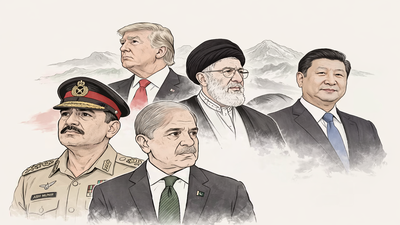
NEW DELHI: As efforts intensify to stabilise a shaky ceasefire between Iran and the United States, a new dimension has come into focus: China’s behind-the-scenes diplomacy. While Pakistan has positioned itself as the venue for talks, officials and analysts suggest Beijing’s role may ultimately prove decisive in determining whether the current truce evolves into a lasting agreement.“On ceasefire night, hopes were fading, but China stepped in and convinced Iran to agree to a preliminary ceasefire,” said a senior Pakistani official AFP source familiar with the negotiations.Diplomatic sources indicate that Chinese Foreign Minister Wang Yi held as many as 26 calls with counterparts from countries involved in the crisis. In parallel, Beijing’s Middle East envoy reportedly “shuttled across” the conflict-hit region, attempting to narrow differences at a critical juncture.The remark points to China’s growing influence in crisis management, particularly in regions where Western-led diplomatic frameworks have struggled to build consensus.
Beijing’s leverage seen as critical to any lasting agreement
Even as Islamabad prepares to host negotiations, multiple diplomatic voices suggest that China’s role could be indispensable in securing a durable peace.Pakistan has received global attention for facilitating a temporary ceasefire between the warring sides, but officials acknowledge that the breakthrough may not have been possible without Beijing’s intervention.“While our efforts were central, we were falling short of a breakthrough, which was ultimately achieved after Beijing persuaded the Iranians,” the same source added, requesting anonymity due to the sensitivity of the talks.US President Donald Trump also appeared to echo this assessment, noting that China played a role in bringing Iran to the negotiating table shortly after announcing the two-week ceasefire.The ongoing conflict—sparked after joint Israeli and US strikes on February 28 and followed by Iranian retaliation targeting Gulf shipping routes and Israeli cities—has already claimed thousands of lives and disrupted global markets.
Pakistan hosts talks, but uncertainties persist over participation
Despite Islamabad’s preparations, confusion continues over whether formal negotiations have actually begun.Iranian state media has categorically denied reports that senior officials, including Foreign Minister Abbas Araghchi and Parliament Speaker Mohammad Bagher Ghalibaf, have travelled to Pakistan.“The news from some media outlets that an Iranian negotiating team has arrived in Islamabad, Pakistan, to negotiate with the Americans is completely false,” a source told Tasnim News Agency.Iran’s Fars News Agency also dismissed claims of participation, stating that Tehran has “no plans to attend peace talks with the American side until a ceasefire is established in Lebanon.”These statements underline a major sticking point: Iran’s insistence that hostilities in Lebanon must cease before broader negotiations can proceed.
JD Vance heads to Islamabad amid fragile ceasefire
Against this uncertain backdrop, US Vice President JD Vance is set to travel to Islamabad to lead the American delegation in talks aimed at salvaging the ceasefire.The visit marks a rare instance of high-level US engagement with Iran, given the strained ties since the 1979 Islamic Revolution.Vance, who has previously expressed scepticism about prolonged military interventions, will be joined by Trump’s envoy Steve Witkoff and adviser Jared Kushner—both of whom have participated in earlier indirect negotiations with Iranian representatives.However, the White House has offered limited clarity on whether the talks will be direct or indirect, reflecting the fragile and fluid nature of the diplomatic process.
Strait of Hormuz dispute adds pressure to negotiations
One of the most contentious issues remains Iran’s control over the strategically vital Strait of Hormuz, through which nearly 20% of the world’s oil and liquefied natural gas flows.Trump criticised Tehran’s handling of maritime traffic, stating it was “not the agreement we have.”“There are reports that Iran is charging fees to tankers going through the Hormuz Strait,” he wrote. “They better not be and, if they are, they better stop now.”Iran’s earlier move to restrict shipping through the passage had heightened fears of a global energy shock, adding urgency to ceasefire negotiations.
Lebanon conflict complicates ceasefire framework
Another major hurdle is the disagreement over whether Lebanon should be included in the ceasefire.While Iran and mediators have insisted that it must be part of any agreement, Israel has rejected the idea outright. Israeli Prime Minister Benjamin Netanyahu stated, “There is no ceasefire in Lebanon.”Israeli forces have continued strikes targeting Hezbollah positions, even as diplomatic efforts unfold. The United States has indicated it will host separate talks in Washington involving Israeli and Lebanese officials.The humanitarian situation in Lebanon has also worsened. According to the World Health Organization, evacuation efforts in Beirut have been severely constrained, with hospitals unable to relocate hundreds of patients amid ongoing strikes.
Tensions rise over Pakistan’s mediation role
Pakistan’s attempt to position itself as a mediator has also drawn sharp reactions.Israeli envoy to the US Yechiel Leiter criticised Islamabad’s role, stating, “Even if it is to your dismay, Israel is here to stay. That’s not for negotiation.”Meanwhile, Israeli Foreign Minister Gideon Sa’ar rebuked Pakistan over remarks by Defence Minister Khawaja Asif, who had called Israel “evil and a curse for humanity.”Asif had said: “Israel is evil and a curse for humanity, while peace talks are underway in Islamabad, genocide is being committed in Lebanon. Innocent citizens are being killed by Israel, first Gaza, then Iran and now Lebanon, bloodletting continues unabated.”“I hope and pray people who created this cancerous state on Palestinian land to get rid of European jews burn in hell,” he added.These remarks have further strained diplomatic efforts and raised questions over Islamabad’s ability to maintain neutrality.
China seen as potential guarantor of peace
Amid the turbulence, several officials and analysts suggest that China may be the only acceptable guarantor for any eventual agreement.“China was requested to be a guarantor. Iran wants a guarantor,” a diplomatic source AFP.Russia, another potential candidate, is seen as less viable due to its ongoing war in Ukraine and lack of acceptability among Western powers.China’s longstanding ties with both Iran and Pakistan—combined with its economic influence and relatively neutral posture—place it in a unique position to facilitate consensus.“China’s role would remain indispensable in clinching any final peace agreement as the ultimate guarantor,” said Mushahid Hussain Sayed, a former Pakistani senator.
Complex negotiations ahead despite diplomatic momentum
Despite renewed diplomatic engagement, officials caution that the path to a comprehensive agreement remains difficult.“Negotiations are very complicated, sensitive…to reach consensus all sides will have to make painful compromises and concessions,” a source involved in the process said.Key issues—including Iran’s nuclear programme, regional proxy conflicts, maritime security, and the status of Lebanon—remain unresolved.While the ceasefire has provided a temporary pause in hostilities, the absence of clarity on core terms and continued military activity on the ground underscore the fragility of the situation.As talks inch forward, China’s quiet but assertive diplomacy may prove to be the factor that determines whether the current truce holds—or collapses under the weight of competing demands.

Leave a Reply