
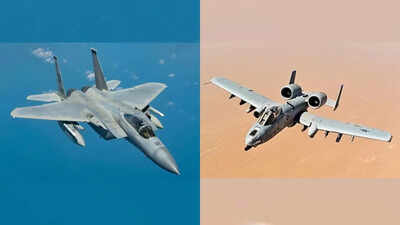
Iran’s downing of two US military aircraft marks the first time in more than 20 years that American warplanes have been shot down by enemy fire, underlining Tehran’s continued ability to retaliate despite claims by US President Donald Trump that the country has been “completely decimated.”The incidents come five weeks into the ongoing US-Israeli campaign against Iran. Earlier this week, Trump had said Tehran’s “ability to launch missiles and drones is dramatically curtailed.” However, US officials confirmed that Iran shot down an F-15E Strike Eagle on Friday. One service member has been rescued, while search operations continue for another. Iranian state media also reported that a US A-10 attack aircraft crashed after being struck by Iranian air defences.
The last confirmed instance of a US fighter jet being downed in combat dates back to 2003, when an A-10 Thunderbolt II was hit during the Iraq war. According to retired Air Force Brig Gen Houston Cantwell, the rarity of such incidents in recent decades is largely because US forces have mostly fought adversaries without advanced anti-aircraft systems.“The fact that this hasn’t happened until now is an absolute miracle,” Cantwell said. “We’re flying combat missions here, they are being shot at every day.”
Shoulder-fired missile likely used
US Central Command said American forces have conducted over 13,000 missions and struck more than 12,300 targets since the start of the Iran conflict. Despite sustained bombardment, Iran has continued to mount attacks, targeting Israel and Gulf Arab states and contributing to regional instability.Behnam Ben Taleblu said the situation reflects the difference between degrading and fully destroying an adversary’s air defence capabilities. “A disabled air defence system is not a destroyed air defence system,” he said. “We shouldn’t be shocked that they’re still fighting.”Taleblu added that US aircraft flying at lower altitudes may have increased their vulnerability. While a surface-to-air missile could have been used, he said it is more likely that a portable, shoulder-fired system was responsible, describing Iran as “weak but still lethal.”“This is a regime that is fighting for its life,” he said.Mark Cancian, a retired Marine colonel, agreed that a shoulder-fired missile was likely used. Despite the losses, he described the broader US air campaign as a “tremendous success.”“But then there’s the political side — you have a American public that is accustomed to fighting bloodless wars,” Cancian said. “Then a large part of the country doesn’t support the war. So to them, any loss is unacceptable.”
Pilots trained for high-risk scenarios
Military experts noted that US pilots are extensively trained for such situations. In high-threat environments, aviators are trained to detect and evade both infrared- and radar-guided missiles. If an aircraft is hit, pilots follow strict protocols after ejection, including assessing injuries and transmitting their location for rescue.However, communication itself can be risky, as adversaries may attempt to intercept or manipulate signals.The last US jet shot down in combat, in April 2003 over Baghdad, saw the pilot eject safely and get rescued.
Helicopters remain more vulnerable
While fighter jet losses have been rare, other aircraft have faced greater risks historically. In 1980, a failed US mission to rescue hostages in Tehran ended in disaster when two aircraft collided, killing eight personnel.More recently, helicopters have been particularly exposed due to their lower speed and altitude. A 2005 incident in Afghanistan saw a Chinook helicopter shot down by a rocket-propelled grenade, killing 16 troops.Cantwell noted that slower and lower-flying aircraft are inherently more vulnerable, adding that recent rescue missions, likely involving helicopters, reflected significant risk.“That’s why those who went out on this week’s rescue missions did such a brave and honourable act,” he said.

Leave a Reply