
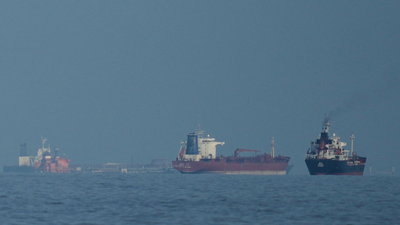
As Donald Trump threatened a naval blockade on Iran, Tehran hit back with an unusual warning—this time using mathematics to make its point on rising fuel prices.Iran’s Parliament Speaker Mohammad Bagher Ghalibaf cautioned that global consumers would soon feel the pain, posting online: “Enjoy the current pump figures. With the so-called ‘blockade’, soon you’ll be nostalgic for $4–$5 gas.”Alongside the remark was a cryptic equation suggesting that any escalation in a blockade of the Strait of Hormuz could trigger a nonlinear spike in oil prices—meaning prices wouldn’t just rise, but accelerate sharply.
ΔO_BSOH>0 ⇒ f(f(O))>f(O) — What does the equation mean?
At its core, the equation argues that even a small increase (ΔO > 0) in Blockade of Strait of Hormuz (BSOH) can lead to compounding effects on oil prices.The first impact (f(O)) is the immediate price rise due to supply disruptionThe second (f(f(O)) ) reflects knock-on effects—panic buying, supply chain shocks, insurance spikes, and market speculationIn simple terms, if tensions worsen, oil prices won’t just go up—they could surge disproportionately, making today’s high prices look mild in comparison.
What triggered the warning?
The message followed the collapse of high-stakes US-Iran talks in Islamabad, which had aimed to extend a fragile ceasefire.Soon after, the US military announced plans to enforce a blockade targeting Iranian shipping, escalating tensions in an already volatile region. While vessels not docking in Iran may still pass through the Strait of Hormuz, the move threatens to choke a critical artery of global energy supply.Trump remained defiant, expressing confidence that Iran would eventually concede. “I predict they come back and they give us everything we want,” he said, adding that Tehran “has no cards.” He also warned of possible military action if Iran resists.Iranian leaders rejected the pressure. Ghalibaf said the threats would have “no effect” and warned Washington against escalation: “If you fight, we will fight, and if you come forward with logic, we will deal with logic.”
Why it matters
The Strait of Hormuz carries a significant share of the world’s oil and gas. Any disruption—especially a prolonged blockade—could:– Drive sharp, cascading increases in fuel prices globally– Disrupt supply chains and trade flows– Add to inflation pressures worldwideThe failed talks also exposed deep divides over Iran’s nuclear programme and control of regional waterways—leaving diplomacy fragile and the risk of escalation high.

Leave a Reply