
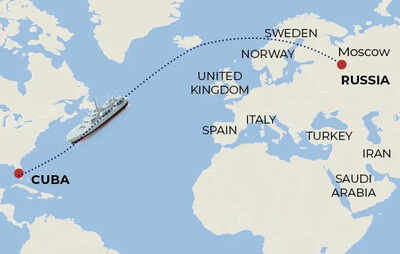
A Russian-flagged tanker, the Anatoly Kolodkin, carrying an estimated 730,000 barrels of crude, is closing in on Cuba even as the United States tightens its de facto oil blockade on the island. Washington is weighing its options, with the possibility of interception looming, while Moscow signals defiance by making the shipment highly visible. What might otherwise have been a routine energy delivery has instead evolved into a geopolitical standoff, raising questions about enforcement, escalation, and intent.The developments come at a time when Cuba is grappling with a deepening energy crisis, triggered by the collapse of Venezuelan oil support and exacerbated by American restrictions.
Israel Iran War
Into this vacuum steps Russia, not with enough fuel to resolve the crisis, but with enough to challenge the blockade — and, more importantly, to test the limits of US resolve in its own hemisphere.The image is strikingly familiar, even if the actors and instruments have evolved. A Russian vessel, loaded with energy supplies, moves steadily toward Cuba. The United States watches closely, weighing interception. The Caribbean once again becomes a theatre where great powers test resolve, signal intent, and flirt with escalation.More than six decades after the Cuban Missile Crisis brought the world to the brink of nuclear war, Cuba is once again at the centre of a geopolitical confrontation between Washington and Moscow. This time, the flashpoint is not nuclear missiles but oil tankers, economic chokeholds, and strategic signalling — a reminder that while the tools of confrontation may change, the island’s strategic significance endures.
A tanker that carries more than oil
The Kolodkin’s journey is not merely logistical. It is political theatre, calibrated for maximum visibility.Escorted briefly by a Russian warship through the English Channel and tracked by Western navies, the tanker has already served its purpose as a signal. Whether or not it successfully docks in Cuba may ultimately matter less than the fact that it is testing the boundaries of American enforcement.As Lawrence Gumbiner, former US envoy to Havana, put it: “Russia loves to poke us in the eye.” His assessment cuts to the core of the episode. The tanker is not about rescuing Cuba’s economy. It is about probing Washington’s red lines.The United States, under Donald Trump, has imposed a de facto oil blockade on Cuba, aiming to starve the government of fuel and force political change. This strategy has been intensified after the collapse of Venezuelan support, historically Cuba’s primary energy lifeline.Yet, the arrival of even a single tanker exposes a vulnerability in that strategy. It raises a critical question: can the United States fully enforce a maritime blockade without risking direct confrontation with another nuclear power?
Echoes of 1962 — but with different weapons
The parallels with 1962 are hard to ignore.During the Cuban Missile Crisis, Soviet ships carrying nuclear missiles approached Cuba while the US Navy enforced a naval “quarantine.” The world watched as John F. Kennedy and Nikita Khrushchev engaged in a high-stakes standoff where miscalculation could have triggered nuclear war.Today, the stakes are different, but the structure of the crisis feels eerily similar.Instead of nuclear warheads, the cargo is crude oil. Instead of a formal naval blockade, there is a sanctions regime backed by implied maritime enforcement. Instead of ideological confrontation between capitalism and communism, the conflict is about spheres of influence, strategic leverage, and geopolitical signalling.But the underlying dynamic remains unchanged: Cuba as a pressure point.In 1962, Cuba was the Soviet Union’s forward base in the Western Hemisphere. In 2026, it remains a strategic foothold for Vladimir Putin — not for nuclear deployment, but for intelligence gathering, influence projection, and bargaining power.
Why Cuba still matters
To understand why this small Caribbean island continues to command outsized geopolitical attention, one must look at geography.Cuba lies just 90 miles off the coast of Florida. Its proximity to the United States makes it uniquely valuable for any external power seeking leverage against Washington.For Russia, Cuba offers multiple advantages.It is a listening post. The reopening of the Lourdes signals intelligence facility has restored Moscow’s ability to monitor communications across much of the Gulf of Mexico.It is a symbolic ally. Supporting Cuba reinforces Russia’s narrative as a defender of states resisting US pressure, particularly in the Global South.It is a bargaining chip. By maintaining a presence in Cuba, Moscow can signal that it retains the ability to challenge US dominance in its own hemisphere — a direct counter to American pressure in Eastern Europe and Ukraine.For the United States, the calculus is equally clear.Washington views Cuba not just as a neighbour, but as a potential platform for adversarial influence. The fear is not simply about Russia, but also about the broader alignment of powers — including China and Iran — gaining a foothold near US shores.This is why the current blockade is so aggressive. It is not just about Cuba. It is about denying rivals strategic space.
A collapsing energy system
The immediate trigger for the crisis is Cuba’s deepening energy emergency.For years, Venezuela supplied the island with heavily subsidised oil, at times exceeding 100,000 barrels per day. That arrangement sustained Cuba’s electricity grid, transportation, and basic economic functions.The sudden disruption of Venezuelan supplies has left Cuba in a precarious position.According to reports, the island has not received significant fuel shipments for months. Power outages have become frequent. Public transport has slowed. Tourism — a key revenue source — is under strain.Cuba requires roughly 100,000 barrels of oil per day to function. The Kolodkin’s cargo, while substantial, would only cover a fraction of that demand for a limited period.Even if successfully delivered and refined, the oil would buy time — not stability.This is why analysts describe the shipment as symbolic rather than transformative. It cannot resolve Cuba’s structural crisis. But it can disrupt Washington’s strategy and demonstrate that the blockade is not airtight.
Strategic signalling and calculated risk
At its core, the movement of Russian tankers toward Cuba is less about immediate relief and more about calculated signalling. By sending a Russian-flagged vessel — openly tracked and briefly escorted by naval assets — Moscow is making its intentions visible rather than covert. The message is deliberate: Russia is willing to test the limits of American enforcement in its own backyard, and it is prepared to do so in ways that force Washington into uncomfortable choices.This is a classic play in geopolitical brinkmanship. The shipment itself is modest in impact, but high in symbolic value. If the United States moves to intercept, it risks escalating a sanctions dispute into a direct state-to-state confrontation. If it holds back, it creates space for further challenges, gradually normalising breaches of its blockade.For Vladimir Putin, the calculus is relatively low-cost. Even a failed delivery serves a purpose by exposing the limits of US control and diverting attention and resources. For Washington, however, every response carries weight, feeding into perceptions of strength, resolve, and credibility — not just in the Caribbean, but across other theatres where American commitments are being tested.In that sense, the tanker is not merely a vessel but a strategic instrument — one designed to provoke, probe, and potentially reshape the boundaries of confrontation without crossing into outright conflict.
The broader geopolitical chessboard
The unfolding tensions around Cuba are not an isolated episode but part of a much larger strategic contest playing out across multiple regions. What appears as a maritime standoff in the Caribbean is, in reality, deeply connected to ongoing confrontations between Washington and Moscow in Ukraine, the Middle East, and beyond.For Russia, the move toward Cuba serves as a reminder that geopolitical pressure will not go unanswered. By projecting influence into the Western Hemisphere, Vladimir Putin is signalling that Moscow retains the ability to challenge the United States far from its immediate periphery. It is a way of stretching the strategic map — forcing Washington to think not just about Eastern Europe, but also about its own neighbourhood.For the United States, the situation is equally layered. Any perceived weakness in enforcing its position on Cuba could ripple outward, affecting credibility in other arenas where American commitments are under scrutiny. Conversely, an aggressive response risks escalating tensions at a time when Washington is already navigating complex engagements elsewhere.This interplay turns Cuba into more than a regional concern. It becomes a lever in a wider negotiation — an implicit exchange where actions in one theatre influence calculations in another. The Caribbean, in this context, is not the centre of the conflict but a pressure point within a broader geopolitical chessboard, where each move is designed to shape outcomes far beyond the immediate horizon.
The Trump doctrine and hemispheric control
At the centre of the American response is a doctrine that echoes older strategic thinking. Donald Trump has articulated a vision of reasserting US dominance in the Western Hemisphere — often seen as a modern reinterpretation of the Monroe Doctrine — where external powers such as Russia and China are systematically pushed out of Latin America.Within this framework, Cuba has emerged as a critical test case. The strategy is not limited to geopolitical signalling; it is designed to reshape the internal balance of power on the island. By imposing a strict oil blockade while simultaneously allowing limited fuel flows to Cuba’s private sector, Washington is attempting a calibrated squeeze — weakening the state while empowering non-state actors.Secretary of State Marco Rubio has framed this approach clearly: support private Cubans, not the government. The policy aims to tilt the economic ecosystem away from state control, creating internal pressure for political change without direct intervention.Yet, the limits of this strategy are increasingly visible. The volume of permitted fuel shipments — roughly 30,000 barrels so far — remains a fraction of Cuba’s daily requirement. Meanwhile, the broader blockade is exacerbating a deepening humanitarian strain, affecting electricity generation, food distribution, and essential services. International bodies, including the United Nations, have warned of worsening hardship as the energy crisis tightens its grip.This dual-track approach underscores the complexity of Washington’s position. Applying pressure is essential to the doctrine’s success, but pushing too far risks triggering outcomes that could backfire. A complete economic collapse in Cuba could unleash mass migration, regional instability, and open the door for rival powers to step in more aggressively under the guise of humanitarian support.The stakes, therefore, extend beyond Cuba itself. Success would reinforce US authority in its immediate neighbourhood and send a broader signal of strategic resolve. Failure, however, could expose the limits of American power — either through an ineffective blockade that is openly challenged, or through an overreach that escalates tensions and undermines stability in the region.
The risk of escalation
The danger in the current standoff lies not in any single move, but in how quickly a chain of reactions could spiral beyond control. A decision by Washington to intercept a Russian-flagged tanker like the Anatoly Kolodkin would not be a routine enforcement action; it would carry the risk of being interpreted in Moscow as a direct challenge to its sovereignty. In such a scenario, even a limited maritime confrontation could trigger a broader diplomatic or military response.At the same time, allowing the shipment to pass unchallenged presents its own risks. It could weaken the credibility of the US blockade and encourage further Russian or even Chinese attempts to breach it, gradually eroding Washington’s leverage over Havana. What appears as restraint in the short term may translate into strategic disadvantage over time.This delicate balance is further complicated by overlapping global tensions — from Ukraine to the Middle East — where both the United States and Vladimir Putin are already engaged in high-stakes competition. In such an environment, even a symbolic confrontation in the Caribbean can carry disproportionate consequences.The real threat, therefore, is miscalculation. Not a deliberate push toward conflict, but a series of calculated moves that, taken together, leave little room for de-escalation. In a region where history has shown how quickly crises can intensify, the margin for error remains dangerously thin.A familiar island, a new crisisThe contours may have changed, but the core reality endures. Situated just off the US coastline, Cuba remains uniquely positioned to magnify great power rivalry. What was once a battleground of ideology has now become a theatre of economic coercion and geopolitical messaging. Yet, the risks remain strikingly similar: a misstep, a miscalculation, or an overreach could quickly transform a controlled standoff into a wider confrontation.In this evolving crisis, Cuba is not merely a bystander caught between two powers. It is once again the stage on which larger global tensions are being tested — a familiar island, confronting a new but equally precarious moment.

Leave a Reply