
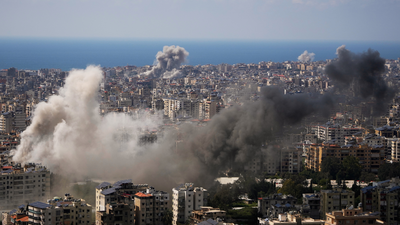
The fragile truce between Iran and the United States showed early signs of breaking down on Thursday, day two of the ceasefire, with Tehran warning it could resume hostilities as Israeli forces intensified strikes in Lebanon and Hezbollah responded by firing back. Both Washington and Tehran had declared victory after agreeing to a two-week ceasefire and initiating negotiations aimed at ending a war that has killed thousands across the Middle East and disrupted global markets. However, cracks in the deal surfaced quickly when Israel launched its heaviest bombardment of Lebanon since Hezbollah entered the conflict in March.According to Lebanese authorities, at least 182 people were killed and nearly 900 injured in Wednesday’s strikes, many of them in densely populated areas of Beirut.Hezbollah retaliated on Thursday by firing rockets towards Israel, accusing it of breaching the US-Iran truce. Israel, however, maintained that its operations against Hezbollah fall outside the scope of the ceasefire — a position echoed by US Vice President JD Vance ahead of planned talks with Tehran.“If Iran wants to let this negotiation fall apart over Lebanon… that’s ultimately their choice,” Vance said, insisting the ceasefire did not extend to Israel’s campaign against the militant group.Iranian Parliament Speaker Mohammad Bagher Ghalibaf signalled growing frustration, warning that the basis for negotiations had already been undermined. He cited continued strikes in Lebanon, a drone incursion into Iranian airspace, and disputes over uranium enrichment as violations of the agreement.The truce — brokered just before a deadline set by former US President Donald Trump — appeared increasingly fragile, with US officials also suggesting discrepancies between Iran’s proposed terms and those accepted by Washington.On the ground in Lebanon, the scale of destruction has been severe. UN human rights chief Volker Türk described the level of casualties as “horrific,” as unannounced airstrikes in Beirut triggered panic among civilians.Since Israel escalated its campaign last month, more than 1,700 people have reportedly been killed in Lebanon.Iran’s Revolutionary Guards warned of retaliation if Israeli strikes continue, while Hezbollah asserted its “right” to respond. Israeli Prime Minister Benjamin Netanyahu reiterated that Israel remains ready to confront Iran directly, stressing that key military objectives — including disarming Hezbollah — have yet to be achieved.US defense secretary Pete Hegseth also said American forces remain prepared should the conflict reignite.
High-stakes diplomacy
The escalating rhetoric comes ahead of crucial talks in Islamabad, expected later this week, where US and Iranian officials are set to negotiate a longer-term resolution.Tensions also remain high around the Strait of Hormuz, a vital global oil route. Iran has indicated alternative shipping paths amid concerns over sea mines, while uncertainty persists over whether the strait remains fully operational.Shehbaz Sharif, whose government helped mediate the ceasefire, urged all sides to respect the two-week pause to allow diplomacy a chance.Meanwhile, reports of fresh Iranian missile and drone strikes targeting US-allied Gulf nations — including Saudi Arabia, United Arab Emirates, Kuwait, and Bahrain — have further raised concerns about the truce’s durability.Despite the tensions, there were no immediate reports of new strikes across the region in the past few hours.
Uncertain path ahead
Global leaders, including those from Europe and United Kingdom and Canada, have called for a swift and lasting end to the war, while Pope Leo XIV described the ceasefire as a moment of “real hope.”However, major differences remain — particularly over Iran’s uranium enrichment, sanctions relief, and control over the Strait of Hormuz — leaving the path to peace uncertain.
Poll
Should the international community intervene more assertively in the Middle East?
While the ceasefire briefly eased economic pressures, sending oil prices sharply lower, the risk of renewed conflict continues to loom large over the region.

Leave a Reply