
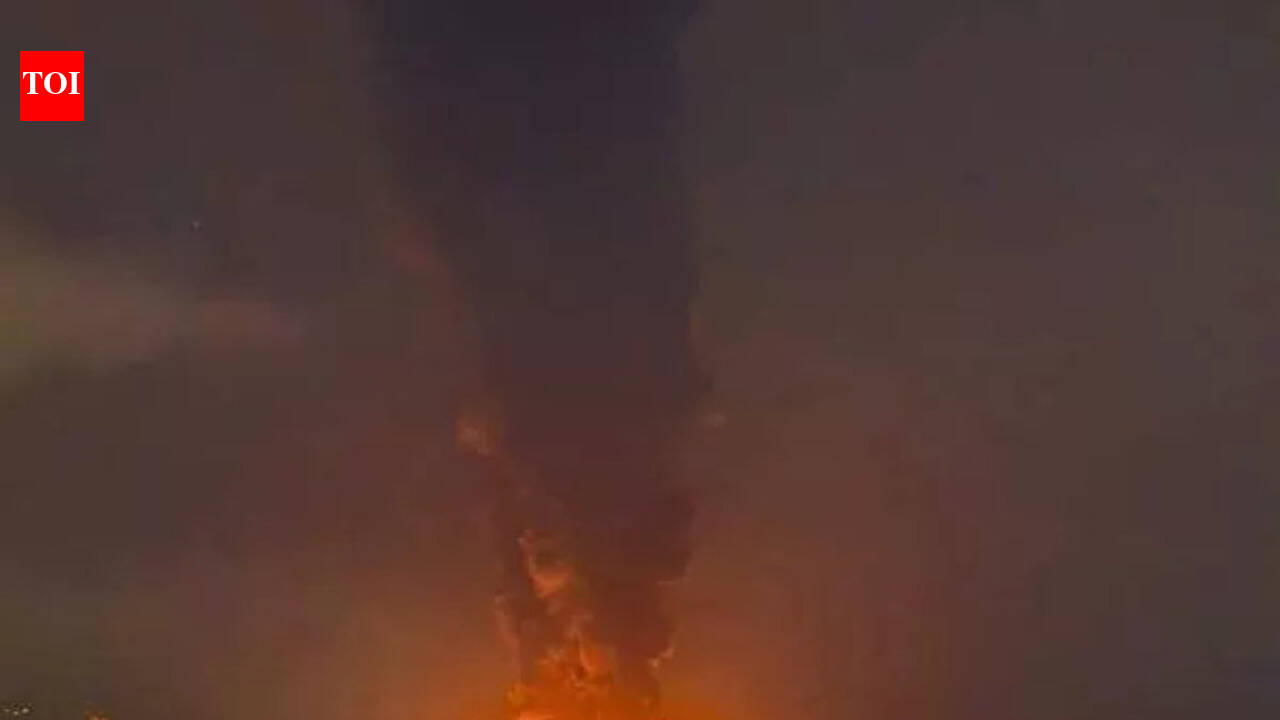
Iran’s capital Tehran and its surrounding areas have been witnessing thick black clouds hovering over it along with “toxic rain of oil” that is descending upon the city in the form of black droplets. This came about after Israeli forces struck the Shahran and Shahr-e-Rey oil depots in Tehran, late on Saturday. Soon after, Iranians living in India shared with TOI the ordeal of their family members back home.“Waking up on Sunday morning seemed to be like a moment of horror. Even at 10am, it was so dark that it seemed like night. People are having severe difficulties in breathing even inside their houses. We feel helpless. Children, elderly, our pets, all are suffocating,” Abgine Khaki, an Iranian in India, told TOI while citing conversation with her family in central Tehran over ‘state-controlled’ messaging app ‘Bale’.It is directly harming the environment and is dangerous for everyone, Khaki said. “Think about the patients in hospitals… Think about those daily wagers who need to step out for work.”In fact, the oil depot strikes by Israel’s forces in Iran’s capital were so intense, that several reports indicated that it went far beyond what the Trump administration had anticipated, with an advisor to the US president saying that “he didn’t like the idea” of those targets.Another Iranian, staying in Mumbai, said that people have been asked by the govt to wear masks. He said that he managed to speak to his father after a lot of struggle, that too only for a few seconds. “There is a strong oil stench in the air. But more than air, it is the toxic black rain droplets which are causing more damage,” he added.After pausing a bit, he said the prices of groceries have increased after the oil depot strikes. “The govt has also put a cap of 5 litres of fuel for vehicles per day due to the huge loss. We hope the situation is contained at the earliest. Ordinary Iranians are suffering the most,” he added.Doctors said that due to acid rain, people with pre-existing illnesses would get affected the most while the situation may also leave people battling against skin, eye and pulmonary conditions.“In this situation, chronic obstructive pulmonary disease (COPD) and asthma can develop, besides acute respiratory distress syndrome. Proper precautions like staying indoors, wearing goggles and mask, and covering face with wet cloth will help,” said Dr Anurag Agrawal, head of department of pulmonary medicine at Govt Doon Medical College Hospital, Dehradun.Mohammed Kashmiri, another Iranian, who has been living in Delhi for over five years, claimed that the persistent communication blackout has made it worse for the residents. “Internet and phone lines are down. One of the few mediums of communication left is Bale, which is heavily monitored by the govt. It has no end-to-end encryption, thus no privacy for users. People have no other option. On top of these restrictions, the almost negligible internet speed is making it difficult to connect with our dear ones back home,” Kashmiri said.Due to the blackout, people are also unable to receive emergency messages.But Iranians know how to survive, Khaki added. People are regularly knocking on the doors of their neighbours and even strangers to ask if they need any help.“We’re confident that this difficult phase of our nation’s history will pass too,” Khaki said.(With inputs from Shivani Azad)

Leave a Reply