
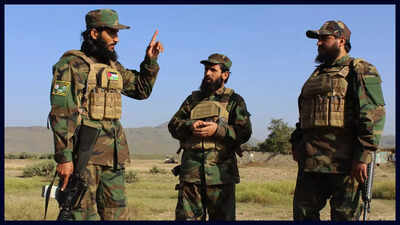
While global attention is locked on the US-Israel-Iran war, another conflict is accelerating on Iran’s eastern flank – Pakistan’s escalating fight with the Taliban government in Afghanistan – and it’s already turning deadly and destabilizing.Pakistan last week launched “Operation Ghazab lil Haq” in response to Afghan Taliban attacks on along the 2,611-km frontier separating the two countries.
Pakistan has described the confrontation as an “open war,” launching airstrikes and cross-border operations that Afghan officials say are hitting military and civilian areas, while Pakistan insists it is targeting militants and “support infrastructure.” Life along the border is collapsing into fear and displacement – and Ramzan is amplifying the misery. Reuters reported residents in Pakistan’s northwest describing a pattern: calm during the day, shelling at sunset – when families sit down for iftar. One local resident, Farid Khan Shinwari, told Reuters: “There is complete silence in the day, but the moment we sit for iftar dinner, the two sides start shelling,” adding, “We open our fast in extremely difficult situations, as you never know when a shell can hit your house.” The clashes are happening even as regional mediation bandwidth is shrinking: Turkey’s President Recep Tayyip Erdogan has offered to help restore a ceasefire, but the Middle East war is consuming diplomatic oxygen across the region. Zoom inThis Pakistan-Taliban conflict highlights a deeper failure in Pakistan’s decades-long militant policy.Pakistan’s security establishment once promoted what critics called the “good Taliban” theory – the belief that some Taliban factions were nationalist actors who would focus on governing Afghanistan rather than exporting jihad. Pakistani generals celebrated the Taliban’s return to power in 2021, believing their long-standing strategy had paid off.Instead, the opposite happened. “Multiple chickens are coming home to roost at the same time,” EAM S Jaishankar said at Munich conference in 2023.Militant attacks inside Pakistan surged dramatically. The Armed Conflict Location & Event Data Project counted about 600 TTP attacks in the year leading to October 2025, warning the group was increasingly positioning itself as “an alternative center of power” in Pakistan’s tribal regions.
More broadly, the Taliban has little incentive to help Pakistan. Despite their former wartime alliance, the Taliban has long mistrusted the Pakistanis. And with the conflict having ended in Afghanistan, it no longer needs Pakistani sponsorship. This deprives Pakistan of leverage over the Taliban.
Michael Kugelman in an article in Atlantic Council
Between the linesPakistan is now operating inside a widening strategic box.Constraint 1: Pakistan can’t “exit” its neighborhoodUnlike the US in Afghanistan, Pakistan doesn’t have the option of withdrawing from geography. Even if airstrikes continue, sustaining this tempo is costly – economically and politically – and can create escalation ladders that are hard to climb down, as per a Foreign Policy report.Constraint 2: The Iran war is creating domestic political and sectarian pressure inside PakistanMichael Kugelman, a senior fellow at the Atlantic Council, wrote on X that Pakistan’s public reactions were predictable once strikes on Iran began, noting: “Pakistan has a large Shia community & also a wider public that’s long been deeply critical of US military action, including those in Pakistan itself (like the drone war), a recent legacy that adds to the anger. Once strikes began on Iran, public reactions in Pak were predictable.” “The war in Iran could destabilize Pakistan if unrest across its Iranian border spills over into Balochistan province, which could embolden separatist insurgents that operate there,” Kugelman wrote in an article in Atlantic Council.Constraint 3: Gulf ties are both a lifeline and a trapPakistan has millions of citizens working in Gulf states and deep financial reliance on Gulf partners – but the same relationships can narrow Pakistan’s strategic options when regional alliances harden.The Financial Times reported Pakistan’s foreign minister Ishaq Dar referenced a defense pact with Saudi Arabia while warning Iran not to expand the conflict to Saudi soil: “I made them understand that we have a defence agreement,” Dar said, describing a conversation with Iranian foreign minister Abbas Araghchi. Why India’s calculus is different from everyone else’sIndia has a direct stake in how this war evolves – not because New Delhi is a party to it, but because Pakistan’s internal security, military posture, and militant ecosystem are all under stress at the same time.1. Militant spillover risk rises when borderlands burnPakistan says its central demand is that the Taliban stop allowing anti-Pakistan militants to operate from Afghan territory. If the fighting weakens control along the border, it can create the kind of permissive space that helps armed groups reorganize and expand – with knock-on effects across South Asia, the FP report said.2. Pakistan’s “two-front pressure” can cut both ways for IndiaA Pakistan military tied down in the west could reduce its capacity to escalate against India – but it could also raise incentives for risk-taking, diversionary tactics, or sharper rhetoric if leaders feel cornered and want to reassert deterrence on the eastern front, the FP report added.3. Nuclear backdrop: Then, there is always the danger of Pakistani nukes falling into hands of rogue elements.4. A broader regional shock could hit India’s economy and energy securityIf the Iran war disrupts Gulf energy flows and shipping, South Asia’s major importers feel it fast – including India – while Pakistan’s fiscal fragility increases the risk of downstream instability on India’s doorstep. Three ways the Pakistan–Taliban conflict could unfold
- As per Michael Kugelman, a senior fellow at Atlantic Council, the best-case scenario would see Pakistan and the Taliban return to internationally mediated talks and agree to a new ceasefire. But even that would likely be temporary.
- A middle scenario is that both sides avoid negotiations but continue limited military action. Pakistani airstrikes and Taliban-backed ground activity could persist, though at a controlled intensity as each side tries to prevent an all-out war.
- The worst-case outcome would see Pakistan dramatically expand airstrikes across Afghanistan, targeting TTP militants and Taliban positions. In response, the Taliban could intensify border operations and encourage militants to launch attacks across Pakistan, including in major cities.
Bottom line for IndiaThe temptation will be to treat the Pakistan-Taliban fighting as background noise behind the Iran war. That’s a mistake. Wars in South Asia have a way of leaking – through refugees, smuggling routes, and militant networks – and India sits close enough to feel the aftershocks.(With inputs from agencies)

Leave a Reply