
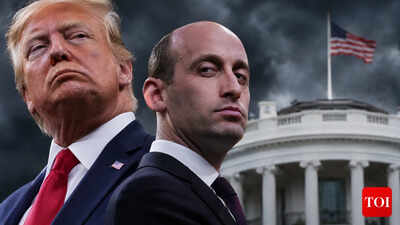
The appointment of Stephen Miller as White House chief of staff signals that Donald Trump is unlikely to respond to his party’s midterm setbacks by moderating his domestic agenda, according to several US media reports.Instead, the US president appears to be placing one of the most uncompromising architects of his America First programme at the centre of White House decision-making as he prepares for two years of confrontation with a Democratic-controlled Congress.Miller, who has been one of Trump’s closest advisers since his first presidential campaign in 2016, will replace Susie Wiles, taking over the position on November 9. The appointment comes after Republicans lost control of both chambers of Congress in the November 3 midterm elections, leaving Trump with a considerably more hostile legislative environment for the remainder of his presidency.The choice is significant because Miller is not simply an immigration hardliner. As deputy chief of staff for policy and homeland security adviser, he has been involved in shaping the administration’s approach to immigration enforcement, federal power, domestic security and other contentious policy areas.His elevation raises an important question: with legislation likely to become harder to push through Congress, will Trump increasingly rely on executive action to pursue his priorities? For India, the implications could extend well beyond immigration, particularly to H-1B visas, skilled-worker mobility and the future of the US-India economic relationship.
What does the chief of staff control?
The White House chief of staff is arguably the most influential unelected official in the US administration. The position does not carry independent constitutional authority, but it offers enormous influence over how the president exercises his powers.The chief of staff effectively acts as the president’s gatekeeper, controlling access to the Oval Office, managing senior White House personnel, coordinating policy discussions and determining which issues receive the president’s attention.The role also involves coordinating the work of the National Security Council, domestic policy teams, communications staff and other senior advisers. The chief of staff helps translate presidential priorities into government action, resolves competing demands between officials and ensures that departments are working towards the administration’s objectives.Importantly, the chief of staff does not directly command cabinet departments or independently make policy. Those powers remain with the president and the relevant department heads.But the person occupying the position can determine how quickly decisions move, which advisers have the president’s ear and how aggressively an existing policy is implemented.Former chief of staff Susie Wiles was widely credited with bringing organisational discipline to Trump’s White House. Miller, meanwhile, has been the ideological and policy driving force behind several of the administration’s most controversial initiatives. CNN reported that Miller’s influence had expanded well beyond immigration, covering much wider areas of domestic policy and homeland security. His elevation therefore brings policy formulation and White House management under the same influential figure.
Immigration
Immigration is likely to remain the centrepiece of Miller’s agenda.He was instrumental in designing Trump’s first-term family separation policy and has subsequently helped develop the mass deportation programme that became a defining feature of the president’s second term.His public statements have consistently advocated aggressive enforcement. He has described illegal immigration as an invasion, called for mass deportations and argued for an expansive interpretation of presidential authority to enforce immigration laws. He has also floated suspending habeas corpus to facilitate deportations, a proposal that raises serious constitutional questions.The political significance of his appointment is that Trump’s immigration agenda has become increasingly contentious. Democrats have promised investigations into enforcement practices, while concerns about the treatment of migrants and the use of federal agents have attracted considerable scrutiny.Rather than choosing an adviser associated with recalibration, Trump has promoted someone deeply invested in the existing approach. Miller’s appointment could therefore mean more executive action, tougher enforcement and attempts to push the limits of presidential authority, even as congressional oversight intensifies.
What has Miller said about India?
Unlike some other Trump advisers, Miller has not established a prominent public profile as a commentator on India or articulated a comprehensive India-specific policy doctrine. His public record is principally centred on immigration, national sovereignty, border security and the economic interests of American workers.However, these positions have direct implications for India because Indian nationals constitute one of the largest groups of skilled foreign workers in the United States.In fiscal 2025, India-born beneficiaries accounted for approximately 70% of approved H-1B petitions, according to figures cited from US Citizenship and Immigration Services. This makes Indian professionals particularly exposed to changes in the programme.The Trump administration has already introduced a $100,000 payment requirement for certain new H-1B petitions involving workers outside the US, alongside changes to visa selection that favour higher-paid positions.Miller’s promotion raises questions about whether the administration will pursue further restrictions. His emphasis on prioritising American workers could translate into greater scrutiny of employers hiring foreign professionals, tighter enforcement and additional barriers for skilled migrants.The consequences would extend to Indian IT companies, American technology firms, universities and thousands of Indian professionals seeking employment in the US.There is also a potential economic consequence. Reuters has reported that restrictions on H-1B visas could encourage American companies to shift more high-value work to their Indian global capability centres rather than relocating employees to the US.
Domestic policy: A more confrontational final two years?
Miller’s influence is not restricted to immigration. He has been involved in the administration’s efforts to reduce the federal workforce, challenge diversity programmes, confront universities and expand federal enforcement powers.His appointment could give these initiatives greater priority during Trump’s remaining two years.With Democrats controlling both chambers of Congress, Trump will face investigations, congressional hearings and resistance to his legislative proposals.Miller is a strong advocate of expansive presidential authority.Consequently, the administration could increasingly turn to executive orders, presidential proclamations and administrative actions to advance policies that might otherwise encounter congressional opposition.That approach, however, will face judicial scrutiny and potential legal challenges. The chief of staff cannot insulate the president’s decisions from Congress, the courts or constitutional limits.Miller’s appointment offers a glimpse of Trump’s priorities after the midterm setback: a White House more firmly organised around his ideological agenda, a harder immigration line and greater reliance on presidential power.Miller’s ideas about immigration, American jobs and national sovereignty could have a negative impact on millions of Indians whose professional and economic futures are tied to the US.

Leave a Reply