
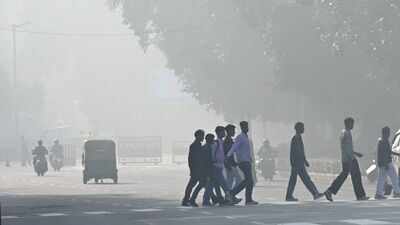
NEW DELHI: Delhi continued to reel under hazardous air pollution on Saturday morning, with the city’s average Air Quality Index (AQI) recorded at 364 at 8 am, placing it in the ‘very poor’ category, according to data from the Central Pollution Control Board (CPCB).While the overall AQI showed a marginal improvement from Friday’s reading of 389, authorities have allowed schools to shift primary classes to a hybrid mode, combining physical and online learning, under Stage III of the Graded Response Action Plan (GRAP). Several monitoring stations across the capital, however, continued to record ‘severe’ air quality.IIT Delhi recorded the highest AQI at 443, followed by Punjabi Bagh at 433 and Narela at 409. Cantonment Area registered an AQI of 315, while Dhaula Kuan recorded 318. Anand Vihar, meanwhile, reported an AQI of 272, placing it in the ‘poor’ category.Misty conditions prevailed at New Delhi’s Safdarjung station in the early hours of Saturday, with the temperature recorded at 17 degrees Celsius at 5.30 am, according to the India Meteorological Department (IMD).The readings came a day after the Commission for Air Quality Management (CAQM) invoked Stage III of GRAP across Delhi-NCR, two days ahead of Diwali, amid forecasts of further deterioration in air quality.Under the GRAP framework, an AQI of 301-400 is classified as ‘very poor’, while readings between 401 and 500 fall in the ‘severe’ category. The four-stage emergency plan is implemented in Delhi and adjoining districts of Haryana, Uttar Pradesh and Rajasthan, based on pollution and weather forecasts issued by the IMD and the Indian Institute of Tropical Meteorology (IITM).With Stage III restrictions now in force, measures under the earlier stages will continue, alongside additional curbs aimed at reducing vehicular emissions, construction dust and industrial pollution.What Stage III restrictions meanThe restrictions include a ban on BS-III petrol and BS-IV diesel four-wheelers in Delhi and designated NCR districts. Curbs have also been tightened on older light and medium goods vehicles, as well as non-Delhi-registered diesel commercial vehicles entering the capital.All non-essential construction activities involving high dust generation, including excavation, earthwork, demolition and road construction, have been suspended. Essential projects allowed to continue will have to follow stringent dust-control measures.Stone crushers and mining activities, which contribute significantly to particulate pollution, will also face shutdowns or operational restrictions.To discourage the use of private vehicles, authorities have also been directed to augment public transport services by increasing Metro frequency and deploying additional buses.Four stages of GRAPGRAP is a four-stage emergency framework implemented by the CAQM in coordination with the CPCB and state governments. Restrictions become progressively stricter depending on the severity of air pollution.Stage I is triggered when AQI ranges between 201 and 300, categorised as ‘poor’. Measures include controlling road dust, enforcing pollution norms and preventing open waste burning.Stage II comes into force when AQI is between 301 and 400, or ‘very poor’. It includes intensified dust-control measures, higher parking fees and staggered office timings.Stage III is implemented when AQI reaches 401-450, classified as ‘severe’. It entails restrictions on polluting vehicles, a halt to non-essential construction activities and the option of hybrid classes for primary school students.Stage IV, or ‘severe plus’, is triggered when AQI crosses 450. It includes restrictions on heavy goods vehicles and additional emergency measures targeting traffic and industrial emissions.The latest restrictions are aimed at preventing air quality from deteriorating further and entering the ‘severe plus’ category. By targeting major sources of pollution, including particulate matter PM2.5 and PM10, as well as nitrogen oxides, the measures seek to reduce the risk of respiratory and cardiovascular illnesses.Authorities have stressed the need for coordinated action across the NCR, even as the emergency curbs remain in place. Cleaner transport, effective waste management and sustained control of construction and industrial emissions remain crucial to addressing the region’s recurring air pollution crisis.

Leave a Reply