
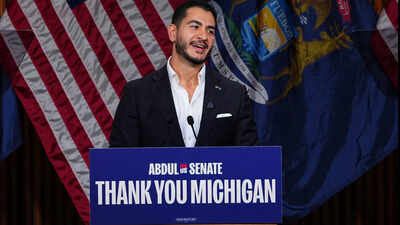
Abdul El-Sayed’s historic election as the first Muslim American to the US Senate has sparked celebrations among Arab communities, with supporters across the US and the Middle East embracing his use of Arabic expressions such as “habibi” and “inshallah” in American political discourse.El-Sayed, the son of Egyptian immigrants, drew widespread attention with his victory speech, in which he mocked US Vice President JD Vance over his earlier criticism of the Democratic candidate. Addressing Vance, he said, “JD, habibi,” before pointing out that the vice president would be constitutionally required to swear him in when the Senate convenes in January.“Habibi”, which literally means “my beloved”, is commonly used as a term of affection and can also mean “buddy” or “pal” in everyday conversation. The expression became a popular campaign slogan, with supporters wearing T-shirts bearing the words “Habibi for Abdul”.El-Sayed also spoke about how his campaign had turned “inshallah”, meaning “God willing”, into “hamdulillah”, or “thank God”, following his election victory. His use of Arabic expressions resonated with supporters, prompting celebrations and a wave of social media posts featuring Arabic music and cultural references.The celebrations were particularly significant for Arab and Muslim communities, which have faced decades of prejudice and Islamophobic rhetoric in the United States. During the campaign, El-Sayed was subjected to attacks from President Donald Trump and other Republicans. Trump called him a “jihadist” and a “communist”, invoked the September 11 attacks and repeatedly mispronounced his name.Responding to the criticism in his victory speech, El-Sayed said, “Donald, look, I know you’ve struggled with my name. So after JD swears me in in January, you can just go on and call me ‘senator.’”The 42-year-old epidemiologist, who was born in Michigan to Egyptian immigrant parents, has frequently spoken about his Egyptian heritage, including his family’s food and humour and his childhood memories of spending summers in Alexandria, where his father grew up.El-Sayed defeated Republican candidate and former representative Mike Rogers in one of the country’s closely watched Senate races. His victory came after he secured the Democratic nomination by defeating Representative Haley Stevens in the party’s primary earlier this year.His campaign was centred on progressive policies, including universal healthcare through the Medicare for All proposal and an end to US military aid to Israel. However, he faced a setback in the final days of the campaign when Stevens withdrew her support and endorsed Rogers after attending church with the Republican candidate.Republicans had sought to portray the contest as a referendum on the Democratic Party’s progressive wing. Despite the attacks and the withdrawal of Stevens’ support, El-Sayed secured the Senate seat, extending the Republican Party’s electoral drought in Michigan. Republicans have not won a Senate seat in the state since 1994.El-Sayed will succeed retiring Democratic Senator Gary Peters. His victory was among several electoral breakthroughs for women, candidates of colour and other underrepresented groups in the November 3 midterm elections, in which Democrats also made significant gains in key statewide races and flipped control of both chambers of Congress.

Leave a Reply