
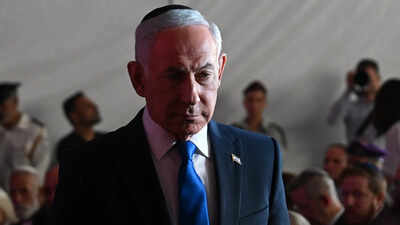
Fifty-three seats. A lead over every rival bloc. And perhaps no government to show for it. Benjamin Netanyahu’s Likud emerged as the single-largest party in Israel’s new Knesset, and his bloc finished ahead of every rival camp.Yet inside President Isaac Herzog’s residence this week, the numbers appear to be shifting towards the man who came second.The numerical paradox at the heart of the election results has left Israel without a new government, Netanyahu without a majority and his challenger, Gadi Eisenkot, without an easy route to power.The final count gave Netanyahu’s right-wing bloc 53 seats in the 120-member Knesset. Eisenkot’s Yashar-led opposition alliance won 48.The two Arab-led parties, the Joint List with 11 seats and Ra’am with eight, took a record 19. The magic number is 61. And nobody has it.Turnout hit 77.9 per cent, the highest since 1999, while Arab voter participation surged to approximately 77 per cent. Netanyahu, meanwhile, portrayed the surge in Arab voter turnout as an attempt to “hijack” the polls.
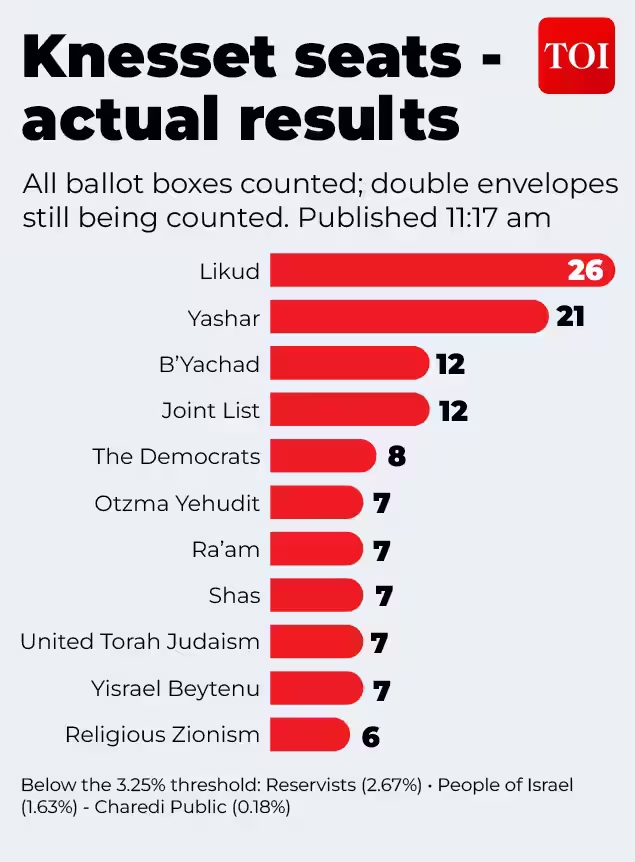
The two Arab-led parties, the Joint List with 11 seats and Ra’am with eight, took a record 19.
Bibi in a bind
Israeli President Herzog received the certified results on Wednesday. The Central Elections Committee reviewed 9,069 polling stations and found no irregularities that compromised the vote.That undercut Netanyahu’s repeated and unsubstantiated claims that Arab parties had “stolen” the election with foreign help.
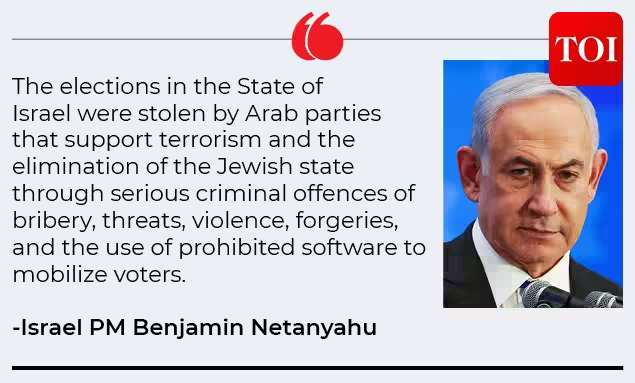
Netanyahu, meanwhile, portrayed the surge in Arab voter turnout as an attempt to “hijack” the polls.
The committee’s head, Justice Noam Sohlberg, warned that “election results, as lawfully determined, are binding on us all.” A separate Shin Bet inquiry into alleged foreign funding continues, though the attorney general has refused to let the agency question elected Arab officials without evidence.Herzog then broke with custom by meeting the smaller parties first and leaving Likud for last on Thursday evening.By Wednesday night, Eisenkot had secured the backing of parties holding 56 seats, putting him ahead of Netanyahu in the race for the mandate to form a government.
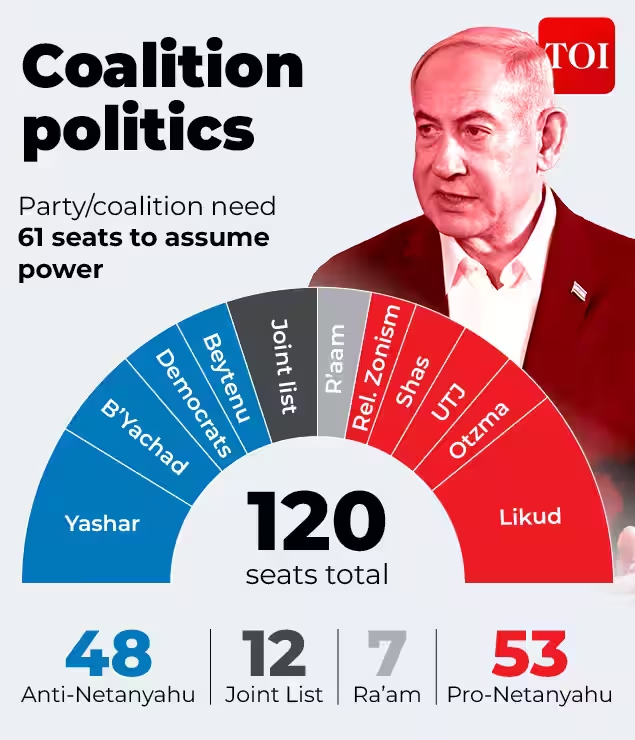
Eisenkot had secured the backing of parties holding 56 seats, putting him ahead of Netanyahu in the race for the mandate to form a government.
United Torah Judaism, the ultra-Orthodox bloc that has long been Netanyahu’s ally, told Herzog it would back neither man. The Joint List had not yet said whether it would endorse Eisenkot or abstain.A lead in recommendations is not a government, and Herzog is not bound to follow the tally. He must choose whoever he thinks can actually build a coalition. The designated candidate then gets 28 days, with a possible 14-day extension.The new Knesset is scheduled to be sworn in on November 10 regardless. If nobody succeeds, Israelis could return to the polls early next year. Memories of political instability remain fresh, since the country held five elections between 2019 and 2022.
Netanyahu’s unfinished tasks
As Israel grapples with the political deadlock, the timing of the impasse is crucial, given the multiple agendas Netanyahu had on the table. The biggest of them is Iran.The war is paused, not finished. The US and Israel began striking Iran on February 28, a Pakistan-brokered ceasefire followed on April 8, and subsequent diplomatic efforts failed to produce a lasting settlement. The Strait of Hormuz remains a flashpoint, with American restrictions and military pressure continuing.Plans for a possible resumption of strikes were in place, with American and Israeli militaries drawing up detailed options, including a short and intense operation. Netanyahu even urged Trump to restart strikes immediately after the midterms, but Trump gave nothing away.Now, the prospect of renewed military action has been complicated by another development: Republicans suffered a crushing defeat in the midterms, with Democrats winning control of Congress. And Israel’s war against Iran cannot be seen in isolation.US Vice President JD Vance, widely reported to have doubted the war from the outset, said it cost Republicans dearly. Trump, though, insisted he would “do it again”. However, the Democratic takeover of Congress, once the new lawmakers are sworn in, could complicate his ability to pursue another military operation, particularly given earlier attempts to curb his war powers.
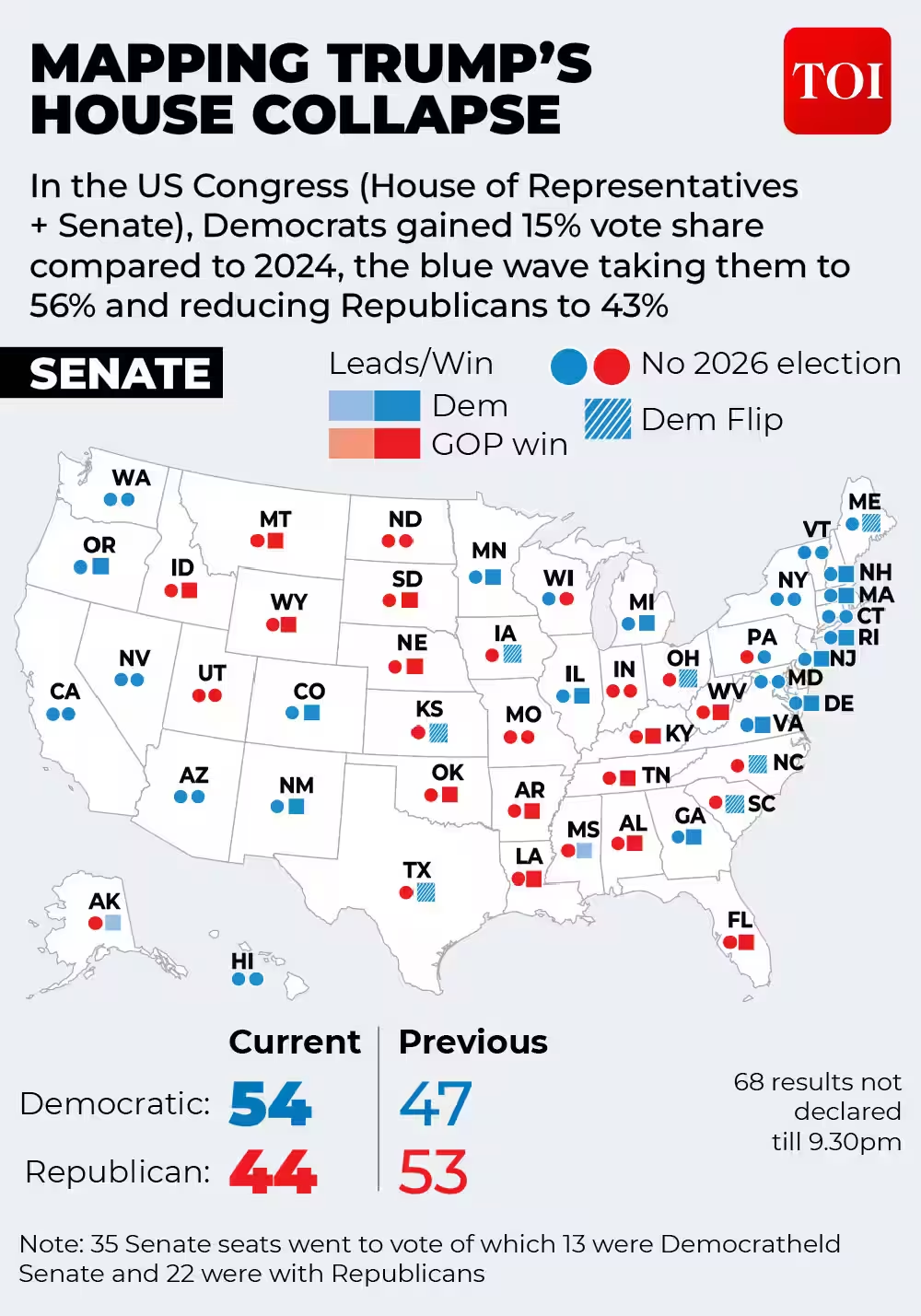
US Vice President JD Vance, widely reported to have doubted the war from the outset, said it cost Republicans dearly.
For Netanyahu, caretaker status could be a temptation, and a fresh operation might shift attention from coalition talks. But how far would Republicans be willing to go under Trump’s leadership, especially after their midterm losses?The more reliable reading, therefore, is that Washington holds the decision. Israeli coalition arithmetic cannot force a resumption, but it may shape how eager Jerusalem is to ask for one.Meanwhile, Netanyahu’s political rival Eisenkot’s stance on Palestinian statehood is not fundamentally different.A former chief of staff of the Israel Defence Forces (IDF) from 2015 to 2019, Eisenkot has called the two-state formula a mistake, rejected Palestinian statehood and argued that Israel should retain overriding security control between the Jordan River and the Mediterranean.He wants Hamas stripped of its military power and removed from power in Gaza, and has pledged to replace its administration within 18 months through a US-backed arrangement or the use of force.He served in Netanyahu’s war cabinet before resigning in June 2024, but his complaint was primarily about execution, not aims.Eisenkot opposes Netanyahu’s far-right partners, criticises settler violence and questions some settlement plans, so the West Bank could see a more controlled approach. On Gaza itself, a change of prime minister would more likely change the method than the goal.
What changes for ‘chaver’ India
For India, the bilateral relationship looks sturdier than the politics.Prime Minister Narendra Modi visited Israel in February, when the two sides announced more than a dozen agreements, discussed a free trade deal and agreed to admit 50,000 more Indian workers.Israeli analyst Alec Pollard told news agency PTI that the partnership goes beyond any one leadership. Yet a drawn-out government formation process could delay defence technology transfers expected by the end of this year.India’s larger exposure lies in the Gulf, with its trade with the Gulf Cooperation Council at about $178.63 billion in 2025-26 and roughly 10 million Indians living in the region.
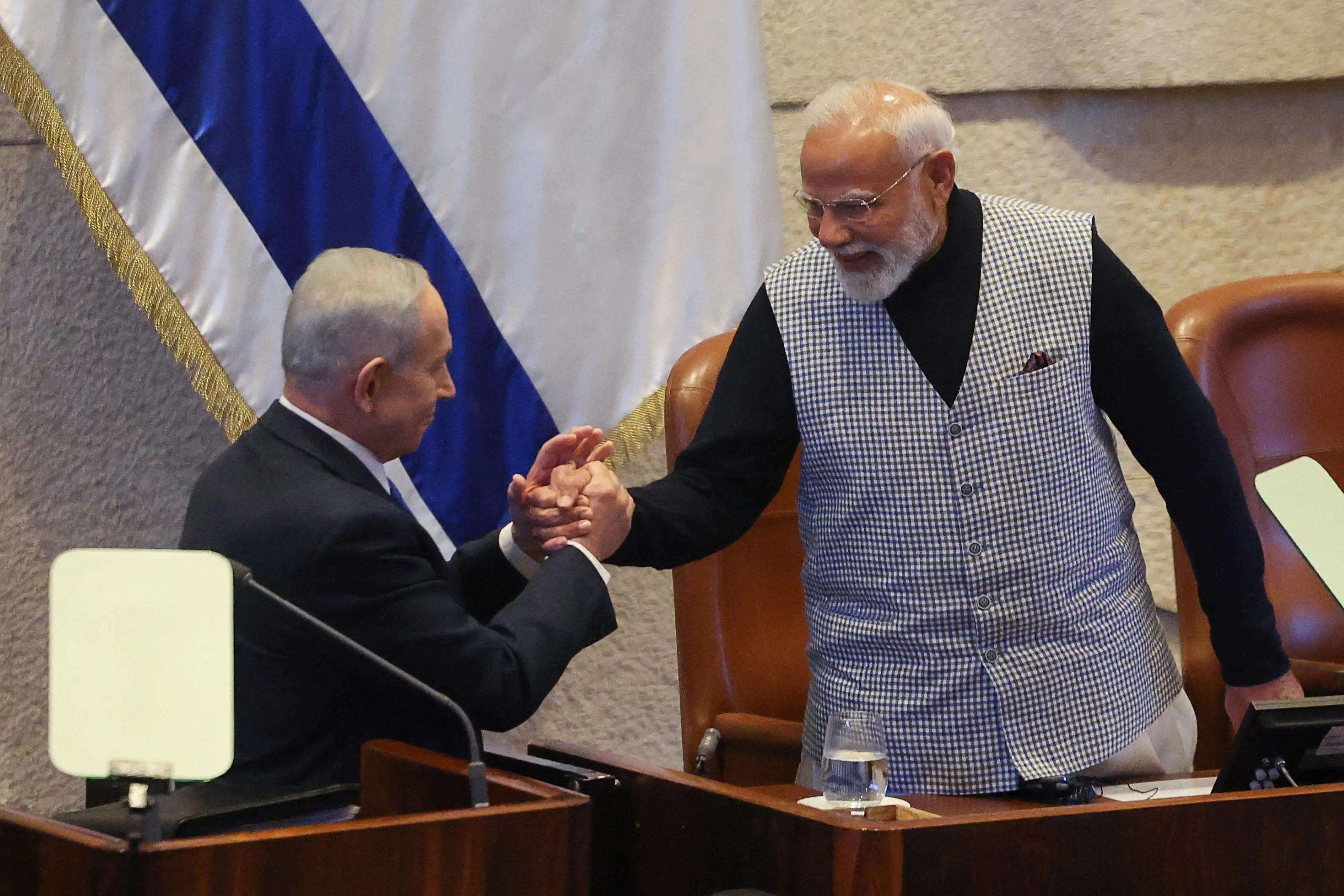
Israel’s Prime Minister Benjamin Netanyahu greets India’s Prime Minister Narendra Modi, during a special session of the Knesset, Israel’s parliament, in Jerusalem February 25, 2026. (Reuters)
Iran matters through the Chabahar port, while the India-Middle East-Europe Economic Corridor depends on regional stability.If strikes on Iran resume and Gulf infrastructure is hit, the impact on India would be felt through oil supplies and its diaspora long before it is felt through bilateral ties with Israel.New Delhi will therefore want stability, whoever finally governs in Jerusalem.In Tehran, Parliament Speaker Mohammad Ghalibaf said, “Americans said NO TO WAR, and we endorse this message.” However, Trump’s insistence that Iran must not be allowed to acquire nuclear weapons makes a thaw in relations unlikely in the near term.
What’s stopping Gadi’s Yashar
Eisenkot’s difficulty is that his bloc has sworn not to sit with Netanyahu, yet cannot reach 61 without Arab votes.Avigdor Liberman has been among the strongest opponents of relying on Arab parties, although his party has backed Eisenkot for the mandate.The Arab parties have offered something short of a partnership, with the Joint List’s Yousef Jabareen saying his party will not join an Eisenkot government but would vote with it in the Knesset, potentially enabling a minority government.Ra’am’s Mansour Abbas has said he would join if given the internal security portfolio. The opposition has set conditions for any such arrangement, including acceptance of Israel as a Jewish state, support for army conscription and a denunciation of Hamas.Dozens of protesters gathered outside Eisenkot’s home to oppose any Jewish-Arab alliance.The other route is no easier, as wooing the ultra-Orthodox parties would mean softening the opposition’s campaign pledge to end military service exemptions. Netanyahu, for his part, would need to peel away at least eight opposition lawmakers.Netanyahu has survived setbacks that once appeared decisive, and the numbers still leave room for another political comeback. But the ground has shifted this week.His key ally in Washington has lost control of Congress, his rivals are rallying behind Eisenkot, and the Arab vote he sought to delegitimise has emerged as a decisive factor in his political future.The coming weeks will determine whether Herzog’s mandate leads to a new government or merely prolongs the political uncertainty.

Leave a Reply