
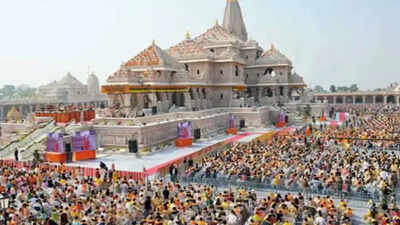
NEW DELHI: Five months after news broke of pilferage of donations at Ayodhya Ram temple, Supreme Court cleared trial of eight people, who figure in the chargesheet filed by the SIT for allegedly siphoning Rs 2.7 crore. It also gave the petitioners, who had sought probe, the status of victims of crime and allowed them to assist in the trial, reports Dhananjay Mahapatra.The SIT’s status report informed SC that financial and forensic examination extended to cash deposits, transactions, property purchases, construction expenditure, vehicles, jewellery, other assets, and event-related spendings. “The amount of alleged embezzlement is approximately Rs 2.7 crore,” the report said.On Monday, solicitor general Tushar Mehta explained to the court the process that involved scrutiny of bank accounts and acquisition of immoveable properties by the accused, as well as examination of CCTV footage that culminated in the chargesheet Sept 23.The plan is to stabilise the monument’s foundation and build a supporting platform. Scaffolding will then go up before the structure is taken down.Every surviving fragment must be preserved and every stone put back where it belongs. The objective is to secure the shrine without erasing the craftsmanship.“There is a deep moat and very little working space, which makes the operation challenging,” ASI director general Yadubir Singh Rawat said. The work is being undertaken by ASI Bhopal circle under superintending archaeologist Shivakant Bajpai. A 12-member core team is handling the exercise.The temple’s origins are traced to a Kalachuri in- scription dating to 850-885 CE, which records its foundation during the reign of Valleka, one of the last Kalachuri governors in the Gyaraspur region.The inscription is preserved in British Museum. Partly carved into natural rock and partly built with stone, the temple appears to rise out of the hillside. Its lofty shikhara, projecting balconies, intricately carved pillars and sculpted facades reflect the finesse of Pratihara architecture.
Join conversation
Share your thoughts in the comments
Be respectful · TOI community guidelines
The structure comprises an entrance porch, mandapa, garbhagriha and towering shikhara, all adorned with elaborate carvings. Its sculptural treasures are equally striking. Among them are a seated Shantinath with a deer emblem, flanked by attend- ant yaksha and yakshi figures, and a 9th-century image of Parshvanath.An elaborate depiction of Chakreshwari, the yakshi associ- ated with Rishabhanath, the first Tirthankara, adds to its iconographic richness. Protective Jain deities carved into niches and walls offer a window into the religious and artistic traditions of early medieval India.

Leave a Reply