
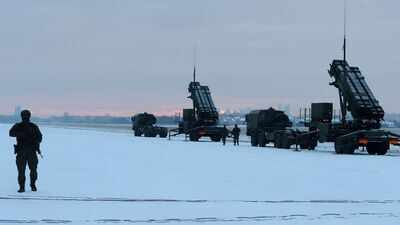
Ukraine is racing to secure hundreds of Patriot air defence interceptors before winter, as Russia intensifies attacks on critical infrastructure and Kyiv faces growing uncertainty over the availability of missiles from the United States and its European allies.Ukrainian President Volodymyr Zelenskyy welcomed the announcement of a proposed $2.1 billion arrangement involving 500 Patriot interceptors but expressed concern that deliveries could take years. Kyiv wants its partners to release missiles from their existing stockpiles immediately, arguing that the coming winter could leave millions of people vulnerable to Russian strikes on electricity, heating, water supply and transport networks.The urgency stems from Ukraine’s limited ability to intercept Russian ballistic missiles. While the country has other air defence systems to counter drones and cruise missiles, Patriot systems remain among its few effective defences against fast-moving ballistic weapons.Damage to power stations and heating infrastructure becomes particularly dangerous when temperatures fall below freezing. Disruptions to electricity, water and heating can affect not only military operations but also civilian life, making energy infrastructure a key vulnerability as winter approaches.
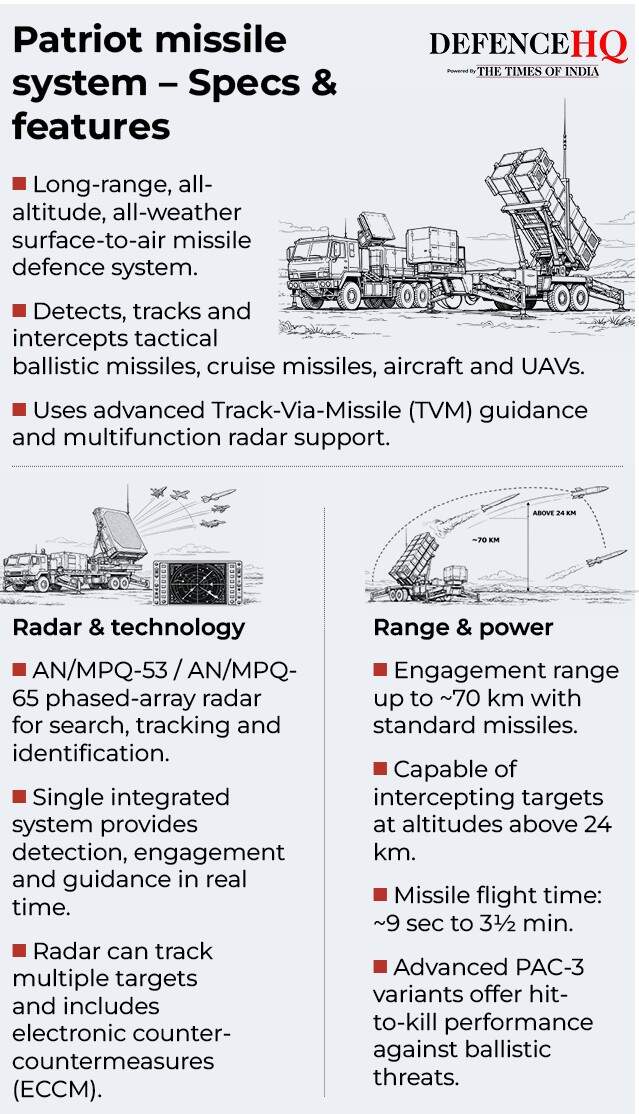
Patriot missile system
The first two weeks of October reportedly saw more than 30 Russian strikes on critical parts of Ukraine’s power grid.Zelenskyy has said Ukraine needs to be in a stronger position during negotiations and prevent Russia from breaking life in Ukrainian cities and communities. He has argued that this would only be possible if Kyiv had enough resources to defend itself.“Five hundred PAC-3 interceptors is a substantial number, and very soon – this winter – they COULD make for a highly effective defence package. However, it has been stipulated that deliveries may begin ONLY IN A FEW YEARS,” Zelenskyy said in an X post.“We are asking for decisions that can guarantee the protection of lives not the day after tomorrow or sometime later, but at the very moment the threat is there,” he added.Kyiv has asked its American partners for a winter support package involving 100 Patriot interceptors a month.“We are asking our American partners to find a solution for the time when there is a real danger and a real need to use PAC-3 interceptors,” Zelenskyy said.He has proposed that the US and its partners supply Ukraine with interceptors from their existing stocks during the winter and replenish their arsenals in subsequent years through production already contracted and paid for by Ukraine and its partners.“The United States, our European partners, and other partners around the world have sufficient stocks of PAC-3 interceptors in their warehouses,” he said, adding that supplying them immediately and replenishing the stocks later would be “entirely feasible”.
Europe’s stockpile dilemma
Ukraine’s demand for Patriot missiles is putting pressure on European countries, which have already supplied Kyiv with military equipment and financial assistance. Several of its leading European backers, however, are now facing a difficult choice between meeting Ukraine’s urgent requirements and retaining enough interceptors to protect their own territory.Germany, one of Kyiv’s biggest military aid donors, has transferred Patriot systems and missiles to Ukraine. Berlin has supplied three systems from its military stocks and subsequently arranged two more through a deal under which the US would replenish the Bundeswehr. The Netherlands has also assembled the components for another complete system, including five launchers, a radar and missiles.But European governments are increasingly concerned about the availability of interceptors. Germany must balance Ukraine’s needs against the minimum stockpiles required to protect its own territory and meet its Nato commitments.“We are really reaching our limits here,” Brig. Gen. Jürgen Schrödl, a senior German defence ministry official, said at a panel in Berlin after the NATO summit in Ankara. “We also have to ensure our own protection.”Norwegian defence minister Tore O. Sandvik has also cautioned against placing the long-term burden of military assistance on Europe.“I think it’s not sustainable for Europe in the long run,” he told POLITICO. “All the European countries have to step up.”The shortage primarily concerns Patriot PAC-3 and PAC-2 interceptors, which Ukraine relies on to counter Russian ballistic missiles. Kyiv is developing its own Freyja interceptor, but the system still requires investment, engineering work and testing before it can take on that role.Until then, Ukraine needs an immediate supply of Patriot missiles.“One of the priority directions is Patriot — PAC-3 or PAC-2,” Mykhailo Podolyak, adviser to the head of Ukraine’s presidential office, told POLITICO. “The first [solution] is buying, or receiving from stockpiles, PAC-3 and PAC-2 interceptors.”The shortage is also linked to competing demands on US supplies. Most PAC-3 interceptors are produced in the US, making Washington central to decisions on their sale, supply and future production.US President Donald Trump had raised hopes at the Ankara summit by indicating that Ukraine could be allowed to produce US-designed Patriot interceptors under licence. Such an arrangement could eventually reduce Kyiv’s dependence on American deliveries, but it would not address the immediate shortage.US Ambassador to NATO Matthew Whitaker said a long-term production agreement would not be concluded before winter, while manufacturing the first missiles would take longer.Trump subsequently appeared to step back from the proposal, saying last week: “We have not agreed to that. We’re talking about it. But it’s a hard thing to give away, that kind of technology.”The war involving Iran has added pressure on US missile supplies, with Washington also seeking to replenish its own stocks. Asked on Thursday about Zelenskyy’s calls for more Patriot missiles, Trump said: “We want missiles too.”Ukraine has also signed an agreement to receive PAC-2 interceptors being manufactured in Germany, although deliveries are unlikely before next year.
Pressure on Europe’s arsenals
The shortage has pushed Kyiv and its partners to look for interceptors across European military stockpiles. Countries such as Poland, Spain and Greece are among those facing pressure to contribute, but their willingness to release missiles varies according to their own defence requirements.Poland confirmed in July that it had released several PAC-3 interceptors following requests from NATO Secretary-General Mark Rutte and senior US commanders. Polish media outlet Defence24 reported that only five missiles were transferred.The decision triggered a political backlash, with opposition lawmakers accusing the government of weakening Poland’s defences at a time when Russian missiles and drones have repeatedly crossed or strayed into its territory.Countries closer to Russia are also reluctant to reduce their existing stocks, with their armed forces already considering their air defences insufficient for national requirements, according to a European diplomat cited by POLITICO.This has shifted attention towards Southern European countries, which have contributed less to Ukraine’s military effort than Germany and several Northern European donors.Spain’s Prime Minister Pedro Sánchez confirmed in 2024 that Madrid was sending missiles to Ukraine, but the government has not disclosed their type or quantity. Greece has not announced any Patriot transfers. Greek media reported in July that Ukraine had requested up to 200 older PAC-2 interceptors from Athens.Kyiv has continued to negotiate with its partners to secure whatever missiles they can spare. During an earlier effort, Ukrainian officials and Rutte approached European governments with requests for interceptors from their existing stocks.“Dear defense minister of Poland, can you give us five?” former Ukrainian Defence Minister Mykhailo Fedorov recalled asking.Berlin also offered to contribute additional missiles if other countries released some from their stockpiles.“If you get 20 out of all the countries, I’ll give you an extra five,” Fedorov quoted German Defence Minister Boris Pistorius as saying. “That’s the exercise we had to perform to get more than 20. And it is a hard mission.”Ukraine’s Foreign Minister Andrii Sybiha has said Kyiv is struggling to buy, exchange or secure available interceptors amid rising demand in the Middle East and the need for the US and European countries to replenish their own supplies.“We are literally fighting for every missile,” Sybiha said.
Ukraine war adds to Europe’s economic strain
The pressure to sustain military assistance to Ukraine comes as European governments face economic challenges, including high energy costs and inflation. The disruption of Russian gas supplies following the invasion of Ukraine has forced several countries, particularly Germany, to rethink their energy arrangements and seek alternative sources.The additional pressure on energy markets following the Iran war has added to concerns over fuel costs and household expenses.Speaking to TOI, Prof Rajan Kumar, professor at the School of International Studies, Jawaharlal Nehru University, said the Ukraine conflict and the disruption of Russian gas supplies had compounded Europe’s economic difficulties, particularly for Germany, which was previously a major buyer of Russian energy.“Europe’s economic difficulties have been compounded by the Ukraine crisis and the disruption of Russian gas supplies. Germany had planned major energy infrastructure projects, including Nord Stream 1 and Nord Stream 2, but the pipelines were destroyed,” Rajan said.“Gas supplies were disrupted, and energy became increasingly expensive. Higher crude oil prices have added to the pressure, making energy costs unsustainable for several European economies,” he added.The economic strain has raised questions about how long European governments can sustain military assistance to Kyiv while meeting domestic spending and defence requirements. The pressure is particularly acute for countries that must simultaneously replenish their own weapons stockpiles and maintain support for Ukraine.For Russia, the challenge facing Ukraine and its European partners presents an opportunity. If Kyiv cannot secure enough interceptors before winter, Russian attacks on energy and civilian infrastructure could place further pressure on Ukraine’s ability to sustain essential services. At the same time, divisions over military stockpiles and the cost of continued assistance could complicate Europe’s response.

Leave a Reply