
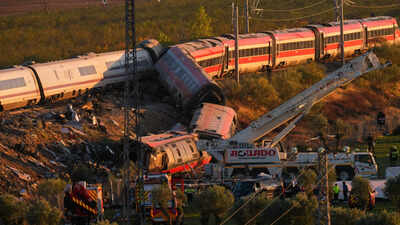
Spain is investigating a deadly high-speed train collision in the central province of Toledo after a state-owned RENFE train struck the rear of an IRYO train that had stopped on the tracks, derailing carriages and killing at least 64 people.The crash occurred at approximately 8:54 am local time (0754 GMT), roughly 120 km south of Madrid. It follows a January collision in Córdoba province that killed more than 40 people and a separate accident near Barcelona in which a train driver was killed.The regional government of Castilla-La Mancha said 58 people were receiving medical treatment in hospitals. Rescue teams searched the wreckage for survivors and bodies as emergency services worked to evacuate passengers from the most severely damaged coaches.According to Spain’s rail infrastructure operator ADIF, both trains were travelling south from Madrid towards Seville when the collision occurred on Wednesday morning. The RENFE train hit the stationary IRYO train, knocking two carriages of the latter off the tracks and derailing the front of the former.
What caused the crash?
The cause of the collision remains unknown. Esther Padilla, spokesperson for the Castilla-La Mancha regional government, said authorities had not yet established what led to the accident.Meanwhile, while addressing reporters in Madrid, Spain’s transport minister Óscar Puente said a computer communications failure disrupted the railway safety system, automatically stopping trains along a 63-kilometre (40-mile) stretch of track. The failure was followed by a decision to allow a southbound RENFE high-speed train to proceed despite a red signal, breaking the protocol, he said.According to CNN, the state-owned railway infrastructure manager ADIF took manual control of the system after the failure. Puente said the RENFE train was authorised to continue despite the signal prohibiting movement, with the decision reportedly made under erroneous instructions from a train controller. The train resumed travelling at about 124 miles per hour before colliding with a stationary IRYO train.“There was a red signal prohibiting movement, yet the train was authorized to proceed,” Puente said at a press conference on Wednesday. “It is a decision made under inexplicable circumstances.”Following the minister’s remarks, the Spanish trade union CSIF called for restraint while the investigation continued and urged the government to respect due process.“We demand that the Government respect the investigation and the presumption of innocence for the head of traffic at ADIF,” the union said.Investigators are expected to examine the communications failure, the decision to override the automatic stop and the authorisation that allowed the RENFE train to continue despite the red signal.The crash occurred on a stretch of railway between the towns of Urda and Los Yébenes, in an area surrounded by olive fields. The impact tore apart carriages and scattered debris down a gravel slope.Passenger Ignacio Relaño, who was travelling on the RENFE train, told Spanish state broadcaster TVE that the train had briefly stopped before moving again and colliding with the IRYO service.“We all felt the train abruptly slowing down and then the impact,” Relaño said. “The car leaned to one side like it was about to tip over. I hit my nose, everything went flying, luggage, cell phones. Everything shook.”
A second deadly collision in a year
The disaster has renewed scrutiny of Spain’s high-speed rail network, which had recorded no fatal accident on its dedicated high-speed lines since the network opened in 1992, according to AP.In January, 46 people died when an IRYO train derailed in southern Spain and struck an oncoming RENFE train. Prime minister Pedro Sánchez visited the latest crash site and announced three days of national mourning.“Today all of Spain is grieving,” prime minister Pedro Sánchez said, as he announced three days of national mourning following the deadly collision. “It is unacceptable for a country like Spain to suffer two high-speed rail accidents in the same year,” he added. Authorities said 397 passengers were aboard the RENFE train and 147 on the IRYO service when the two trains collided.The disaster has renewed scrutiny of Spain’s high-speed rail network, which has expanded significantly over the past three decades. Spain has built approximately 3,900 kilometres (2,400 miles) of high-speed railway, making it one of the world’s largest networks.

Leave a Reply