
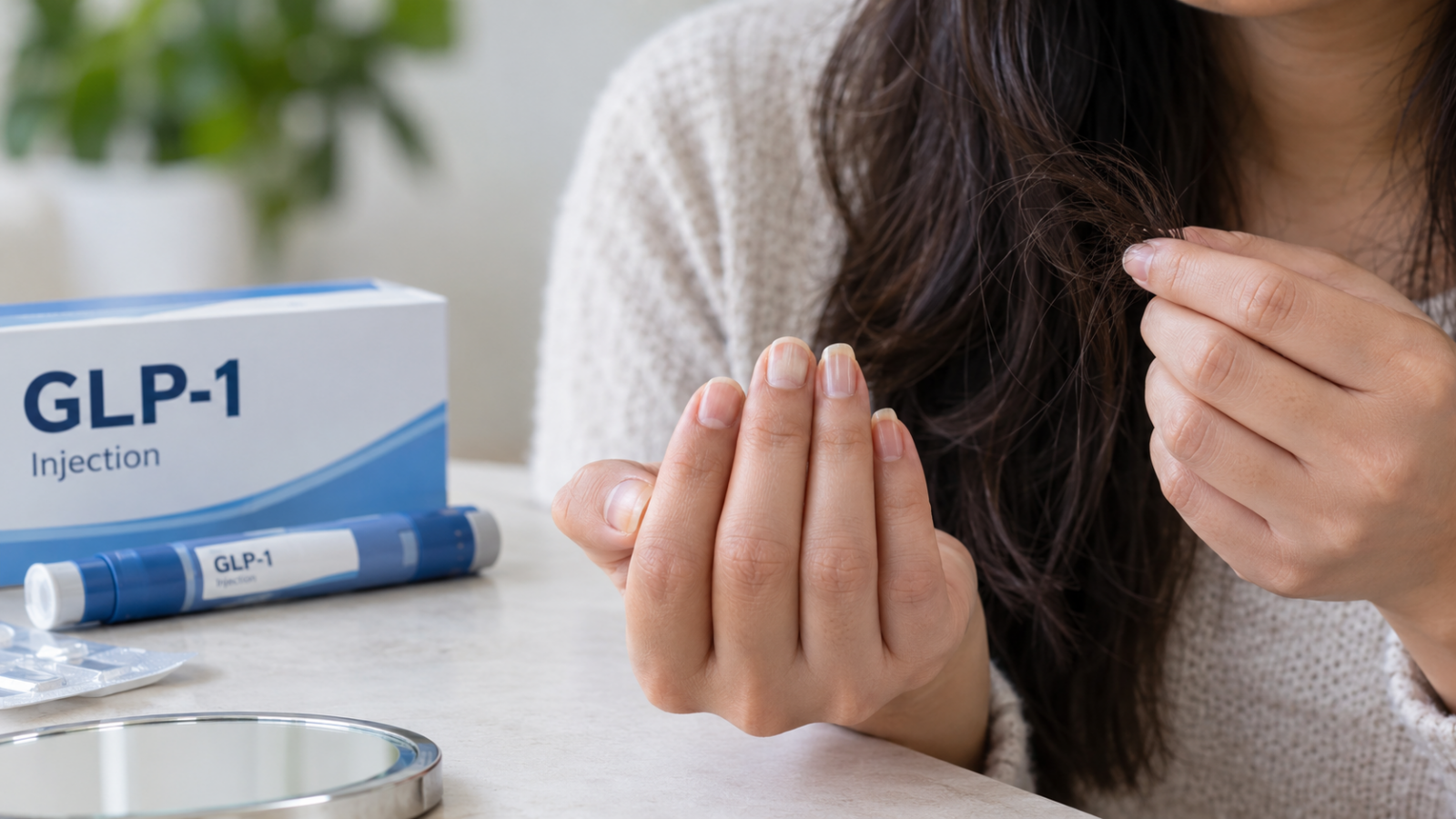
GLP-1 (Glucagon-like peptide-1) medications have become quite popular lately for weight loss, but could their effects show up somewhere unexpected, such as your fingernails? A new study found that people taking these drugs reported nail changes, hair loss, and scalp irritation more often than those who had never used them.
The findings, presented at the European Academy of Dermatology and Venereology (EADV) Congress 2026, suggest that these changes may involve more than weight loss. However, are these findings enough to prove that GLP-1 medications directly cause them? Are the skin- and hair-related side effects after GLP-1 inevitable? Let’s understand more in detail.
DISCLAIMER: This article is based on information from the public domain and/or the experts we spoke to. Always consult your health practitioner before starting any routine.
What did the study find?
New study results linked GLP-1 receptor agonists (RAs) to nail disorders, including a fourfold increase in the incidence of onycholysis. Experts agreed that further investigation is needed and advised against raising unnecessary concerns in patient interactions.
The findings were presented on October 1 in a late-breaker session at the European Academy of Dermatology and Venereology (EADV) 2026 Congress in Vienna, by study co-author Bianca Maria Piraccini, MD, PhD, of the Dermatology Unit at the University of Bologna in Bologna, Italy. While noting the novel findings, she acknowledged that more studies are likely needed to establish any potential causation. Tap the link to read more on the study: https://t.co/thMcsC7ILu
— Medscape (@Medscape) October 9, 2026
Researchers examined 1,904 people from France, the United States, Brazil, and Mexico. Of these, 575 were taking GLP-1 medications, while 1,329 people with type 2 diabetes and/or obesity had never used them.
Nail detachment, which occurs when a nail separates from the skin underneath it, was reported by 39 per cent of GLP-1 users, compared with 9 per cent of non-users. Nail discolouration affected 46 per cent of users versus 17 per cent of non-users.
Overall, 66 per cent of people taking the medications reported at least one nail disorder, compared with 53 per cent of those who had never taken them.
The researchers also found differences in hair and scalp health:
- Hair loss: Reported by 50 per cent of GLP-1 users, compared with 34 per cent of non-users.
- Reduced hair volume: Reported by 42 per cent of users versus 19 per cent of non-users.
- Hair loss beginning after treatment: Reported by 26 per cent of users, compared with 12 per cent of non-users.
- Scalp redness: Approximately three times more common among users.
Many participants who reported hair shedding also experienced itching, redness or flaking of the scalp.
Story continues below this ad
Are GLP-1 medications causing these problems?
Not necessarily. Dr Arunima Ray, dermatologist at Narayana RN Tagore Hospital, Mukundapur, Kolkata, explains that rapid weight loss can affect hair and nails, particularly when people eat less and do not get enough protein or essential nutrients.
“While GLP-1 medicines may play a role, this study does not prove that the medication itself is directly causing these changes,” she tells indianexpress.com.
Reduced appetite and dehydration may contribute, while deficiencies in iron, zinc, vitamin B12, or vitamin D can also affect hair health. Anaemia, thyroid problems, hormonal changes, and stress are other possible factors. Existing nail conditions and scalp problems, including eczema and fungal infections, may also contribute.
Dr Himalaya Agarwal, consultant (obesity) at Voy India, which calls itself an “expert-led weight loss program for Indians”, also cautions against drawing firm conclusions from the findings.
Story continues below this ad
“This striking claim warrants digging rather than alarm: it cannot establish causation, and its association weakens under scrutiny,” he says.
The obesity expert points out that participants reported their own symptoms without standardised examinations by dermatologists. Moreover, the study’s recruitment process and how well its participants represented the general population are unclear.
Agarwal also points out that people who already had nail or hair problems may have been more likely to notice or report them. Fungal nail infections, which are common in people with diabetes, could also have affected the results.
Around half of the GLP-1 users reported nail problems even before starting treatment.
“In my practice, I have not encountered a convincing drug-related nail problem, though a few patients report increased hair shedding,” Dr Agarwal says.
Story continues below this ad
“Better studies with proper examinations are needed, as the authors themselves note,” he adds.
What does hair loss alongside scalp irritation mean?
 This is absolutely no reason to deny or stop treatment, unless your doctor suggests so (Image: Pexels)
But how can patients distinguish hair shedding associated with weight loss from hair loss that needs medical evaluation?
“Weight-loss-related shedding usually starts two to three months after rapid weight loss and tends to be diffuse, rather than causing bald patches. It often settles gradually,” Dr Ray explains. Regaining full hair density, in such cases, can take up to a year.
However, itching, redness or flaking may point to an additional scalp condition rather than hair shedding linked to weight loss alone.
Story continues below this ad
“When hair shedding occurs with itching, redness or flaking, it may point to an inflamed or irritated scalp rather than simple weight-loss-related shedding,” Dr Ray points out.
Conditions such as eczema, psoriasis, seborrhoeic dermatitis, and fungal infections can cause these symptoms. Persistent shedding, bald patches, or an uncomfortable scalp warrant medical evaluation.
What should you do if you notice these changes?
Depending on the symptoms, a doctor may recommend blood tests to check haemoglobin, iron stores, vitamin B12, vitamin D, zinc, and thyroid function. A scalp or nail examination, and sometimes fungal testing, may help identify the underlying cause.
“Patients should not stop their GLP-1 medication on their own. They should inform the prescribing doctor and see a dermatologist for a proper assessment,” Dr Ray advises.
Story continues below this ad
Dr Agarwal echoed this advice: “This is absolutely no reason to deny or stop treatment.”
He recommends adequate protein intake, gradual dose increases under medical supervision, and an individualised treatment plan. Nutritional supplements should be based on individual needs. Biotin, for example, helps only when a person is deficient.
As Dr Agarwal further explains, “Hair shedding after rapid weight loss (telogen effluvium: a medical term, not a magical spell) happens because the body shifts more follicles into a resting phase. The hair falls out two to three months later. It usually regrows, though full density can take up to a year.”
Further research following patients over time, with proper clinical examinations, is needed to establish whether GLP-1 medications contribute directly to nail and scalp problems. For now, anyone experiencing unusual nail changes, persistent hair loss, or scalp irritation while taking these medicines should seek medical advice rather than changing treatment independently.
DISCLAIMER: This article is based on information from the public domain and/or the experts we spoke to. Always consult your health practitioner before starting any routine.

Leave a Reply