
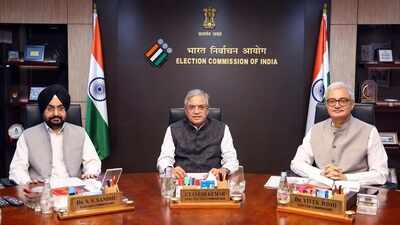
NEW DELHI: After election commissioners S S Sandhu and Vivek Joshi wrote to cabinet secretary T V Somanathan in July objecting to the revised allocation of work among senior commission officers by senior deputy election commissioner Maneesh Garg without the EC approval, the cabinet secretariat refused to intervene, saying the communication was not from EC as a whole, and also cited poll panel’s status as a constitutional body that was independent of executive and empowered to conduct its own affairs.According to documents shared as part of an RTI response, two ECs in their separate but near-identical letters to Somanathan on July 29 objected to Garg’s conduct and an order he issued revising allocation of work among senior officers. The two ECs alleged the changes were made without prior discussion with the commission or officers concerned.The reallocation of work by Garg was ordered while he was filling in for DEC (administration) Bhanu Prakash Yeturu, who was then on leave. It would change how files were to be routed by IT division headed by DG Seema Khanna; they would no longer be routed through DEC Sanjay Kumar. Sandhu and Joshi, according to a report in The Indian Express, dated Sept 23, had in internal notes to DEC concerned, alleged that ECINET software conceived and managed by the IT division, was too centralised, blocking access to field officers who were authorised by law to make changes to the electoral roll. However, the reallocation order issued by Garg was never implemented, after the ECs objected.Explaining the rationale behind the reluctance to take any action, a confidential note on the file shared by the cabinet secretariat with transparency activist Commodore Lokesh K Batra (retd), as part of its RTI reply, said the EC being a constitutional body was insulated from the executive’s interference by design.The cabinet secretariat, while stopping at only acknowledging letters from the two ECs, also marked a copy of its response to the CEC.“The communications are from ECs in their individual capacity and, while they must be taken with due seriousness, they cannot be seen as a formal communication from EC as a whole,” it said, adding that Garg was an officer of the poll panel and his conduct was to be regulated by rules and guidelines of the EC. It also emphasised that EC’s decisions are to be taken unanimously and, when not possible, by majority.
Join conversation
Share your thoughts in the comments
Be respectful · TOI community guidelines
“In absence of any official communication from EC as a whole, any action at this stage may be inappropriate. It may also be construed as interference in functioning of the constitutional body,” the note said, before stating the decision to merely send an acknowledgement to the two ECs, with copies marked to CEC and the DoPT.Sources said no follow-up action was taken by EC or the CEC as Garg, going by an office order of 1997, acted as per rules. The 1997 order had delegated commission’s financial and administrative powers to DECs, with DEC (administration), the position held by Garg, given powers concerning appointment, recruitment, transfer and posting of employees, and posting and transfer of all personal staff of ECs and the DECs. “No files related to transfers and postings thus needed to be put up routinely to the EC,” a commission officer said.Batra on Sept 24 sought copies of ECs’ communications, details of steps taken by the cabinet secretariat and the relevant file notings.

Leave a Reply