
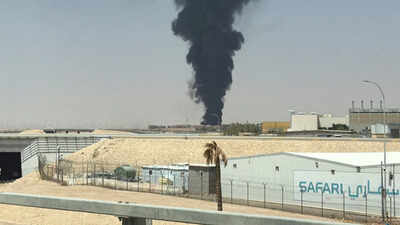
Saudi Arabia has launched an investigation into how its air defence systems failed to stop a barrage of missiles and drones fired by Iran-backed Houthi rebels at Riyadh, including a strike on King Khalid International Airport that killed at least 13 people and wounded more than 300, two regional officials said on Monday. The probe will examine why the weapons reached the Saudi capital despite travelling more than 1,000 kilometres and why the military did not issue an earlier warning.The initial findings suggest the Houthis first launched multiple drones to pave the way for cruise and ballistic missiles to reach the airport, one of the officials said. The investigation is also examining why Saudi Arabia’s air defence systems failed to intercept the incoming weapons.The officials spoke on condition of anonymity because they were not authorised to comment publicly. Saudi Arabia’s government-run Center for International Communication, which oversees foreign media, did not immediately respond to a request for comment.The attack has raised serious questions about the kingdom’s ability to defend its critical infrastructure as the conflict involving Iran and its regional allies spreads across the Middle East.
Houthi attacks expose gaps in Saudi air defences
The airport strike is among a series of Houthi attacks targeting Saudi airports since last week. The attacks have highlighted potential weaknesses in the kingdom’s air defence network at a time when the wider regional conflict is intensifying.The Houthis possess ballistic missiles and advanced systems fitted with warheads that can change direction during flight. These weapons pose a challenge to Patriot interceptors and other air defence systems used by Saudi Arabia.The investigation will seek to establish how the missiles and drones travelled such a long distance without being intercepted or triggering an earlier warning.Saudi state-run media reported on Monday that the country’s military was responding to another attack involving drones and cruise missiles. It did not provide further details.Riyadh airport remained closed on Monday. Workers in the capital’s financial district were also told to work from home.Saudi Energy Minister Prince Abdul Aziz bin Salman acknowledged the seriousness of the situation while addressing the World Petroleum Energy Congress in Riyadh.“The events of recent weeks are serious,” he said. “Our response must be equally serious.”
Saudi Arabia wants greater US involvement against Houthis
Saudi Arabia wants the United States to play a more direct role in countering the Houthi attacks. Washington has provided intelligence sharing, target identification and planning support for a Saudi-led offensive, but has so far refrained from carrying out strikes against the rebels.US President Donald Trump said on Saturday that he was considering military action against the Houthis following the deadly airport attack.However, a US intervention could widen the conflict and threaten a critical global shipping route. The Houthis could attempt to disrupt traffic through the Bab el-Mandeb Strait, which connects the Red Sea to the Gulf of Aden near Yemen.Such a move could further restrict the movement of oil from the Persian Gulf. Global energy supplies are already facing disruption because of Iran’s efforts to choke off the Strait of Hormuz, through which about one-fifth of the world’s oil flowed before the US-Iran war began.The Houthis seized key areas along the Bab el-Mandeb last month. The Saudi-led coalition, which backs forces aligned with Yemen’s internationally recognised government, has been trying to retake them.For Trump, the prospect of deeper military involvement comes at a politically sensitive time. The US midterm elections are approaching, and voters will decide whether his Republican Party retains control of Congress. Persistent inflation and high petrol prices, fuelled by the conflict with Iran, have contributed to widespread American disapproval of the war. A wider US military campaign in the region could add to that discontent.
UAE calls for joint Gulf response as Iran offers mediation
Anwar Gargash, a diplomatic adviser to the rulers of the United Arab Emirates, called on Monday for “joint Gulf action” to defend regional countries against attacks by Iran and its allied groups.Gargash said Iran and its allies had wrongly assumed that Gulf Arab states were “the weakest link” in the US war against Iran. Tehran and its allies have repeatedly attacked Arab countries across the Gulf during the conflict.“It has become clear that we are all targeted, and that our security is indivisible,” he wrote on social media.Iran’s Foreign Ministry, meanwhile, expressed concern over the fighting between Saudi Arabia and the Houthis and offered to help resolve disputes.“We are severely concerned about developments in the Arabian Peninsula,” spokesman Esmail Baghaei said at his weekly briefing. “We have many times announced readiness for applying our good offices in order to facilitate talks between the two sides.”Baghaei said Iranian Foreign Minister Abbas Araghchi and Saudi Foreign Minister Prince Faisal bin Farhan Al-Saud spoke by phone on Sunday about the situation. He did not disclose further details of their conversation.
Houthis report deaths in alleged Saudi strikes on Yemen
The Houthi-run health ministry said on Monday that airstrikes on a government complex and a house in Yemen’s northern al-Jawf province killed nine people, including five children and a woman. Seven others were wounded, according to the Houthi-controlled SABA news agency.Houthi officials also accused Saudi Arabia of carrying out fresh strikes on the Yemeni capital, Sanaa. They said the attacks killed one person and wounded 12.The claims could not be independently verified from the information available.The latest reports come as Saudi Arabia faces mounting pressure to protect its territory while supporting forces fighting the Houthis in Yemen.
Jordanian killed in airport strike buried in Amman
Meanwhile, mourners gathered in Amman on Monday for the funeral of Mahmoud Al-Barqawi, a 33-year-old Jordanian killed in the missile strike on King Khalid International Airport.Al-Barqawi, who worked at a cafe in Riyadh and was the father of two children, was buried after a funeral procession began at a mosque in the Jordanian capital.His father, Hasan al-Barqawi, said the family was struggling to come to terms with the loss.“No one can truly feel the pain of this tragedy,” he said.The strike also wounded four Jordanian citizens. Jordan’s Royal Court chief Yousef Al-Issawi attended the funeral and offered condolences on behalf of the king and crown prince.Despite the airport closure and the latest security concerns, Saudi Arabia continued with the second day of the World Petroleum Energy Congress in Riyadh on Monday.

Leave a Reply