
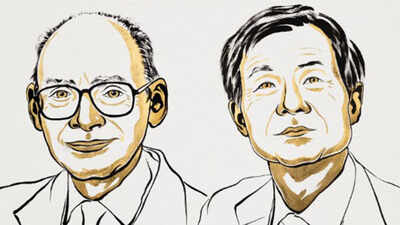
The Nobel Prize in Chemistry for 2026 has been awarded to France’s Henri B Kagan and Japan’s Kenso Soai. The scientists solved more than a century-old puzzle about why living organisms are made of one type of amino acids despite the existence of two similar mirror types in nature, and how a single type could be artificially produced so that the pharmaceuticals made from them do not exhibit harmful side effects on the human body.If we hold up our hands. they are mirror images of each other, yet no matter how you turn them, you cannot lay one perfectly over the other. Many molecules share this property. They come in two mirror-image forms, called left-handed and right-handed, built from the same atoms connected in the same order.Chemists call this property “chirality”, from the Greek word for hand, and such molecules are called “chiral” molecules.
A world of one-handed molecules
However, life is strikingly one-sided.Amino acids, the building blocks of proteins making up our body, exist in both left- and right-handed forms, but the proteins in our cells are built almost exclusively from the left-handed kind. The right-handed versions are rare in nature. Chemists call this uniformity “homochirality”, or the “same hand”.The puzzle is that ordinary chemistry, the one in our labs, has no such preference. When chemists ran reactions capable of producing these amino acids, they always got an equal 50/50 mixture. Nothing in the flask favoured one hand.Since we know the drugs that treat us are produced in labs, they were based on amino acids that existed in the 50/50 mixture. However, since the body is made of one-handed molecules, a drug’s two mirror images can behave very differently. One may heal, while the other does nothing, or worse, have harmful side effects.Pharmaceutical chemists have long needed to make only the useful version.This phenomenon gives us two questions that were profoundly answered by Kagan and Soai’s contributions:How did life end up with just one? And how could chemists produce a single hand on purpose?
Kagan: A surprising amplification
The standard approach is to use a catalyst, a helper molecule that speeds up a reaction, which is itself single-handed and steers the reaction toward one hand. The common assumption was that a catalyst that is only partly pure should give a product that is also partly pure.In 1986, Henri Kagan found this was not always true. Sometimes an impure catalyst produced a much purer product than expected. The likely explanation is that left- and right-handed catalyst molecules pair up with one another and become locked into inactive duos, much like left and right gloves put away together in a drawer. The unpaired leftovers, all of one hand, do the real work.This “nonlinear effect” showed that a greater excess of one mirror image was achievable.
Soai: a reaction that amplifies itself
Kenso Soai took the idea further. In 1995, he published work describing a reaction with the potential to become fully homochiral, or “one-handed”.The trick was autocatalysis, in which the product of the reaction also acts as the catalyst for making more of itself.For example, by chance, a little more right-handed product forms at the start. That small excess catalyses the creation of still more right-handed product, which speeds things up further.Each cycle magnifies the imbalance, like a snowball rolling downhill.In 2003, Soai achieved the result, i.e a reaction that ended with only one of the two mirror images. Which hand wins in any given flask is a matter of chance, but each flask ends up single-handed. Before this, no one had matched what life itself does.
Why it matters
For medicine. Many drugs must be made as a single mirror image to be safe and effective. Kagan’s and Soai’s ideas gave chemists new strategies for designing such reactions, which also reduces waste, since half a batch is no longer discarded.Soai’s reaction demonstrates that for the origin of life, an extremely small, random asymmetry can snowball into complete one-handedness without outside guidance.“Henri Kagan and Kenso Soai have provided a solution to a chemical mystery that is over a century old: how homochirality can emerge spontaneously. The chemical reactions they have developed are spectacular,” said Heiner Linke, chair of the Nobel Committee for Chemistry.

Leave a Reply