
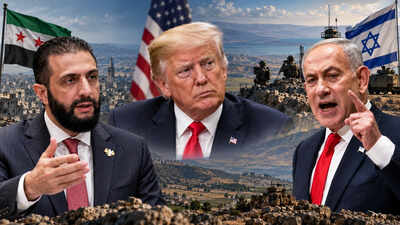
The Golan Heights dispute returned to the centre of the diplomatic spotlight at the United Nations General Assembly in September 2026, when Syrian President Ahmed al-Sharaa declared that the territory “will remain Syrian”, while Israeli Prime Minister Benjamin Netanyahu invoked its biblical links to defend Tel Aviv’s claim.Addressing the UN on September 23, al-Sharaa accused Israel of violating Syrian sovereignty through more than 500 air and artillery strikes, over 1,200 land incursions and nearly 300 detentions since the fall of Bashar al-Assad in December 2024. He called for Israeli forces to withdraw to the lines held on December 8, 2024, and reaffirmed Syria’s commitment to the 1974 disengagement agreement. He also rejected what he described as Israel’s attempt to impose a “fait accompli”, saying that the Golan would remain Syrian territory.A day later, Netanyahu responded directly to al-Sharaa during his own UN General Assembly address. “Mr. al-Sharaa, you should know the Jews have been on the Golan Heights since the days of Moses. You can read it in the Bible,” he said, invoking Israel’s historical and religious links to the plateau.The exchange captured the central challenge facing Washington as it attempts to broker a new security arrangement between the two countries. The US wants to reduce tensions along the Israel-Syria border and create conditions for wider diplomatic engagement. But the disagreement is no longer confined to the Golan Heights, which Israel captured from Syria in 1967 and annexed in 1981. Since Assad’s fall in December 2024, Israeli forces have established positions inside southern Syria, while Damascus has demanded their withdrawal.The violence in the Druze-majority province of Suwayda in July 2025 has added another layer of mistrust, raising questions about whether a border agreement can address Israel’s concerns over the treatment of minorities. Washington may be able to negotiate security zones and monitoring arrangements. Whether it can bridge the two countries’ competing claims over territory, sovereignty and security is a much harder question.
Why the Golan remains a central dispute
The Golan Heights is a strategic plateau overlooking northern Israel and southern Syria. Its elevated terrain offers military and surveillance advantages, making it important to Israel’s defence planning. Israel captured the territory from Syria during the 1967 Arab-Israeli war and extended its law and administration to it in 1981.That annexation was rejected by the United Nations and most of the international community. UN Security Council Resolution 497, adopted on December 17, 1981, declared Israel’s decision to impose its laws and administration on the Golan “null and void” and without international legal effect. The UN continues to regard the territory as occupied Syrian land.
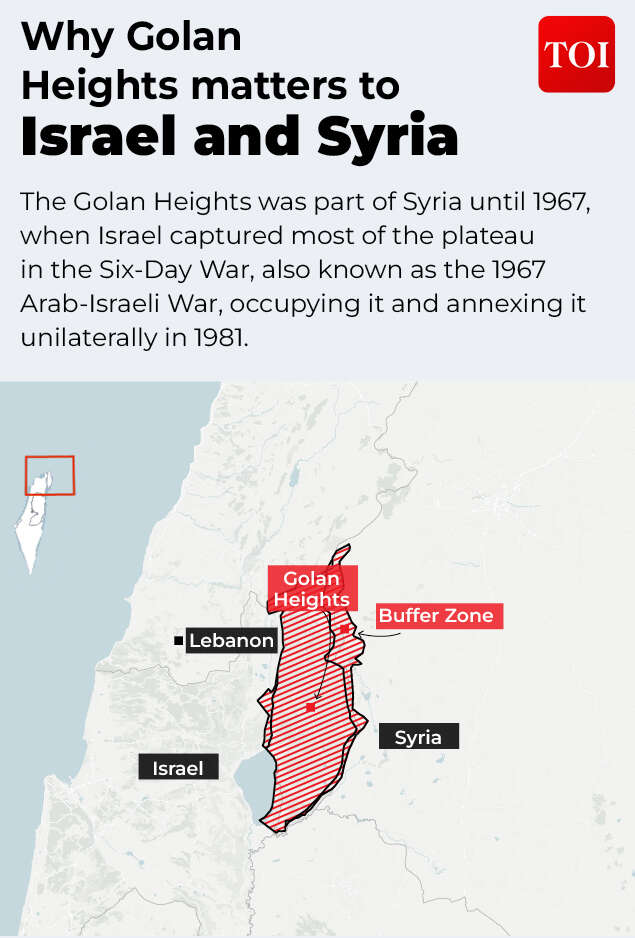
The strategic plateau overlooks northern Israel and southern Syria, offering commanding views of the border and a military advantage. Its control remains a major point of contention between the two countries.
The United States departed from its previous position on March 21, 2019, when then-President Donald Trump announced that Washington would recognise Israeli sovereignty over the Golan. The decision reversed decades of US policy, but did not change the position of the UN or most countries. Colombia’s recognition of Israel’s claim in August 2026 made it the second country to do so, according to reports.The dispute has endured even during periods when the border remained relatively quiet. Syria has continued to claim the territory, but has not made a serious military attempt to retake it in recent decades. The 1974 disengagement agreement, signed after the 1973 Arab-Israeli war, established a separation zone and restrictions on military deployments, monitored by the United Nations Disengagement Observer Force (UNDOF).That arrangement helped contain direct confrontation, but it did not settle the question of sovereignty. This distinction is central to the current negotiations: a security agreement could regulate military activity without resolving who owns the Golan.
What Washington wants from a new agreement
The Trump administration is pushing for a security arrangement that could reduce the risk of conflict along the Israel-Syria border. Washington sees such an agreement as a possible first step towards wider diplomatic engagement, including eventual normalisation and Syria’s entry into the Abraham Accords.The proposed framework, as described in reporting and analysis, would involve a demilitarised zone across southern Syria, a return towards the 1974 disengagement lines, guarantees for the Druze community and an Israeli withdrawal from positions established inside Syrian territory after Assad’s fall. The question of Golan sovereignty would be postponed rather than resolved.The approach reflects a familiar diplomatic calculation: address immediate security concerns first and leave the most politically difficult territorial issue for later. Israel could receive assurances that Syrian forces would not approach the border in strength, while Damascus could maintain that it had not formally surrendered its claim to the Golan.
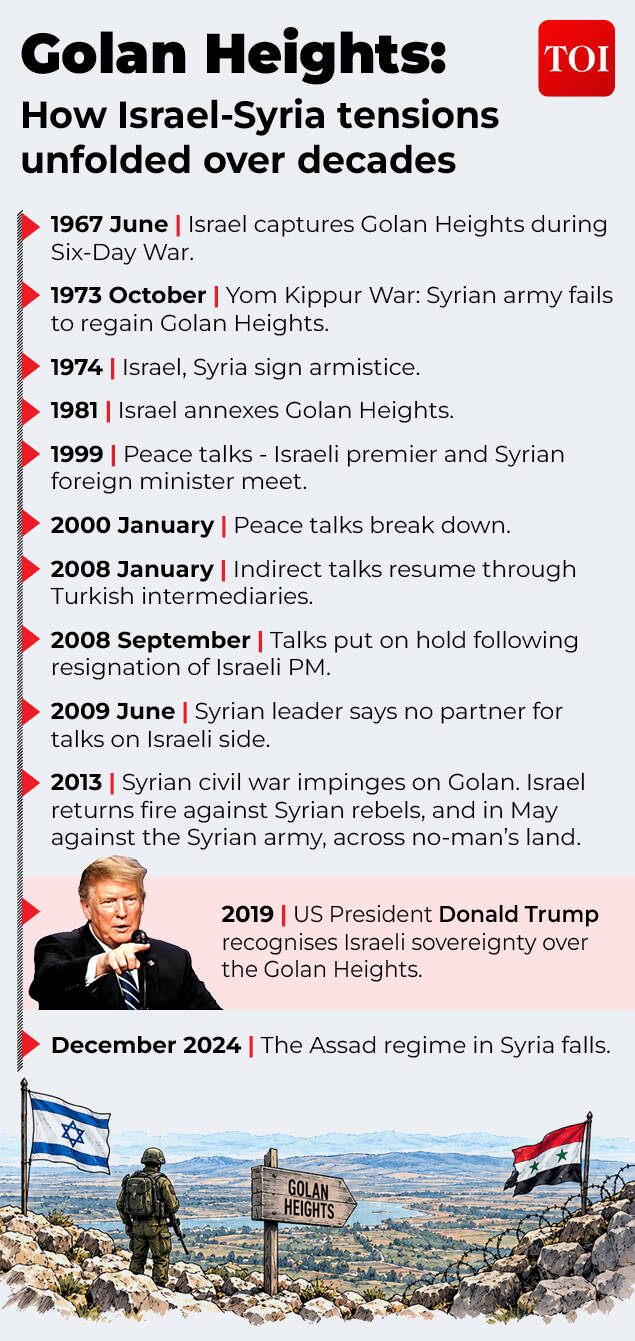
A timeline of the decades-long Israel-Syria dispute, from Israel’s capture of the strategic plateau in 1967 and its 1981 annexation to Donald Trump’s recognition of Israeli sovereignty in 2019 and the fall of the Assad regime in December 2024.
But the two sides disagree over the sequence and terms. Damascus wants Israeli forces to return to the positions they held before December 8, 2024, and says it should retain the right to rebuild its military and determine its alliances. Israel, meanwhile, wants security guarantees and restrictions on military activity in southern Syria before giving up positions it considers valuable.The negotiations have come close to an understanding, but have not produced a durable agreement. Syrian Foreign Minister Asaad al-Shaibani said in August 2026 that the two sides had agreed on paper to “almost everything” around the beginning of the year, including arrangements for security zones in southern Syria. But Damascus doubted Israel’s willingness to implement the proposed deal.
Why Israel wants military positions inside Syria
Israel’s military presence inside Syria expanded after Assad was toppled in December 2024. Israeli forces moved into areas near the Golan and the UN-patrolled buffer zone, while Israel also struck Syrian military facilities and other targets. Israel has described these actions as defensive measures intended to prevent threats from emerging near its border.The positions offer more than a physical buffer. They can provide observation over approaches to the Golan, improve Israel’s ability to monitor movement in southern Syria and give its military more time to respond to potential threats. The terrain around Mount Hermon is particularly important because elevated ground offers a broad view of surrounding territory.The military presence also gives Israel leverage in negotiations. A withdrawal can become part of a broader bargain involving security guarantees, limits on Syrian military deployments and monitoring mechanisms. From Israel’s perspective, leaving without enforceable assurances could mean giving up a strategic advantage while relying on a government whose future conduct remains uncertain.For Damascus, however, the same positions represent an infringement on sovereignty. Syria argues that Israel should withdraw from territory it entered after Assad’s fall before the two sides discuss a longer-term security arrangement.The disagreement was underscored on September 9, 2026, when Netanyahu visited an Israeli military position on Mount Hermon, inside Syrian territory. He said Israel had established “absolute control” over an area stretching from the mountain’s summit south to the Yarmouk River and west to the Mediterranean Sea. Syrian officials condemned the visit as a violation of the country’s sovereignty and territorial integrity.The RSIS analysis published on September 17, 2026, said a framework under discussion included an Israeli withdrawal from nine outposts established inside the Syrian Golan over the preceding year. These positions have therefore become a test of whether the two sides can translate diplomatic understandings into a change on the ground.
The Suwayda crisis: The obstacle beyond the Golan
The violence in Suwayda in July 2025 exposed a problem that a border agreement may not be able to solve. The province, in southern Syria, has a large Druze population. A local conflict escalated after government forces entered the area, widening into a crisis involving government troops, tribal fighters and Druze armed groups.A United Nations inquiry later put the death toll above 1,700, most of them Druze civilians, and said that government troops, tribal fighters and Druze militias may have committed war crimes. Israel intervened militarily, striking the Defence Ministry in Damascus and government forces near Suwayda. It said its actions were intended to protect the Druze community.The episode matters because it shaped Israel’s assessment of the new Syrian authorities. If Damascus uses force against a minority community, Israel may see a reason to intervene regardless of what happens along the Golan border. In that scenario, a demilitarised zone could reduce the risk of a conventional military clash but would not prevent a crisis elsewhere in Syria from drawing Israel in.A September 17, 2026, analysis by the S. Rajaratnam School of International Studies argued that Washington may be misdiagnosing the central obstacle by focusing too heavily on Golan demilitarisation. Its assessment is that the deeper issue is whether the Syrian government can be trusted not to coerce or attack minority communities. A security agreement could establish rules between two states, but it could not guarantee how Damascus would treat its own citizens.This is also where proposed guarantees for the Druze become difficult. A written commitment may be possible, but enforcing it would require clarity about who monitors violations, what happens if Syrian forces enter the province and whether Israel would retain the right to intervene. Those questions go beyond the technical design of a border arrangement.
Al-Sharaa’s position: Security first, Golan later?
Al-Sharaa has signalled that Syria is willing to discuss security arrangements, but has resisted any suggestion that Damascus can abandon its claim to the Golan.In April 2026, he indicated that Syria could discuss the Golan at a later stage if Israel withdrew from territory seized after Assad’s fall. His September 23 address at the UN, however, left little doubt that Damascus would not accept a settlement that treated the Golan as territory Washington could allocate.Al-Sharaa invoked Security Council Resolution 497 and called on international partners to abide by it. He also reaffirmed Syria’s commitment to the 1974 agreement and demanded that Israeli forces withdraw to the lines held on December 8, 2024, the day Assad was removed from power.His position reflects a domestic political constraint. Any Syrian leader who appears to surrender the Golan would face opposition, particularly after years of conflict and foreign intervention. Al-Sharaa has therefore tried to separate the immediate security question from the long-term sovereignty dispute.At an Atlantic Council event on September 22, 2026, he said negotiations with Israel had resolved nearly 90% of the outstanding issues needed for a security agreement. He also joked that he had asked Trump why he did not give Israel New Jersey instead of the Golan. The remarks suggested that Damascus was still open to an agreement, but not to giving up its territorial claim.
Netanyahu’s position: Security zones and sovereignty
Netanyahu’s UN remarks reinforced Israel’s refusal to relinquish its claim to the Golan. By invoking Jewish presence there since the days of Moses, he placed the dispute within a historical and religious framework, rather than treating it only as a question of military control.Israel’s immediate security position is also tied to its expanded military presence in southern Syria. Defence Minister Israel Katz said in response to al-Sharaa that the Golan under Israeli sovereignty was “an inseparable part of the State of Israel forever”. He also said Israel would remain on Mount Hermon and in the security zone as long as it perceived a jihadist threat near its border.The remarks underline the gap between the two governments. Syria wants Israeli forces to withdraw to pre-December 2024 lines and restore the 1974 arrangement. Israel wants to retain strategic positions and security zones until it is satisfied that threats from Syrian territory have been removed.That difference also complicates Washington’s role. The US can press Israel to redeploy, but it must also address Israeli concerns about the security environment in southern Syria. At the same time, it cannot expect Damascus to accept an open-ended Israeli military presence as the price of negotiations.
The Turkey factor complicates Washington’s task
The Israel-Syria negotiations are also taking place against the backdrop of growing tension between Israel and Turkey. Ankara is a major regional backer of the new Syrian authorities and has an interest in helping rebuild Syria’s military and state institutions. Israel, meanwhile, is wary of Turkish military influence near its borders and has opposed the possibility of Turkish forces operating at Syrian bases.The issue came into focus in August 2026, when Israel struck the Abu al-Duhur airbase in northwestern Syria. Israel said the strike was intended to prevent a Turkish military deployment, while Syria and Turkey denied that such a deployment was planned. The episode showed how a bilateral Israel-Syria agreement could be affected by a third country’s role in Syria.For Washington, this creates a difficult balancing act. It wants to prevent Israeli-Turkish competition from destabilising Syria, while also encouraging Damascus to accept security arrangements that Israel considers necessary. But restrictions on Syria’s military partnerships could be seen in Damascus as an attempt to limit its sovereignty and dictate its regional relationships.The challenge is therefore larger than drawing a new line on a map. Washington must find a formula that addresses Israel’s concerns without turning southern Syria into a zone where Damascus has limited control over its own security policy.
Can Washington solve the Golan problem?
Washington can help the two sides reach a practical security agreement. It can mediate a return to the 1974 disengagement framework, negotiate monitoring arrangements, define limits on military deployments and establish channels to prevent incidents from escalating. It can also use diplomatic pressure and incentives to encourage Israeli withdrawal from positions established after December 2024.But the United States cannot make the underlying political dispute disappear. Trump’s 2019 recognition of Israeli sovereignty over the Golan has narrowed Washington’s room to act as a neutral mediator on the territorial question. The UN and most of the international community continue to regard the territory as occupied Syrian land, while Israel considers its control essential to national security.Nor can Washington guarantee that future violence inside Syria will not trigger Israeli intervention. The Suwayda crisis demonstrated that Israel’s security calculations extend beyond the immediate border. If Damascus is accused of targeting minorities, a deal focused only on demilitarisation may prove inadequate.The most realistic outcome may therefore be a limited security arrangement rather than a comprehensive peace agreement. Such a deal could reduce the risk of accidental clashes, establish communication channels and clarify military restrictions. It could also create space for future talks on the Golan. But it would not amount to normalisation, and it would not settle the question of sovereignty.The UN exchange between al-Sharaa and Netanyahu showed how far apart the two sides remain. For Syria, the Golan is a matter of sovereignty and international law. For Israel, it is tied to history, security and the military control of strategic terrain. Washington may be able to negotiate a temporary compromise, but a lasting settlement will depend on whether both governments are willing to accept security guarantees without demanding that the other abandon its core position.

Leave a Reply