
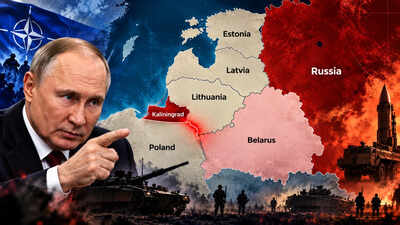
Russian President Vladimir Putin has warned that Moscow could use “all weapons” in its arsenal, including nuclear weapons, if its Baltic exclave of Kaliningrad comes under direct attack. The warning has brought renewed attention to a narrow stretch of land between Poland and Lithuania, known as the Suwałki Gap, which lies between Kaliningrad and Russia’s ally Belarus and is considered a potential flashpoint in a conflict between Russia and Nato.Speaking at the Valdai Discussion Club in Moscow on Thursday, Putin said Russia had no plans to attack any European country but would respond if the West escalated tensions or threatened Russian territory. He referred to Nato military activity in the Baltic region, attempts to intercept Russian ships and statements about Kaliningrad.“The drills in the Baltic Sea, following one another … Then the attempts to arrest our ships and vessels. All this is an escalation. And then we began to hear statements regarding the Kaliningrad region,” Putin said.“If it comes to direct attack against the Russian Federation, in this case on Kaliningrad and possibly some other territories, of course the issue of using all weapons in our country’s arsenal will inevitably and unavoidably emerge on the agenda. This is unavoidable,” he cautioned.The remarks followed a Russian diplomatic warning that Moscow could resort to nuclear weapons if Nato attempted to cut off Kaliningrad by land, air or sea. Nato secretary general Mark Rutte said the alliance was defensive and urged Russia to stop its nuclear rhetoric. He also said there was no immediate threat to Nato territory from Russia.
Why Kaliningrad matters to Russia
Kaliningrad is a heavily militarised Russian territory separated from the country’s mainland. It is located between Poland and Lithuania, both Nato members, and has a coastline on the Baltic Sea. The region has a population of about one million and is slightly larger than the US state of Connecticut.The territory was formerly known as Königsberg and was the capital of East Prussia. It became part of the Soviet Union after the Red Army captured it in April 1945, towards the end of World War II. The victorious Allied powers subsequently divided East Prussia, and the northern part, including Königsberg, came under Soviet control. The city was later renamed Kaliningrad.Its location gives Moscow a military foothold on the Baltic Sea, far from the Russian mainland but close to several Nato countries. Kaliningrad provides a base for Russian air defence, missile and naval forces, allowing Moscow to project military power into northern and central Europe.That strategic value also creates a vulnerability. Since the region is separated from mainland Russia by the territory of other countries, Moscow would face logistical challenges in supplying or reinforcing it during a conflict. Its land borders are with Poland and Lithuania, while access to the Baltic Sea is subject to the military and political situation in the region.Kaliningrad’s position has become more sensitive since Russia launched its full-scale invasion of Ukraine in February 2022. Nato has strengthened its eastern flank, while Finland and Sweden joined the alliance in 2023 and 2024 respectively. Their membership has altered the security environment around the Baltic Sea and added to Moscow’s concerns about the alliance’s military presence in the region.
The Suwałki Gap vulnerability
The Suwałki Gap is a narrow stretch of land, around 60 miles long, along the Poland-Lithuania border. It separates Kaliningrad from Belarus, a close Russian ally. It is also the land corridor connecting the Baltic states of Estonia, Latvia and Lithuania with the rest of Nato.
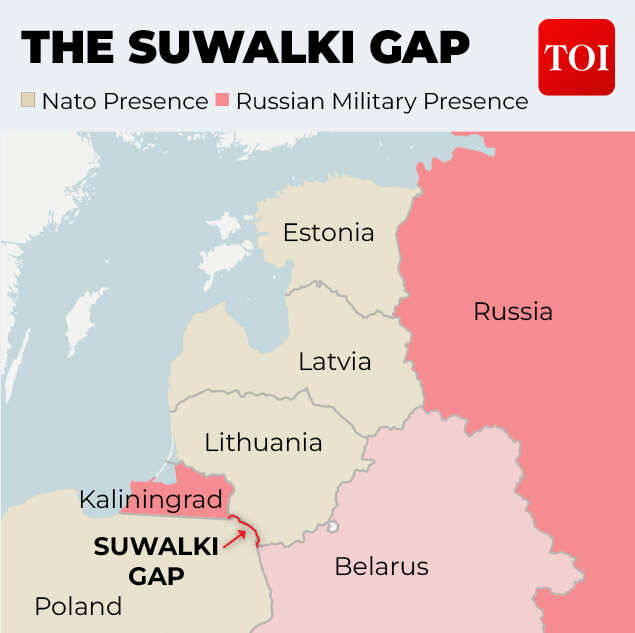
The Suwałki Gap: A narrow corridor at the heart of rising Russia-Nato tensions.
The corridor has acquired strategic importance because of what could happen if Russia gained control of it. A Russian military advance through the gap could potentially link Kaliningrad with Belarus and disrupt the land connection between the Baltic states and other Nato members.Also read: What’s Suwalki gap? Europe’s ‘achilles heel’ that it fears could be Putin’s targetSuch a move would place Estonia, Latvia and Lithuania in a more isolated position during a conflict. Their security depends on the ability of Nato forces to move personnel, equipment and supplies through Poland and Lithuania. The Suwałki Gap is therefore viewed by security analysts as a vulnerable point in the alliance’s eastern defences.The gap is not, however, an established route for an imminent Russian operation. Any attempt to seize it would mean a direct military confrontation with Poland and Lithuania, and therefore with Nato. The possibility is one of the reasons the corridor features prominently in military planning and discussions about the defence of the Baltic states.For Moscow, Kaliningrad is both a military asset and a territory that could become difficult to defend if a conflict disrupted its access routes. For Nato, the Suwałki Gap is important because it links the Baltic members of the alliance to the rest of the bloc. This geography makes the region a potential flashpoint, even without an active military confrontation.
What has triggered the latest tensions?
Tensions around Kaliningrad have increased as Nato has strengthened its presence in the Baltic region following Russia’s invasion of Ukraine. Moscow has repeatedly criticised Western military activity near the exclave and described comments by European officials about Kaliningrad as threatening.In May 2026, Russia condemned remarks by Lithuania’s foreign minister, who said Nato had to demonstrate that it could penetrate what he described as the “small fortress” built by Russia in Kaliningrad and destroy its air defences and missile bases.A Western military source told Reuters that dozens of aircraft from Nato countries took part in an unannounced operation in the airspace around Kaliningrad in mid-August. The operation reportedly demonstrated the alliance’s ability to disrupt the exclave’s radio and radar links, as well as its air defences, in the event of a conflict.Nato has said its increased presence in the Baltic Sea is partly a response to concerns over threats to critical undersea energy and communications infrastructure. The alliance has also cited the need to strengthen deterrence along its eastern flank.Russia, meanwhile, has accused Nato of escalating tensions and has used diplomatic statements and social media posts by its embassies to draw attention to what it describes as threatening military movements and rhetoric. The alliance has rejected the suggestion that it intends to attack or isolate Kaliningrad.
Why a crisis could escalate
Analysts have warned that a direct confrontation between Russia and Nato could emerge from a miscalculation rather than a planned attack. Kaliningrad’s location makes it particularly sensitive to incidents involving military aircraft, drones, naval vessels or critical infrastructure.Possible triggers include a drone incident, disruption of undersea infrastructure, new missile deployments or an action that Moscow interprets as an attempt to impose a blockade on the exclave. A dispute over access to Kaliningrad could also intensify if military movements in the Baltic Sea or around the Suwałki Gap were misread by either side.Since 2022, European countries have supported Ukraine with weapons, intelligence and sanctions against Russia while avoiding direct participation in the war. Moscow has accused Western countries of effectively waging war against it, a charge rejected by Nato members.Putin’s warning over Kaliningrad comes amid this wider confrontation. It does not establish that Russia has decided to use nuclear weapons, but it underlines Moscow’s willingness to invoke its nuclear arsenal in response to what it describes as a direct attack on Russian territory.Nato has said it does not threaten Kaliningrad and has described Russia’s nuclear warnings as irresponsible. Rutte said the alliance had responded calmly to Moscow’s warning and reiterated its defensive position.
Ukraine war adds to pressure on Moscow
Putin’s comments on Kaliningrad came as Russia’s war in Ukraine entered its fifth year. Moscow has continued its offensive and intensified attacks on Ukrainian energy infrastructure and Kyiv ahead of winter.Ukraine, meanwhile, has stepped up drone strikes on Russian oil refineries and other targets deep inside Russian territory. Ukrainian President Volodymyr Zelensky has described such strikes as “long-range sanctions”, aimed at reducing Russia’s revenue and military capacity and pushing the Kremlin towards negotiations.Putin acknowledged that Ukrainian attacks on Russian oil refineries had affected the country’s economy. He said the strikes had cost Russia about 1% of its gross domestic product. He also said Ukrainian military operations in the Black Sea had damaged or destroyed more than 100 Russian ships.“In the Black Sea — that’s a combat zone; we struck military vessels and ships transporting military cargo, and we hardly ever made a mistake. Throughout this whole saga, they [Ukraine] have knocked out over 100 of our ships. Well, we started hitting back, and now we’re being bombarded from every direction with appeals: “Oh, please stop doing that,” Putin said.“It’s the same story with our oil refineries; they (Ukraine) openly declared their goal was to damage our economy. Did they succeed? Partially — by our estimates, we lost about one percent of our GDP. And it was done deliberately — these are civilian targets, after all. Well, they got a mirror-image response,” Putin added.His remarks came a day after he told newly elected members of Russia’s State Duma that the country’s economy was stable. He also criticised Ukraine’s reliance on financial assistance from Western allies, saying Russia did not need external handouts.“Mistakes, especially now, are absolutely unacceptable,” he warned parliamentarians. “Unlike some, and we won’t point fingers, Russia can’t run around the world humiliating (itself) by begging for handouts with an outstretched hand,” he said.Putin has said he would prefer the war to end through negotiations, but has not indicated that Moscow is prepared to withdraw from its military objectives. A Levada Center poll in August found that 59% of Russians favoured moving towards peace talks.Russia’s planned defence spending also points to a continued military commitment. Budget documents reviewed by Reuters show that Moscow plans to spend 17.1 trillion roubles ($205.112 billion) on defence in 2027, about 27% more than originally budgeted and the highest level since the full-scale invasion of Ukraine.
India’s military connection to Kaliningrad
Beyond its strategic importance in European security, Kaliningrad has a direct defence connection with India through the Russian Yantar Shipyard.Located in the exclave, Yantar has built several warships for the Indian Navy, including two upgraded Talwar-class frigates, INS Tushil and INS Tamal. Both vessels were constructed in Russia and commissioned into the Indian Navy at Kaliningrad.INS Tushil was launched at Yantar Shipyard on October 28, 2021, and commissioned in December 2024. INS Tamal, the second frigate under the project, was commissioned at the same facility on July 1, 2025.The two vessels are part of a four-frigate arrangement between India and Russia under Project 1135.6. The agreement involves constructing two ships in Russia and two in India, with technology transfer and design assistance from the Russian side.The commissioning of INS Tamal marked the completion of the Russian-built portion of the project. However, India’s naval cooperation with Russia has not ended with the delivery of these two warships.The remaining two frigates, INS Triput and INS Tavasya, are being constructed at Goa Shipyard Limited (GSL) in India.The first vessel, Triput, was launched on July 23, 2024, while Tavasya was launched on March 22, 2025. Both are based on the Project 1135.6 design and are intended to undertake surface, sub-surface and air combat operations.The ships are 124.8 metres long, have a displacement of approximately 3,600 tonnes and can achieve a maximum speed of 28 knots.Their construction represents India’s transition from directly procuring warships from Russia to manufacturing them domestically with foreign design assistance.The ministry of defence has described the project as part of India’s efforts to strengthen indigenous warship construction. The vessels incorporate a large percentage of Indian-origin equipment, weapons and sensors. These include localised components such as the BrahMos missile system, torpedo launchers, sonar and auxiliary control systems.
Is India still dependent on Kaliningrad?
India is no longer receiving complete frigates from Kaliningrad under this particular project. However, the Russian connection continues through the technology transfer and design assistance arrangement for the two ships being constructed in Goa.

Leave a Reply