
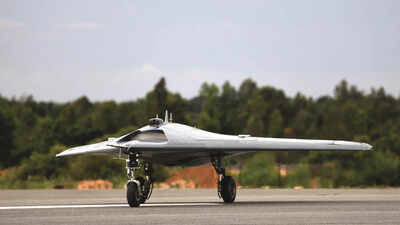
NEW DELHI: In a big milestone for India’s homegrown engine, the DRDO-built Kaveri dry engine has cleared high-altitude and flight trials in Russia, paving the way for its integration within Ghatak, India’s proposed stealth Unmanned Combat Aerial Vehicle (UCAV).“Kaveri successfully cleared tough trials in Russia some time back and recorded a peak dry thrust of 48.5 kilonewtons (kN) — beyond 46 kN it was expected to deliver… Now, the next phase is its certification and integration with UCAV Ghatak and thereafter its flight trials,” a defence source told TOI. “Once the flight trials are cleared with the cooperation of the Indian Air Force, it will be ready for induction, which is expected in 2-3 years,” the source said. Ghatak is an advanced, jet-powered stealth flying-wing combat drone designed for deep-strike missions.The Kaveri engine, built by DRDO’s Gas Turbine Research Establishment (GTRE), has undergone trials at two Russian institutes — Central Institute of Aviation Motors (CIAM) and Gromov Flight Research Institute. The Kaveri dry engine, or Kaveri Derivative Engine (KDE), is a jet turbine built without an afterburner. The Bengaluru-based Centre for Military Airworthiness and Certification (CEMILAC) will now go through all the test data before it gives its airworthiness clearance, the source said.Ghatak is a tailless flying-wing configuration with curved air intake paths and shaped exhausts to drastically reduce radar cross-section and detection. It has been built using 80–90% carbon-fibre prepreg composite materials that lower structural weight and absorb radar waves. It is designed to carry missiles, bombs and precision-guided munitions internally to maintain its low-observable stealth profile. Ghatak’s mission roles will be to penetrate heavily defended enemy air defences to destroy critical command centres and radar installations; to suppress enemy air defences; and to coordinate closely with manned fighter jets like Tejas and AMCA in future operations.The Kaveri engine project began in the late 1980s with the goal of powering the indigenous LCA Tejas. However, when it did not power the production version of Tejas due to falling short of the required thrust-to-weight ratio and facing weight issues, Indian scientists stripped the engine of its afterburner to create a non-afterburning variant known as KDE, which will now power Ghatak.

Leave a Reply