
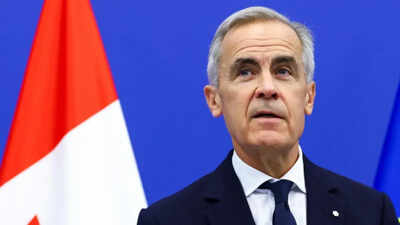
With Canadian Prime Minister Mark Carney saying his government has considered the possibility of US military action against Canada, an extraordinary scenario has entered the public debate between two countries that have historically maintained one of the world’s closest defence partnerships.The United States and Canada share an approximately 8,900-kilometre border and have worked together on North American defence for decades.Their militaries operate together through the North American Aerospace Defense Command (NORAD), the binational command responsible for monitoring and defending North American airspace and maritime approaches.Carney, however, described possible US military action as an “extreme tail risk” that his government had a responsibility to examine and prepare for. His comments came amid heightened tensions between Washington and Ottawa, including disputes over trade and President Donald Trump’s repeated remarks about Canada becoming the “51st state”.The scenario remains remote, with Carney stressing that it is not his government’s “base case”. Against this backdrop, how do the military capabilities of the US and Canada compare?
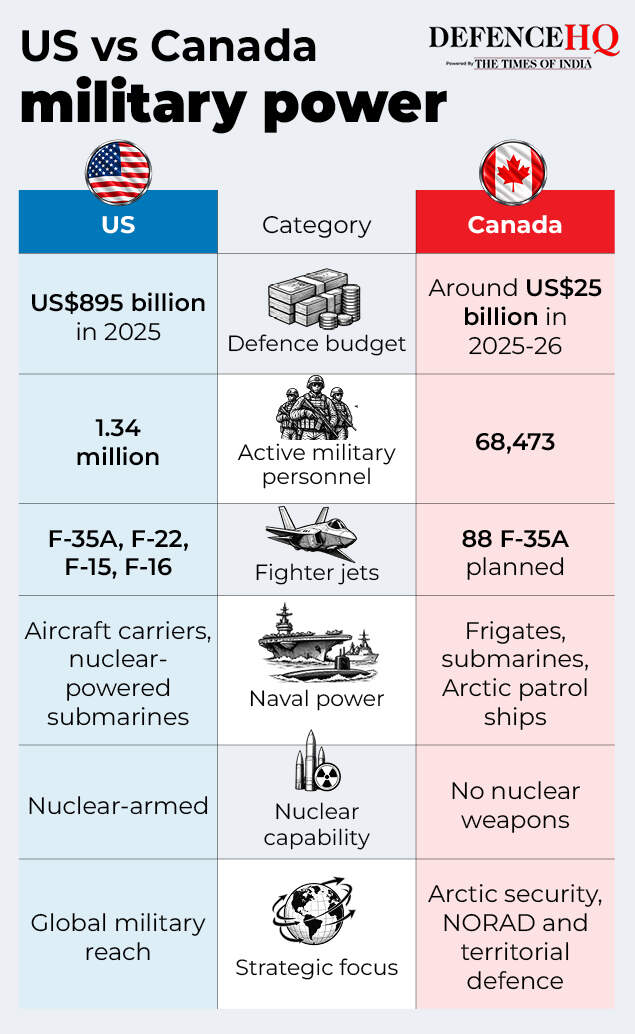
Defence spending and military manpowerThe United States’ defence budget dwarfs that of Canada. Washington’s defence budget was about US$895 billion in 2025, while spending for 2026 was around US$1 trillion. For 2027, the US government has requested about US$1.45 trillion in total defence resources.Canada, by comparison, has planned about US$25 billion in defence spending for 2025-26 and about US$37 billion for 2026-27.The difference is also evident in manpower. The US FY2027 plan provides for about 1.34 million active-duty personnel across its military services, while Canada’s latest official figures put its Regular Force at 68,473 personnel. Canada is also trying to expand its military workforce as part of its wider defence buildup.The gap extends to land forces and armoured equipment. The US Army operates the M1 Abrams main battle tank and Bradley fighting vehicle, while Canada’s armoured force includes the Leopard 2 main battle tank.Air power and naval strengthThe difference is particularly visible in air power. The US operates the F-35A, F-22, F-15 and F-16 fighter families, alongside its strategic bomber fleet. The US also operates B-1B, B-2 and B-52 strategic bombers.Canada, meanwhile, has committed to acquire 88 F-35A fighters to replace its ageing CF-18 fleet. The programme is currently being reviewed by Ottawa, although deliveries and preparations for the fleet are continuing. The first eight aircraft are scheduled for delivery to the US for Canadian pilot training, with the first aircraft due to arrive in Canada in 2028.At sea, the disparity is again substantial. The US operates a global naval force built around aircraft carriers, nuclear-powered submarines and large surface combatants, giving it the ability to sustain operations far from American shores.Canada’s Royal Canadian Navy operates Halifax-class frigates, Victoria-class submarines, Kingston-class coastal defence vessels and six Harry DeWolf-class Arctic and Offshore Patrol Ships.Strategic power and Arctic advantageThe most fundamental strategic difference is nuclear capability. The United States is a nuclear-armed state, with nuclear forces spanning land-based missiles, ballistic-missile submarines and strategic bombers. Canada does not possess nuclear weapons.Canada’s strategic importance instead comes heavily from its geography and role in North American defence. Its vast Arctic territory makes northern surveillance, sovereignty and continental defence central to Canadian military planning.Ottawa is investing in Arctic capabilities and NORAD modernisation, while the Royal Canadian Navy’s Harry DeWolf-class vessels are specifically designed to strengthen Canada’s presence in Arctic and coastal waters.The US also has a major Arctic position through Alaska, while NORAD provides the two countries with a joint framework for aerospace and maritime warning and defence. This means that despite the enormous difference in military scale, the two countries’ defence systems remain closely interconnected.

Leave a Reply