
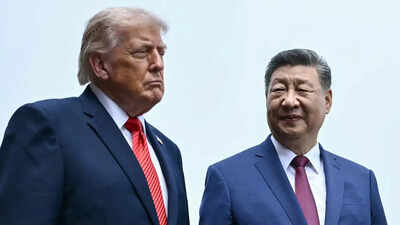
Chinese President Xi Jinping is expected to press US President Donald Trump to halt arms sales to Taiwan when the two leaders meet in Washington this week. Sources have informed Reuters that Beijing is likely to invoke a 1982 US-China agreement that commits Washington to gradually reducing weapons sales to Taipei.The issue is likely to be among the most sensitive points in Xi’s talks with Trump, as Beijing considers Taiwan a core sovereignty issue and has repeatedly demanded an end to US arms sales to the self-governed island.Three sources briefed on US-China discussions told Reuters that Beijing is expected to raise its interpretation of the third of the three US-China joint communiques, signed in 1982.Under the communique, Washington said it intended to gradually reduce its arms sales to Taiwan and did not seek to maintain long-term weapons sales to Taipei.But an accompanying memo by then-US President Ronald Reagan said the US commitment to reduce arms sales was “conditioned absolutely” on China’s continued commitment to resolving differences with Taiwan peacefully.The distinction is significant because China has sharply expanded its military activity around Taiwan in recent years, including military exercises involving live missile tests. Chinese forces now operate around the island on an almost daily basis, according to Reuters.
$14 billion Taiwan deal remains on hold
The Trump administration approved an $11 billion arms package for Taiwan in December, described as the largest such package to date. But a second package worth about $14 billion has remained on hold for months.Trump said after meeting Xi in Beijing in May that he was keeping the package in abeyance and described it as a “very good negotiating chip”.A White House official said Trump would decide on the new package within a relatively short period.Trump approved more arms sales to Taiwan during his first term than any previous US president, the official said, adding that his second-term approvals in the first year had already exceeded the total approved during all four years of Joe Biden’s presidency.Taiwan’s foreign ministry said it was closely monitoring the US-China exchanges while maintaining communication with Washington.
Beijing wants arms deliveries stopped
China is also seeking an end to deliveries of weapons that Taiwan has already ordered from the US, according to the sources, who spoke on condition of anonymity because of the sensitivity of the discussions.One source said Xi could tell Trump that Taiwan was the “provocateur” and the source of instability in US-China relations, while accusing Taipei of changing the status quo.Beijing could offer cooperation in putting pressure on Iran over the Middle East war in return, the sources said.China’s foreign ministry has said Washington must honour the three joint communiques and previous commitments on Taiwan, calling this a necessary condition for stable and healthy US-China ties.The US, however, maintains a “one China” policy under which it does not take a formal position on Taiwan’s sovereignty and acknowledges, without endorsing, Beijing’s position that Taiwan is part of China.Washington is also required by US law to provide Taiwan with the means to defend itself, despite the absence of formal diplomatic relations between the US and Taipei.
Xi could ‘lecture’ Trump on Taiwan
The 1982 agreement is not the only document shaping the US position on Taiwan.The “Six Assurances” issued to Taiwan that year, but declassified only in 2020, stated that Washington had not agreed to set a date for ending arms sales to Taiwan or to consult Beijing before approving such sales.US lawmakers have also urged Trump not to weaken Washington’s support for Taipei ahead of his meeting with Xi.Republican senator Pete Ricketts, who chairs the Senate foreign relations subcommittee on East Asia, said last week that Trump should make clear that US policy on Taiwan had not changed.John Moolenaar, the Republican chairman of the House Select Committee on China, separately told Trump that Chinese objections to US arms sales and security cooperation with Taiwan and other Asian allies should be rejected.Matt Pottinger, who served as deputy national security adviser during Trump’s first administration, said he did not expect a substantive change on Taiwan during the summit.But he predicted Xi would likely “lecture” Trump at length on Taiwan, as he had done in previous meetings with US presidents.

Leave a Reply