
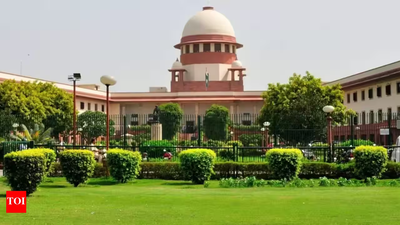
NEW DELHI: The Supreme Court on Tuesday refused to examine at this stage whether the National Song should be limited to two stanzas or extended to six, but agreed to examine whether not singing it can be made a punishable offence.A bench led by CJI Surya Kant, along with Justices Joymalya Bagchi and V Mohana, referred to the Supreme Court’s ruling in Bijoe Emanuel, saying the law laid down in that case, that no one can be punished for not singing the National Anthem, continues to hold good.The apex court asked the centre to file its response to the PIL. However, it did not issue notice to the centre at this stage. The bench said the penal consequences of the law may be examined in the context of the fundamental rights guaranteed under Articles 25 and 26 of the Constitution.The plea has been filed by Carnatic vocalist T M Krishna, who has challenged the law mandating the singing of six stanzas of Vande Mataram. Krishna has argued that the last four stanzas expressly invoke devotion to Hindu deities and that making their singing mandatory violates the secular character of the country, as per a report by PTI news agency.The plea also challenges the amendment bringing Vande Mataram under the Prevention of Insults to the National Honour Act, alleging that it is arbitrary, violates personal liberty and furthers a “majoritarian religious message”.The PIL petitioner has also questioned the extension of the National Song from two to six stanzas and the provision seeking to make non-singing of it punishable.Solicitor General Tushar Mehta, appearing for the centre, opposed the challenge and said those who do not bear allegiance to the Constitution and rule of law, and have a “naxalite mindset”, should not question the National Song while forgetting its role during the freedom struggle.

Leave a Reply