
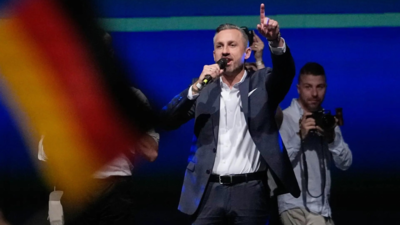
Germany has just delivered a political shock that is reverberating far beyond its eastern border.The Alternative for Germany (AfD) won 44.5% of the vote in Saxony-Anhalt, more than doubling its 2021 tally and crushing Chancellor Friedrich Merz’s Christian Democrats, which fell to 18.5%. The result was historic as no far-right party has come this close to dominating a German state since World War 2.The immediate political effect may be limited as mainstream German parties still refuse to cooperate with the AfD, but the psychological effect is already being felt.Germany’s political firewall against the far right has been breached electorally, and the question now spreading across the continent and the world is simple: is Europe turning right?The answer increasingly appears to be yes. So, what does it mean for the European Union, Nato, Russia and the US?
Germany’s warning shot
AfD candidate Ulrich Siegmund’s triumph is particularly significant because Germany has long been the country where the political barrier against the far right was considered strongest given its history.That barrier remains institutionally intact. But electorally, it is under extraordinary pressure.As per political analysts, the party’s success reflects a combination of anger over immigration, economic frustration, dissatisfaction with mainstream parties and opposition to Berlin’s support for Ukraine. Its rise also demonstrates that the AfD is no longer simply a protest vehicle for voters on Germany’s political fringes.Germany is also Europe’s economic and political heavyweight.If the AfD eventually becomes part of a future federal government, its positions on Russia, Ukraine, Nato and the EU could become questions for the entire continent.For now, however, Germany is more likely to see a different effect: the mainstream right moving further right to stop voters from defecting to the AfD.That is how Europe’s political centre can shift even while the far right remains outside government.
France could be the next big test
Marine Le Pen’s National Rally has spent years transforming itself from a party of protest into a plausible governing force. Whether Le Pen herself is ultimately able to contest the 2027 presidential election remains a legal and political question, but the RN’s position is clear: it is now a serious contender for power.Recent polling has placed an RN candidate, Le Pen or Jordan Bardella, at roughly one-third of the first-round vote, substantially ahead of individual mainstream challengers.In several second-round scenarios, Bardella has also been competitive or ahead.France is crucial because a right-wing government there would not merely alter immigration policy.France is a nuclear power, a permanent member of the UN Security Council, one of Nato’s most important militaries and the EU’s other major strategic power alongside Germany.A National Rally government could therefore reshape debates over European defence, Ukraine, sanctions against Russia and the future of the EU.The party has moderated some of its earlier positions on Russia, but the issue remains contentious. Current RN figures have argued for continued support for Ukraine while demanding a fundamentally different relationship between French assistance and national interests.
Right = Pro-putin? Meloni says no
Italian Prime Minister Giorgia Meloni and her right-wing administration has surpassed 1,413 consecutive days in office, making her government the longest-serving uninterrupted single-term administration in Italy since World War II.Despite Meloni’s marathon tenure, Italy remains firmly within the Nato camp.Her Brothers of Italy remains the country’s largest party, polling around 25-26%, while a new and more radical force led by former general Roberto Vannacci has risen rapidly. Reuters reported in September that Vannacci’s party had overtaken Silvio Berlusconi’s Forza Italia in polling.Meloni’s continued success is important as it complicates the idea that a rightward Europe necessarily means a pro-Russian Europe.She has taken a hard line on immigration and embraced socially conservative politics, but she has also backed Ukraine, maintained close ties with Washington and accepted Italy’s role within Nato.The danger for her now comes from her right.If Vannacci’s movement continues to grow, Meloni could face pressure to adopt a more nationalist and confrontational position towards Brussels and a less hawkish approach towards Moscow.Italy therefore offers Europe a choice between two versions of the right: Meloni’s conservative Atlanticism or a more radical nationalist model.
Spain could make the far right kingmaker
The conservative People’s Party is leading national polling at around 32%, with the governing Socialists at approximately 26%. Vox, meanwhile, is hovering around 18%, up significantly from its 2023 election performance.That makes Vox potentially decisive.Recent regional elections have already shown the pattern: the PP can win, but may need Vox to govern. In Andalusia, for example, the PP won the election but lost its absolute majority, leaving Vox with significant leverage.Vox leader Santiago Abascal has welcomed the AfD’s success.The significance is not necessarily that Vox will take power by itself. It is that the radical right may become impossible for Europe’s mainstream conservatives to ignore.The far right does not have to win outright to win influence. It only has to become indispensable.
Poland: The right is rising, but Putin is a problem
Poland presents perhaps the biggest obstacle to the idea of a unified European right.The country’s conservative and nationalist parties remain powerful. But Polish politics is shaped by a fundamental reality that does not apply with the same intensity elsewhere: Russia is viewed as an existential security threat.Recent polling shows the ruling Civic Coalition around 31%, Law and Justice around 22%, the Confederation around 14-15% and the more radical Confederation of the Polish Crown near 10%.The combined strength of the right is therefore enormous.But its Russia policy can be very different from the AfD’s.That explains Prime Minister Donald Tusk’s furious reaction to Germans celebrating the AfD victory. He described those celebrating the result as “idiots or traitors”.Poland demonstrates why the phrase “Europe’s right” can be misleading.There is no single European right.There are nationalists who want to weaken Brussels but strengthen Nato. There are conservatives who want tougher immigration policies while remaining strongly pro-Ukraine. And there are parties that question sanctions against Moscow and want a fundamental reset with Russia.Those differences could determine Europe’s future.
What does all this mean for Putin?
For Russia, the best possible outcome is not necessarily a Europe full of openly pro-Russian governments.It is a divided Europe.
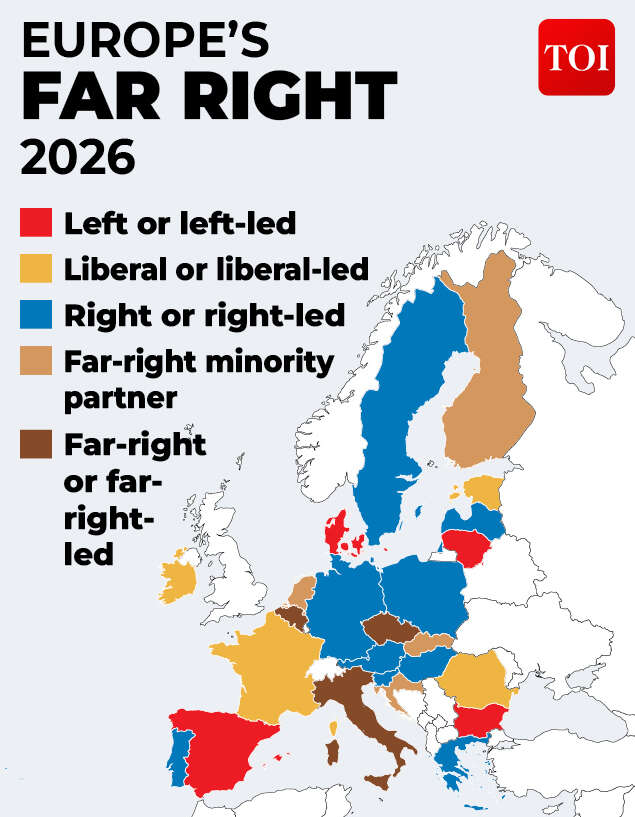
Political map of Europe.
The EU’s ability to impose sanctions, finance Ukraine and coordinate economic pressure on Moscow depends on political consensus. Nato’s deterrence depends on member states agreeing on the nature of the Russian threat.If France, Germany, Italy, Spain and Poland begin adopting substantially different positions on Ukraine and Russia, Europe’s collective leverage could weaken even if every individual country remains formally inside Nato.But there is an important counterargument.A rightward Europe could also become more militarily capable.Meloni’s Italy, Poland’s conservatives and Europe’s mainstream centre-right increasingly support higher defence spending and stronger national militaries. A Europe that is more conservative on immigration and more nationalist about sovereignty could still become more determined to defend itself against Russia.
Trump gets his European political moment
The AfD victory also matters enormously for Donald Trump.Trump has repeatedly backed Europe’s nationalist right and criticised European political establishments over immigration, national sovereignty and their approach to Russia and Ukraine.The AfD’s breakthrough gives Trump’s movement a powerful argument: Europe’s voters are moving in the direction he has been advocating.For Trump, the result is therefore politically useful.It provides evidence that the European establishment is losing voters to parties promising tougher immigration controls, greater national sovereignty and a rejection of the old political consensus.But there is a contradiction.Trump wants Europe to become more responsible for its own defence. A nationalist Europe could spend more on defence and reduce its dependence on Washington.Yet if nationalism also produces divisions over Ukraine, Russia and Nato, America could end up with a Europe that is more willing to spend but less willing to act together.That is not necessarily what Washington wants.
Europe is not turning right in one direction
The AfD victory should therefore not be read as proof that Europe is about to become a continent of far-right governments.The more profound change may be happening inside mainstream parties.Conservatives are adopting tougher positions on immigration. Defence spending is rising. National sovereignty has returned to the centre of political debate.Mainstream parties are increasingly forced to compete with nationalist movements on their own terrain.That could produce a Europe that is more conservative without becoming uniformly far-right.If the European right follows Meloni’s model, Europe could become tougher on migration, more assertive about national interests and simultaneously committed to Nato and Ukraine.If it follows the AfD’s model, the EU’s unity on Russia could come under severe strain.If France moves towards the RN while Germany moves towards the AfD, and Spain’s Vox becomes indispensable to government formation, Europe’s political centre of gravity could shift dramatically.But Poland could remain firmly anti-Russian, while Italy remains Atlanticist under Meloni.That is why the next chapter of European politics will not simply be about left versus right.It will be about which right wins, and what it believes Europe should do about Russia, America and the EU itself.The AfD’s victory has shown that the old political order is under pressure.The elections and political battles now unfolding across Europe will determine whether that pressure produces a new conservative mainstream, or a fractured continent where Moscow finds more room to manoeuvre.

Leave a Reply