
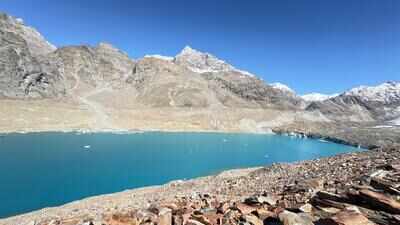
KULLU: Within days of the devastating Nepal floods, Lahaul Spiti administration has stepped up preparedness against a possible glacial lake outburst flood (GLOF) risk, and begun ‘highest flood level’ (HFL) markings at 32 vulnerable locations along the likely flood path of Ghepan lake, considering its expansion from 36.5 hectares to 101.3 hectares in just 13 years.Thirty-two residential areas from Sissu to the Sansari border have been identified and 128 locations are being marked as potential flood-prone zones.Ghepan Lake, located at an altitude of 4,070 metres, expanded by 178% between 1989 and 2022. Above Sissu and around 11km from the town, the potential downstream flood path extends for about 90 km through Udaipur to the district boundary.ISRO had informed the district administration in Nov 2023 that the lake had expanded considerably from its normal size and advised authorities to take necessary precautions, said Kiran Bhadana, Lahaul-Spiti deputy commissioner and chairperson of the District Disaster Management Authority.The HFL marking is being carried out under National Disaster Management Authority to create clear and permanent reference points indicating potential flood levels and to increase awareness among people living in vulnerable areas, Bhadana said.An early warning system (EWS) will be installed at Ghepan Lake this month through Centre for Development of Advanced Computing (C-DAC), Thiruvananthapuram, to continuously monitor the lake’s water level and other critical parameters and provide timely information. The system was successfully tested at Sissu Lake in April this year.Ghepan glacial lake is 2,464 metres long and 625m at its widest near the glacial snout that gradually narrows towards the outlet. It is estimated to carry a volume of over 35 million cubic metres.A five-member team from Geological Survey of India (GSI) is scheduled to visit Ghepan Lake area for 14-day study during which they will assess the lake and its surroundings, measure lake depth and water flow, study meteorological parameters and examine areas vulnerable to avalanches and landslides. The administration will send a separate team to the lake this month to directly assess its current condition, said an official.As part of preparedness measures, rapid response teams have been formed in Sissu and Shashin villages, while residents in vulnerable areas are being trained and sensitised on disaster preparedness, rapid response and necessary precautions.The administration is constituting a district-level GLOF Monitoring Committee comprising officials from various departments, experienced mountaineers and other people with relevant expertise. The committee will conduct periodic field inspections and assess risks such as loose rocks, unstable terrain and other potential hazards, added the official.The number of glacial lakes in Himachal Pradesh has increased substantially in recent decades. According to a report by Himachal Pradesh State Centre on Climate Change (SCCC), the four river basins of Satluj, Beas, Ravi and Chenab had a total of 1,619 glacial lakes in 2022.

Leave a Reply