
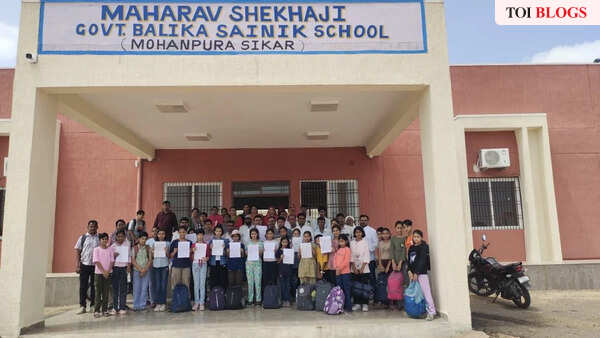
We might be underestimating just how significant it is when schoolchildren across the country start protesting about the lack of basic infrastructure. Their complaints precede politics, and focus on things central to their prospects in life. There is nothing abstract about these issues, nor can their contentions be challenged when the visual evidence is overwhelming. What they are seeking is accountability, which in the Indian context is an elusive commodity.At one level, their demand is basic. People elected to power need to be answerable to those who voted for them. Isn’t that what democracy is supposed to be about?And yet, in India accountability is difficult to contrive. Power is answerable only to a higher authority and not to an internal sense of responsibility. Which is why bureaucrats and politicians do not overly concern themselves with answering to the people they are meant to serve, but to their bosses who control their destiny.Which is why a tyrannical boss who terrorises his subordinates feels no embarrassment in turning into a wriggling quiver of jelly when speaking to his own boss before them. The rules are clear, the contract has no hidden clauses: power needs visible submission. And this form of accountability looks upwards, not downwards.Since it is possible to win elections through identity politics or large direct transfers of grants and subsidies, the system offers little incentive to become accountable to the people who vote.This is why, despite all the visible surface change in the country, some foundational realities do not change. Rural schools are abysmal, public health facilities pitiable, new roads get built with a flourish and collapse even more spectacularly. In urban areas, sanitation is poor, flooding common and the air poisonous.More importantly, the system is self-sealing and immunises itself against change. Attempts at reform end up being co-opted. A brave officer here, an honest politician there gets either subsumed or neutralised.When the new begins to look too threatening, the past is not afraid to use force. We saw a recent example where a Khap Panchayat decided to confiscate the phones of all the girls in a village and smash them in public. This is blatantly illegal and unconstitutional, but in our social structure there is very little that can be done about it. The girls are meant to be the ‘responsibility’ of the community; it exercises ownership over them in the name of values. They have to submit to their parents, who in turn have to submit to the village elders. External agents like the police come from the same world and accept most of its rules. The possibility of change is foreclosed.Which is why the current protests by children across the country stand out as being different. So far, we have had the past trying to shape the future and finding that it could not escape itself. Every attempt to change things has ended up being a new version of itself.This is the future trying to shape its own reality. And here, being children is a huge advantage. They are insiders who as yet do not know better. They cannot easily be accused of being mouthpieces for other people’s agendas, nor of being funded by Soros. They are raising issues that directly concern them and are almost impossible to refute or discredit.Being insiders matters. External influence in India is neutered or domesticated till it becomes an extension of the past. The young come from within the culture, speak in its idiom and carry with them a hope for the future.Yet, in spite of being insiders, they still carry a distance, a temporal one. They have not fully absorbed the past; they have not as yet become instruments of it. They are able to see what is wrong without knowing that it has always been this way, and that this is how things are meant to be. They are able to view the present more clearly and critique it with greater innocence.Their power comes from their status as children, something even our current discourse, which finds ways to demonise critique, has not been able to devalue. But what has made them significantly more powerful is the smartphone. With it, they can present unimpeachable evidence. Their faces tell a story that no second-hand report can hope to match. They become incontrovertible witnesses who can ask questions that cut through the barriers constructed against asking questions.Questions lead to more questions. A video that gets traction encourages children from other regions to tell their own stories of neglect. The state is caught in a bind: if it does not react, the anger grows; if it does act, it proves that such protests are effective and encourages more people to come forward.When the future demands accountability, it goes beyond political parties. While the current protests seem to be against the party in power, their significance goes deeper. They are taking aim at the current idea of politics itself, one that has created a system immune to the needs of people.There is reason for hope just as there is reason for cynicism. We are seeing something genuinely new, but Indian society is especially good at making something new an extension of the old.But never before have the people asking for change been too young to be part of the old arrangement. Perhaps that means something.
Disclaimer: Views expressed above are the author’s own.

Leave a Reply