
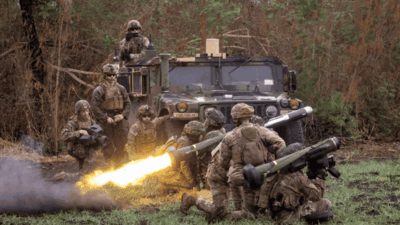
India and the United States have signed a Rs 292-crore government-to-government deal for around 60 Javelin anti-tank guided missiles for the Indian Army, in a procurement aimed at strengthening the force’s anti-armour capabilities after Operation Sindoor, defence sources told ANI.The missiles are being acquired under the sixth emergency procurement window (EP-6), which permits the armed forces to procure equipment worth up to Rs 300 crore per contract. The Javelin deal is therefore being placed in limited numbers, with deliveries under the emergency procurement contracts expected to begin by the end of 2026-27.The deal follows a public announcement by US Ambassador to India Sergio Gor, who said India planned to buy the “battle-tested” Javelin anti-tank system. Gor said the acquisition would deepen the US-India defence relationship and could also open the door to co-production opportunities between the two countries.What is the Javelin?The FGM-148 Javelin is a man-portable anti-tank guided missile system developed and produced by the Javelin Joint Venture of Lockheed Martin and RTX for the US military. It is designed primarily to destroy tanks and other armoured vehicles, but can also be used against bunkers, fortified positions, buildings and other battlefield targets.The system consists of a missile sealed inside a disposable launch tube and a reusable Command Launch Unit (CLU), which provides day and thermal imaging sights for target detection and engagement.The Javelin uses a passive imaging-infrared seeker and has a fire-and-forget capability. Once the operator locks on to a target and launches the missile, the seeker guides it without requiring the soldier to continuously control its flight. This allows the operator to quickly move to cover or change position after firing.The missile has a 127-mm diameter and weighs about 15.5 kg as a complete round, while the missile itself weighs around 11.8 kg. The reusable command launch unit weighs roughly 7 kg in the current configuration. The system can engage targets from around 65 metres to up to 4 km in most operational conditions.Another important feature is its soft-launch system. The missile is initially ejected from the launch tube before its main rocket motor ignites, allowing the Javelin to be fired from relatively confined positions. The system can be operated by infantry and can also be integrated with vehicles and other platforms.Javelin first saw during the 2003 US-led invasion of Iraq. According to its manufacturers, Javelin had been used in more than 5,000 engagements in Iraq and Afghanistan.The missile gained renewed international prominence after Russia’s full-scale invasion of Ukraine in 2022. Ukraine had received Javelins from the US before the invasion and used them against Russian armoured forces during the early stages of the war

Leave a Reply