
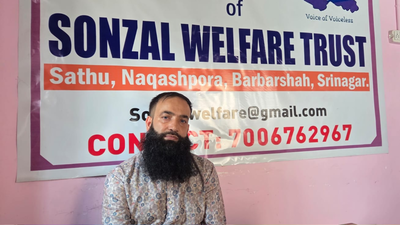
SRINAGAR: Phones monitored, friendships scrutinised, movements watched and marriage pushed as a “solution” — these were among the forms of control LGBTQIA+ people in Kashmir described during eight months of fieldwork for a report that documented how visibility could bring acceptance for some but surveillance, stigma and, at times, violence for others. Based on interviews with 60 participants, including 44 LGBTQIA+ community members, the study examined their experiences across families, educational institutions, healthcare, law enforcement and wider social and political structures.Dr Aijaz Ahmad Bund, researcher, activist and assistant professor in the higher education department who led the study, said LGBTQIA+ discourse in Kashmir had changed considerably since he began advocacy work in the early 2010s, but the change had not translated into widespread acceptance. “We have been able to normalise the discourse to some extent and bring into the public conversation something that was considered a stigmatised topic,” he said. For Bund, however, the dilemma remained whether queer Kashmiris should make themselves visible in what he described as the region’s “most socio-homo-friendly” place and risk backlash, surveillance and stigma, or remain quiet and deal with what that silence brought.The report, ‘Yes, We Exist’, prepared by Sonzal Welfare Trust on the lived realities of LGBTQIA+ people in Kashmir with research support from the Marivala Health Initiative, found familial discrimination to be one of the most significant forms of marginalisation. In Kashmir’s closely knit family structures, where reputation was often collective, participants described denial, silence, surveillance, emotional pressure, coercion and, in some cases, violence after relatives discovered or suspected their sexual or gender identities. A 22-year-old participant from Srinagar recalled that after his brother found messages on his phone, he was told, “This is not who we are. This is not our culture.”Others described similar attempts to change or control their identities, with one participant saying his mother believed prayer could change him, while many reported increased monitoring of their phones, social-media accounts, movements, friendships, clothing and gender expression. Marriage frequently emerged as another form of pressure: one participant said family members told him that marrying a woman would make “everything normal”, while others described being pushed towards marriage proposals or counselling aimed at changing their identities. A lesbian participant said her father stopped paying her college fees after she rejected marriage proposals, leaving her more economically dependent and putting her education at risk.Not all discrimination involved confrontation. “Silence communicates shame without confrontation,” the report said, describing how withdrawal and refusal to discuss a person’s identity could become another form of emotional control, while guilt and fear of disappointing the family often accompanied such responses. The study, however, also recorded signs of gradual change, with one participant saying her mother, after months of silence, began asking questions and stopped describing her identity as a disease.Bund said families had increasingly begun approaching activists for support and, in some cases, showed concern for their children rather than simply rejecting them. Sonzal Welfare Trust, formed in 2017 as the region’s first openly functioning LGBTQIA+ organisation, had meanwhile expanded mental-health services, safe spaces, community support and digital storytelling to amplify anonymous LGBTQIA+ voices while allowing people to participate without necessarily exposing their identities publicly.Educational institutions presented another layer of difficulty, with participants describing verbal harassment, social isolation and physical intimidation. One person said classmates mocked the way he walked and talked before the harassment escalated into physical bullying in school corridors, while the report found that teachers sometimes ignored such incidents and, in other cases, reinforced conventional expectations around gender and sexuality. Bund said education remained one of the areas where greater awareness could help break the cycle of stigma.The report also documented exclusion from religious spaces, particularly among transgender Kashmiris, some of whom said they did not feel welcome in mosques or had been prevented from praying because of their gender identity. At the official level, legal and policy interventions had brought limited recognition, including acknowledgement of transgender identities in some administrative processes, but the report said LGBTQIA+ people continued to live largely in conditions of invisibility.The study placed these experiences within Kashmir’s prolonged conflict and heavily securitised and militarised environment, saying checkpoints, identity checks, communication restrictions and surveillance could further restrict the movement and association of LGBTQIA+ people whose gatherings were already often discreet because of social stigma. For people trying to build community while remaining unnoticed, these conditions could make even ordinary social interaction more complicated.Sonzal itself had encountered the risks of maintaining a public presence online: its Facebook account was hacked, while the organisation eventually discontinued its Twitter account after sustained hate and abuse. Bund said Instagram offered greater control over content and audience moderation and believed younger users there were more tolerant, but his experience had also made him cautious about treating visibility as an unqualified goal.His own identity reflected that tension. Bund said some people found it difficult to reconcile his long beard and religious appearance with his queer identity, while within queer spaces he was sometimes perceived as “too religious to be queer” and outside them as “too religious to be a queer”, placing him at the intersection of religion, sexuality and identity that the report repeatedly explored.Despite years spent bringing LGBTQIA+ issues into public conversation, Bund said he would advise people against “coming out of the closet”, particularly where openness could bring serious consequences. That uncertainty extended even to the study itself. “We are thinking whether the report should be formally released or it shouldn’t,” he said, reflecting the choice many queer Kashmiris continued to navigate — becoming visible enough to challenge the idea that they did not exist while remaining cautious about the risks that visibility could bring.

Leave a Reply