
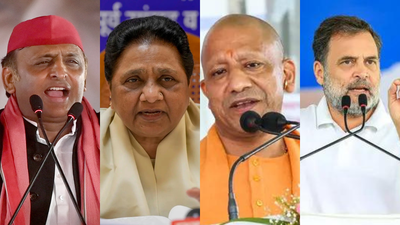
NEW DELHI: Dalit politics in Uttar Pradesh is at a crossroads. For a very long time, Mayawati and her Bahujan Samaj Party were synonymous with the idea of Dalit vote in UP. Not any more. Mayawati’s BSP today is a much weaker force. The last three elections in the state have pushed Mayawati, the four-time chief minister of UP, to the margins of state politics. This has opened up the Dalit space and triggered an interesting scramble among political parties for a slice of the Dalit pie in the 2027 assembly elections.So, we have the BJP playing the name-change game in Bhadohi and organising a 7-month campaign to honour 15th-century saint-poet Sant Ravi Das. Then we have Samajwadi Party chief Akhilesh Yadav announcing 14 extra seats for the Dalits to cement his PDA (Pichhda, Dalit, Alpsankhyak) politics. Congress too is trying to win back voters it lost decades ago. Then there is Chandrashekhar Azad, who is trying to consolidate his own space in the state.As Uttar Pradesh heads towards 2027, the question is: if the BSP continues to lose ground, where does Mayawati’s old support base go and which of her rivals stands to gain the most?
From 206 seats to one: How BSP lost ground
The BSP’s rise in UP politics was as dramatic as its fall. The party was founded by Kanshi Ram in 1984 with the idea of giving Dalits and other marginalized communities an independent voice. Mayawati, who emerged as his political successor, took the BSP to great heights in Uttar Pradesh. Under her leadership, the BSP won a majority on its own in the 2007 assembly elections, winning 206 seats with a vote share of 30.43%.Dalits, who constitute around 21% of UP’s population as per the 2021 census, have for years been the core base of Mayawati’s Bahujan Samaj Party. But that dynamic has now changed.BSP is a much weaker force today. Mayawati has failed to mobilise Dalit support for her BSP in the last two elections in the state, thereby opening up the space for other political contenders. In the 2022 assembly elections, the BSP could win just 1 seat with a vote share of 12.88%. This was a sharp decline from the 19 seats and a 22.23% vote share that Mayawati had got in 2017.The 2024 Lok Sabha elections went on to showcase that Mayawati’s dismal 2022 performance was not an aberration. The BSP supremo failed to win even one Lok Sabha seat, while her party’s vote share dipped to 9.4% from 19.43% in 2019. Clearly, the results reinforced the gradual decline in BSP’s influence among Dalits.As Mayawati gears up for the 2027 assembly challenge, she faces an uphill road. The BSP chief has not just lost support of voters, but also control over her party. So, when Mayawati issued a stern message that all the candidates for the upcoming poll will be finalised by her and not by her nephew Akash Anand, it was an indication of the internal tussle in her party.Akash Anand, who has been in and out of Mayawati’s favour in the past, launched the party’s 2027 assembly poll campaign from Sadabad in Hathras this week.Mayawati, who has often been accused of helping the BJP, has ruled out any pre-poll alliance. She has claimed that some candidates have already been finalised for the upcoming assembly elections. Mayawati has asked party cadres to start rebuilding the party and drum up OBC support ahead of the polls. The cadres have apparently been asked to remind people of the party’s past governance and convince them that the real benefit and welfare of the OBC community lie with the BSP and its “iron lady government”.Mayawati, however, must consider that it will be difficult for the BSP to come back to power only by holding on to its core Dalit vote alone. It will have to recreate the Dalit-OBC combination that originally carried Mayawati to power in Lucknow with a majority of her own.
BJP’s Dalit outreach gets sharper ahead of 2027
One interesting fallout of BSP’s decline has been the BJP’s aggressive outreach to woo the Dalits. When Uttar Pradesh chief minister Yogi Adityanath announced the renaming of Bhadohi district as Sant Ravidas Nagar last month, he put the BJP right at the middle of the Dalit outreach battle ahead of 2027 polls.The move also revived an old political contest over name-change politics. Mayawati was the one who had renamed Bhadohi as Sant Ravidas Nagar in December 1997. Akhilesh Yadav restored the old name in 2014. Now, by bringing Sant Ravidas Nagar back, Yogi sought to make a bigger political point, accusing the SP of erasing a Dalit symbol while positioning the BJP as a party willing to restore it.Mayawati publicly welcomed the decision, a rare moment of agreement with the ruling party. She was quick, however, to remind voters that it was her government that had changed the district’s name in the first place and that the decision was later reversed under Akhilesh.The party realises that Dalit votes are up for grabs and hence is going all out to woo them. The party’s ‘Samrasta Sankalp Abhiyan’ appears planned to coincide with assembly elections in two key states, Uttar Pradesh and Punjab, early next year.Both these states have a sizeable population of Dalits who play an important role in many constituencies. In the 2022 assembly elections, the BJP and its ally Apna Dal (Soneylal) together bagged 63 Scheduled Caste (SC) seats compared to 20 won by the then Samajwadi Party-led opposition alliance. But the 2024 Lok Sabha polls changed the dynamics, with the SP and the Congress winning 43 of the 80 seats in the state and pushing the BJP to make an aggressive outreach. The loss of Faizabad seat to SP’s Awadhesh Prasad, a Pasi leader, was particularly significant and gave Akhilesh Yadav fresh ammunition for his PDA pitch.Earlier this year, the Yogi Adityanath government approved the “Dr B R Ambedkar Murti Vikas Yojna” under which Rs 1 crore is to be allocated to each of the state’s 403 assembly constituencies for the beautification and development of statues of social reformers.The BJP’s efforts to woo Dalits has also been visible in its recent Cabinet expansion. Of the six new ministers inducted into the Yogi government, two were Dalits, Krishna Paswan from the Pasi community and Surendra Singh Daler from the Valmiki community. Three others were from OBC groups. Two non-Yadav OBC ministers were also given independent charge.The BJP’s primary task ahead of 2027 would be to hold on to the non-Jatav Dalit support it built over the past decade and prevent a repeat of 2024.
SP’s Dalit outreach
The 2024 Lok Sabha elections also showed that the Dalits in UP were ready to back other political parties who wooed them. Dalit support played a key role in the spectacular success of Akhilesh Yadav’s Samajwadi Party, which won 37 seats in 2024.Together with its alliance partner Congress, the INDIA bloc won 43 of the 80 seats in the state, pushing the BJP on the back foot. Akhilesh Yadav, who has centred his politics around PDA (Pichhde, Dalits and Aplasankhyaks), gained from his Dalit outreach in the 2024 elections. His Samajwadi Party fielded two Dalit candidates from general seats. While one of them went on to win the all-important Faizabad seat, the other lost by just 10,585 votes to the BJP in Meerut.
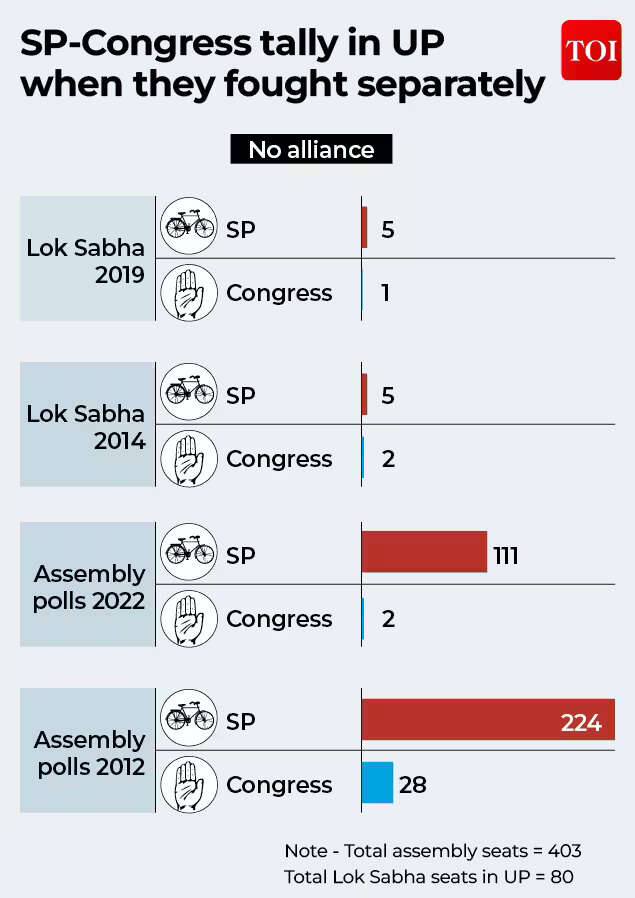
How Samajwadi Party performed when they contested independently
Little wonder, in the run-up to the 2027 assembly elections, Akhilesh has already announced plans to field 14 Dalit candidates from general seats. Uttar Pradesh has 84 seats reserved for Scheduled Castes and two for Scheduled Tribes. With 14 more candidates on general seats, the total tally of reserved candidates for SP will increase to 100. This will help reinforce his message to the Dalits in line with his PDA politics. The move will also help the SP shed the narrative of being a Muslim-Yadav party.
Congress tries to reclaim lost ground
Rahul Gandhi has made it clear that Dalits would now play a ‘central role’ in Congress. Before Mayawati and the BSP built their massive Dalit vote bank in the 1990s, Congress was the primary choice for Uttar Pradesh’s Dalits. For nearly three decades after that, Congress was almost pushed out of UP politics.Rahul Gandhi has started his road to the UP election by acknowledging that the party had failed to take the right steps for the community in the 1980s and 1990s. He even praised Kanshi Ram for bringing Dalits together and giving the community a sense of confidence.Rahul has also made the Constitution a regular part of his social justice pitch. He is often seen carrying the red book of the Constitution while warning that constitutional rights and reservation are under threat. He has repeatedly invoked BR Ambedkar in the same pitch, asserting that Congress wants to position itself as a guardian of the Constitution.The party has also put a Dalit leader in charge of Uttar Pradesh. Rajendra Pal Gautam, who heads the Congress’s Scheduled Castes Department, has been appointed UP in-charge ahead of the 2027 polls. Interestingly, Gautam had also made an unsuccessful attempt to meet Mayawati at her Lucknow residence earlier this year.Whether the party will be able to translate this outreach into votes remains to be seen.
Chandrashekhar Azad adds another claimant
Then there is Chandrashekhar Azad, whose 2024 victory from Nagina made him a prominent figure in UP’s Dalit politics. Unlike BJP, SP or Congress, Azad is trying to build an independent space outside the BSP. His challenge now is to take that appeal beyond one constituency and build an organisation strong enough to matter across the state in 2027.
Join conversation
Share your thoughts in the comments
Be respectful · TOI community guidelines
That is what makes the coming assembly election in Uttar Pradesh interesting. For decades, politics in Uttar Pradesh has revolved around caste. Political parties build their electoral strategies around social coalitions, loyalty of communities and traditional vote base.Mayawati may no longer command the Dalit vote the way she once did, but that vote bank has not disappeared. It simply has more claimants. And in 2027, where those voters eventually move could make a significant difference.

Leave a Reply