
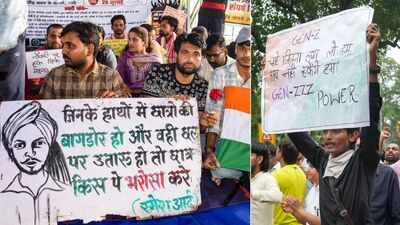
India just witnessed the ‘reel’ generation make the ‘real’ world listen. July 2026 saw something Indian parents have dreamt of for years: Gen Z looked up from its screens. But it was for a cause. They turned memes into megaphones and forced the country to pay attention to exam reforms. In their own language, they ate and left no crumbs.Exam paper leaks weren’t new. Student protests weren’t either. What was different was how a “cockroach” remark snowballed into a meme, then into the Cockroach Janata Party, and eventually into a nationwide movement that dominated headlines.Now comes the bigger question: What other issues is India talking about?
Eyes on Jharkhand
While the CJP protest has ended, the demand for a system overhaul has not. As Jantar Mantar went quiet, Jharkhand emerged as the new battleground as students demand accountability over JPSC-JSSC exam irregularities.Student leader Devendra Nath Mahto has been on a hunger strike since August 2, while protesters are seeking an independent probe and reforms in the recruitment process.
E20
Then there is E20, a policy that directly affects vehicle owners.The nationwide rollout of 20% ethanol-blended petrol has sparked a political and online debate over mileage, older vehicle compatibility and whether the Centre followed the phased roadmap laid out by NITI Aayog.After the NEET protests, calls for Union minister Nitin Gadkari’s resignation began circulating, while leaders including Arvind Kejriwal and Rahul Gandhi also raised the issue.Vivek Rajput, a CA at a top government firm, says that although he has never attended a protest, this might become his first. “If there is a protest over E20, I will definitely go. My vehicle’s mileage has gone down compared to before.”CJP spokesperson Ashutosh Ranka agrees that E20 deserves attention, but questions whether the government has adequately addressed concerns around its impact and benefits. “Obviously, E20 is an important issue that needs to be addressed. I don’t think the government has very scientifically backed data to suggest whether the vehicles would be impacted or not,” Ranka said.“Neither has there been any clarification on why the prices haven’t dropped as it was promised to us. So what exactly has ethanol E20 petrol achieved in the country? There is no sort of clarity on that.”
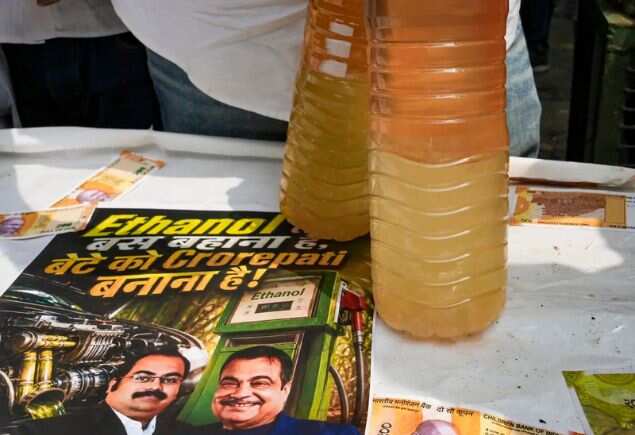
Containers displayed as purported fuel samples are seen during an Indian Youth Congress (IYC) protest against E20 fuel policy (PTI)
Lack of jobs
India’s job crisis is particularly acute among its growing pool of educated young people. According to the State of Working India 2026 report, the number of young graduates rose nearly 13-fold from about 5 million in 1983 to 63 million in 2023, but graduate unemployment among those below 25 remains close to 40%. The number of unemployed graduates has also surged 16-fold, from less than 1 million to around 11 million over the same period. Government data points to continued pressure: youth unemployment among 15-29-year-olds reached 16.2% in June 2026, even as their labour force participation rate fell to 40.3%. The figures highlight a widening gap between the number of young people entering the workforce and the availability of secure, quality jobs.Also read: Inside India’s broken jobs market and why the ‘cockroaches’ are fed upAnger has also been growing over the increasing tax burden on common people. “As the finance minister, Nirmala Sitharaman is not giving enough tax benefits to salaried people. Under the old tax regime, at least people could save money and also save on taxes. Now, neither are we able to save, nor are we getting tax benefits,” said Rajput.
Anti-reservation movement
Reservation Hatao Andolan (RHA) recently gained nearly 6 million followers on Instagram. “Backed by citizens who feel left behind by reservation politics and driven by merit. The brave earn respect through their character and perseverance. Only the cowardly and the cruel keep shouting about caste,” the Insta bio of the page reads.The page was formed in October last year and the first post was made in March this year. Since the CJP protest, the account became more active.
” msid=”133053603″ width title=”RHA’s Insta page has gained significant followers” placeholdersrc=”https://static.toiimg.com/photo/83033472.cms” imgsize resizemode=”4″ offsetvertical=”0″ placeholdermsid=”47529300″ type=”thumb” src=”https://static.toiimg.com/photo/83033472.cms” class data-src=”https://static.toiimg.com/photo/msid-133053603/rhabr.jpg” data-api-prerender=”true”>
RHA’s Insta page has gained significant followers
But quota has been a divisive issue in India. Unlike the paper-leak issue, which is an offence and affects students across categories, reservation is a constitutional policy rooted in questions of representation, historical disadvantage and unequal access — and does not attract a unified opinion.The merit debate also gets complicated when cut-offs enter the picture. In 2023, when the NEET-PG qualifying percentile was reduced to zero for all categories amid thousands of vacant seats, candidates who had fallen below the original cut-off became eligible for admission. General-category candidates accounted for the largest share of those admitted after the reduction — over 56%, compared with 26% OBC, 11% SC and 6% ST. The skew was sharper in private colleges, where General-category candidates accounted for around 70% of those who secured clinical specialities after the cut-off was lowered. The data does not suggest that General-category candidates were given a special concession; rather, it shows that they formed the largest share of those who benefited from the relaxation.Caste-based reservation in education has been part of India’s affirmative-action framework for decades. Before independence, several rulers and institutions had experimented with measures to uplift historically disadvantaged communities. After independence, the Constitution formally provided for reservation for Scheduled Castes and Scheduled Tribes, which was later expanded to other backward classes and, in a different form, economically weaker sections.Those advocating against the existing quota system argue that it compromises merit and should be replaced or reworked around economic disadvantage.
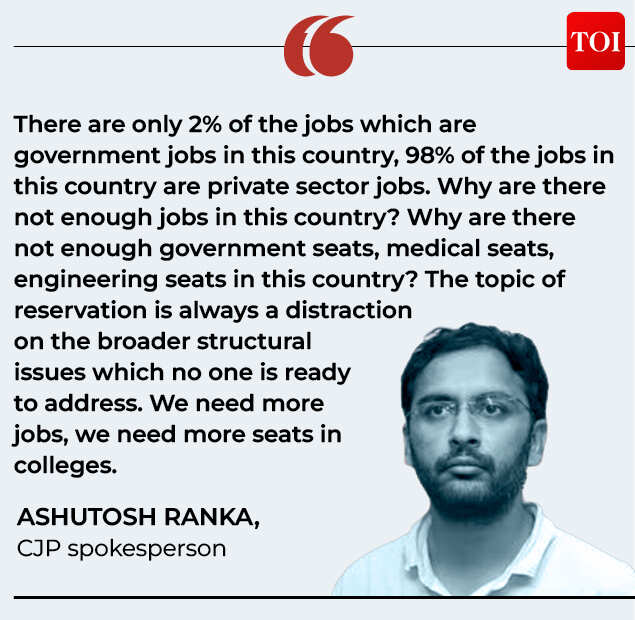
CJP’s spokesperson Ashutosh Ranka brings focus on lack of jobs
RHA has posted five broad demands:Income-based reservation: Under this, they demand that the reservation should purely be based on the income.One family, one reservation, one time: Under this, it demands that once a family has benefited from reservation, the next generation should compete on merit.Minimum standards for everyone: Under this, it demands that every exam should have minimum qualifying marks within 10-20% of the higher quota cut-off. If reserved seats fall vacant, it wants them allotted to the General category.No reservation politics: Under this, it demands:
- Political parties be barred from promising new or higher reservation quotas during elections.
- The 50% limit on caste-based reservation should not be breached.
The sunset clause: Under this, it demands that no policy should run forever.
- Set a time-bound roadmap to improve government schools, teachers and educational infrastructure.
- As educational inequality reduces, reservation should be gradually phased out.
- Reservation should be reviewed every 10 years using updated socio-economic data.
- Reservation lists should be updated periodically, moving communities that have progressed to the General category.
CJP spokesperson Ashutosh Ranka, however, believes the reservation debate itself risks taking attention away from a larger problem: the shortage of opportunities.“I think the reservation-hatao movement, I just don’t get the idea,” Ranka said. “The focus every time the debate is brought on reservation, that really means that people, there is a distraction from the broader issue.”For Ranka, that broader issue is jobs and seats. “There are only 2% of the jobs which are government jobs in this country, 98% of the jobs in this country are private sector jobs,” he said. “Why are there not enough jobs in this country? Why are there not enough government seats, medical seats, engineering seats in this country?”“Reservation, the topic of reservation is always a distraction on the broader structural issues which no one is ready to address. We need more jobs, we need more seats in colleges. That’s what people should be asking,” he said.Others, however, see reservation itself as the issue that needs to be challenged.The matter has gained even more attention after the UGC rules. The UGC equity regulations have also become a potential flashpoint, with the 2026 rules aimed at addressing discrimination in higher education.
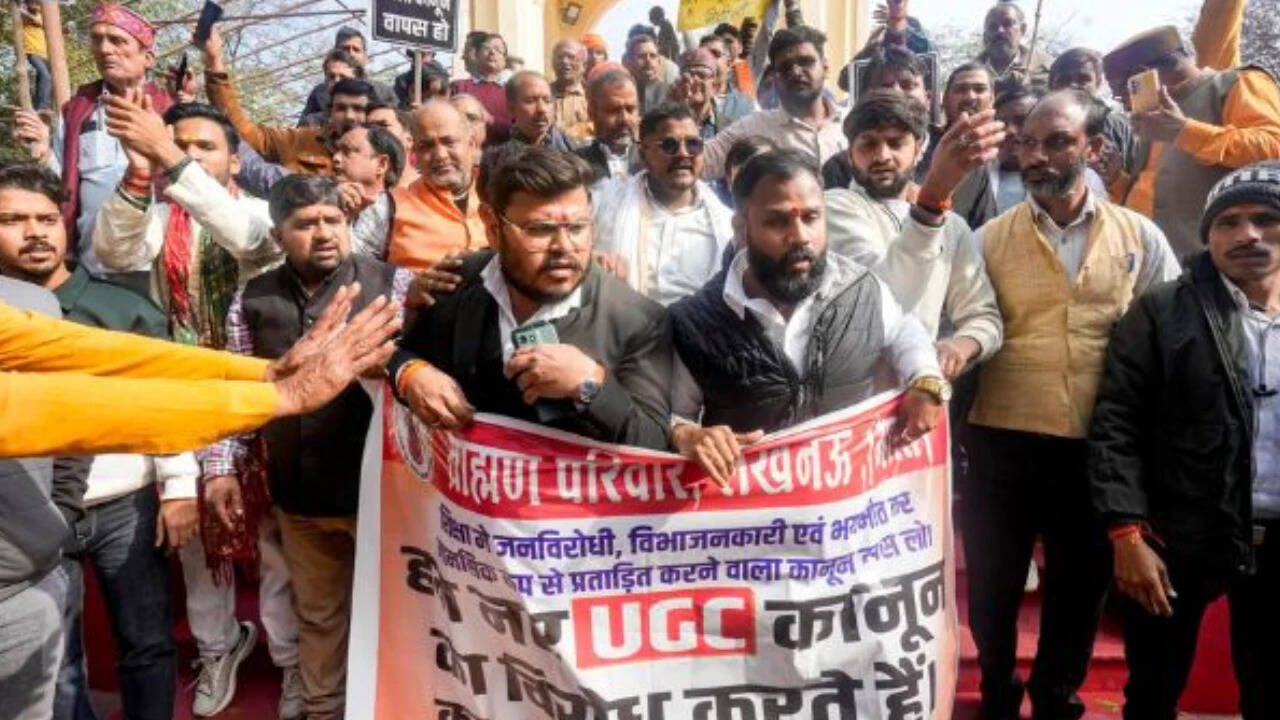
Members of Swarn Samaj and Brahman Parivar stage a protest against the UGC’s new caste-based equity rules at Hazratganj, in Lucknow, Uttar Pradesh in January (PTI)
The Supreme Court stayed the regulations in January, citing ambiguities and the possibility of misuse, but the issue has resurfaced amid growing anti-reservation sentiment online and could emerge as another potential trigger for youth mobilisation.But whether online traction can become a street movement remains an open question.Rajput said his brother sent him the Reservation Hatao Andolan page on Instagram and he started following it only last week. He said there were 21 people on his team with eight or nine belonging to the General category while the others benefited from reservation.For Rajput, however, the online movement has not yet translated into a willingness to protest on the ground. That distinction could prove crucial. After all, CJP’s success was not simply about getting people to watch, like or share.But there is a counter-argument to the idea that reservation could become the next universal youth cause. Many SC/ST communities and other socially disadvantaged groups still lack equal access to quality education, particularly in rural areas where caste-based discrimination and social inequalities continue.So, unlike the paper-leak issue, where the grievance could unite students across categories, an anti-reservation movement begins with a built-in fault line.It may have the followers. It may have the slogans. It may even have people ready to take the fight to the streets. But whether it can replicate CJP’s cross-sectional appeal is another question altogether.
Pollution
Diwali is just a couple of months away. And, as predictable as the festival itself, the annual debate will return: to burn or not to burn crackers.But for Delhi-NCR, pollution is not just a seasonal social-media debate. When the air turns toxic, the Graded Response Action Plan (GRAP) kicks in, bringing curbs that can affect everything from construction and traffic to office timings and schools. A study by IITM-Pune and CAQM found that without GRAP, Delhi could see 60% more severe-AQI hours, while the measures could reduce PM2.5 levels by up to 42 µg/m³, depending on the stage.
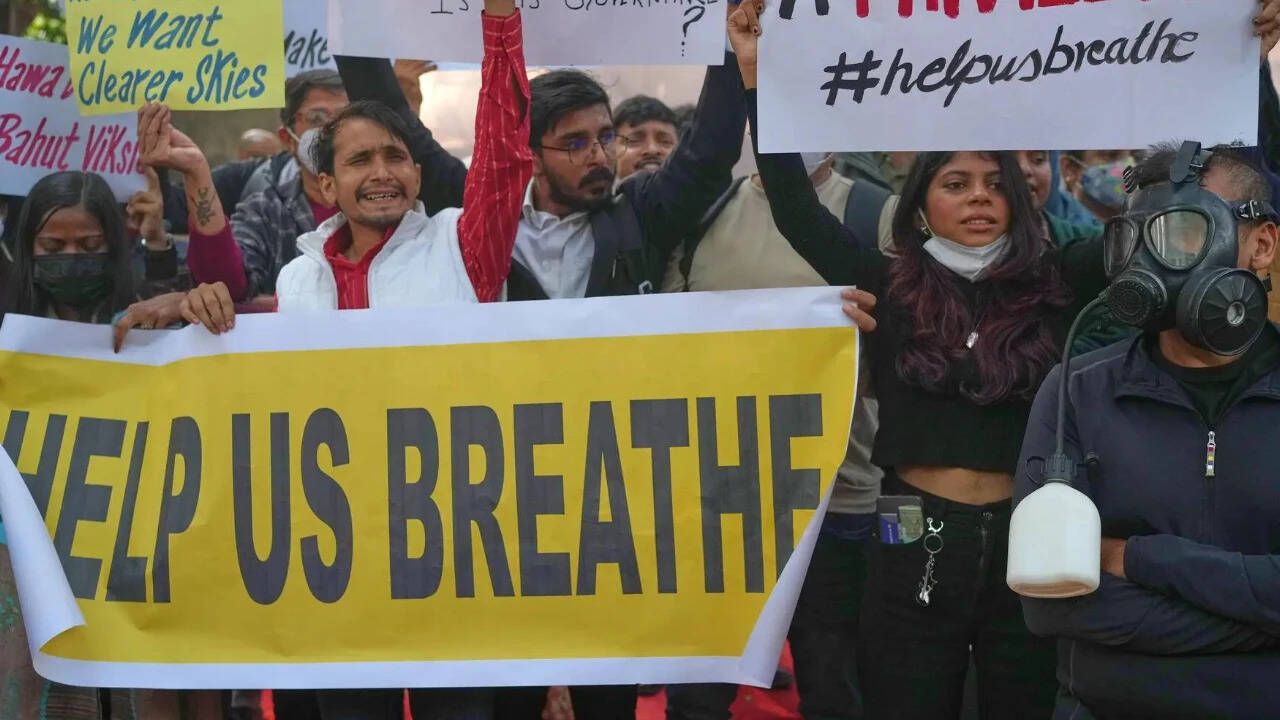
Anti-pollution protest: Protesters last year showing posters of Maoist commander Madvi Hidma, who was killed in an encounter (PTI)
In Mumbai too, pollution has emerged as a growing urban challenge, with construction and road dust, vehicle emissions and industrial activity among the key contributors to poor air quality. Pollution spikes have become a recurring concern, with several parts of the city recording AQI levels above 200, raising concerns over prolonged exposure to harmful particulate matter such as PM2.5. The problem adds to the wider challenges of rapid urbanisation, infrastructure growth and increasing vehicular traffic in the city.So, could pollution become the next rallying point, or is an issue with no single villain simply too difficult to turn into a movement? “If there is a protest over pollution, I’ll go for that too. I think we can raise our voice over issues that directly affect us. I would even join a protest over taxes,” said Rajput.The logic is simple: if an issue hits your lungs, your wallet or your everyday life, it may be easier to turn outrage into action.
So, what actually makes people protest?
For Ratna Singh, CJP’s legal head, the answer isn’t simply the issue itself. It is how that issue is packaged, communicated and mobilised.She believes CJP gained momentum because it was a Gen Z protest around education — an issue that extends well beyond NEET aspirants to competitive-exam candidates, school and college students, graduates and young people looking for jobs.Education, she said, allowed both Gen Z and Gen Alpha — and even their parents — to relate to the movement. “A lot of people in the crowd, when they were coming, they were like, you know, my parents were not letting me be here. But now I’m here. So they’re also supporting,” Singh said.And then comes the part that may matter most for the next protest. “Something can trend on Instagram, but on ground, how you are planning it, how you are strategising it, that’s also important,” Singh said.She added that people may relate to an issue online but still not turn up physically. How organisers convey the importance of an issue — and how they plan to keep an agitation going — can determine whether it survives beyond a social-media trend.
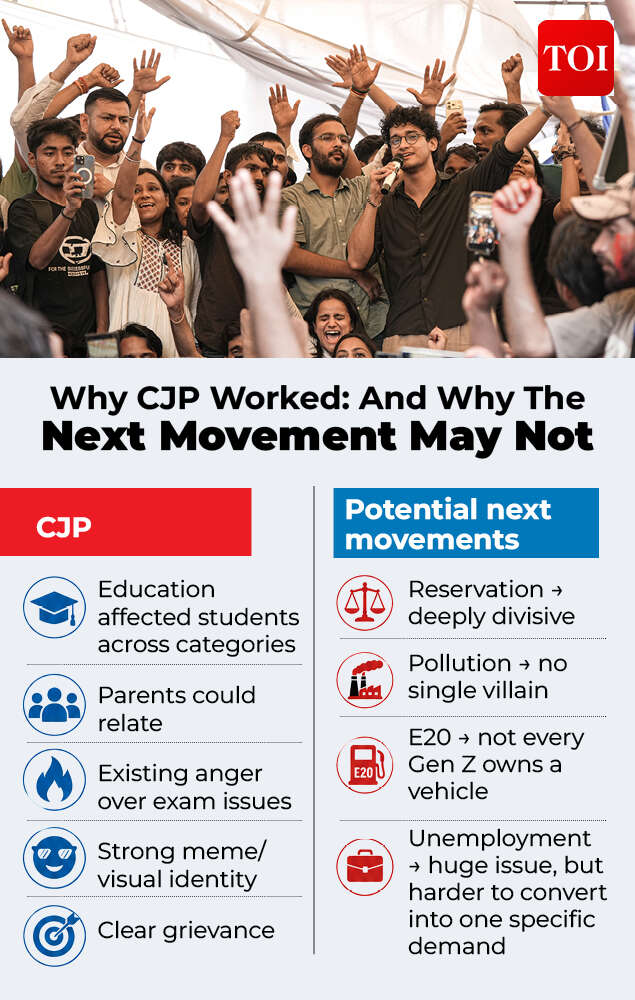
Why CJP clicked with India’s youth: Anger, accessibility and a platform to be heard
That is perhaps the biggest lesson from CJP.Going viral can get an issue noticed. Mobilising people can turn it into a movement.
Join conversation
Share your thoughts in the comments
Be respectful · TOI community guidelines
Singh believes unemployment could be the next major youth issue. CJP is planning a nationwide “Kya Bolti Public” campaign in September to hear from young people across states about the problems they face.She said the organisation wants unemployment and education to become a more central part of the public conversation and wants to understand youth concerns and push for reforms. “With the success of Cockroach Janata Party, this wave has started, where people will come forward, people will talk about issues, people will also talk about unemployment and youth-related, youth-centric issues,” Singh said.Reservation has the Instagram audience. Pollution has the lived experience. E20 has the everyday grievance. Unemployment has the scale. But whichever issue wins the race will need to clear one final hurdle. It has to make people look up from their screens — and then actually leave them.

Leave a Reply