
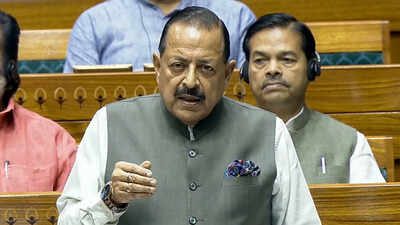
NEW DELHI: Twenty active Indian satellites in low earth orbit (less than 2,000 km altitude) out of a total of 22 active satellites are at higher risk of collision due to denser space object population in this region, space minister Jitendra Singh informed Lok Sabha Wednesday.Isro executed 20 collision avoidance manoeuvres (CAMs) in 2025 and till date nine such manoeuvres have been conducted in the year 2026, he said in a written reply.India is an active participant in international cooperation frameworks on space debris management, such as Inter-Agency Debris Coordination Committee (IADC), UN Working Group on Long Term Sustainability (UN-LTS), Expert Group of Space Situational Awareness (SSA), International Academy of Astronautics (IAA) Space Traffic Management (STM) Working Group (WG), International Astronautical Federation (IAF) space debris WG, which are involved in technical and policy-related deliberations for space debris mitigation, he said.Isro has contributed substantially to the revised IADC space debris mitigation guidelines and provided inputs based on technical studies. As part of the commitment to mitigate space debris, India’s intent for debris-free space mission (DFSM) initiative was announced in 2024. Isro aims to achieve the goal of zero debris by all Indian actors, government as well as private, in the future, LS was informed. Currently, the multi-object tracking radar (MOTR) at Sriharikota is capable of tracking large objects in low earth orbit and has been utilised to track objects. The upcoming optical telescope at Hanle (Ladakh) under Network for Space Object Tracking and Analysis (Netra) project is nearing completion and will be capable of tracking objects of size 30 cm or bigger at GEO altitude, Jitendra Singh said in LS.Gaganyaan Mission:In a separate reply on Gaganyaan, the minister said, “The first uncrewed experimental mission to validate various technologies that are being developed for the first time including Vyommitra half-humanoid is targeted in Q4 of 2026. Further, two uncrewed missions in identical configuration of the first crewed mission and the first crewed mission are targeted by 2027.”India’s Space Station:The minister said, “Operationalisation of Bharatiya Antariksh Station (BAS) is targeted by 2035. Isro has worked out the overall configuration of BAS comprising five modules. Government has approved the development and launch of the 1st module of BAS-01. Overall system engineering of BAS-01 module and technology development activities of various subsystems are progressing in Isro centres. The budgetary allocation of Rs 20,193 crore towards accomplishment of eight missions was approved by Cabinet in Sept 2024.”Isro collaboration with various space agencies:Network operations support for Gaganyaan missions is being enabled through collaboration with European Space Agency (ESA). Through an implementing arrangement with Australian Space Agency (ASA), cooperation on crew and crew module recovery for Gaganyaan missions is being pursued. Isro’s collaboration with French National Space Agency (CNES) has enabled training of flight surgeons and ground support teams in CNES/European facilities. Further, Isro and State Space Corporation Roscosmos of Russia entered into an MoU for joint activities in Human Spaceflight Programme. This has enabled contracts for delivery of subsystems such as crew seat, viewport, flight suits, wind tunnel testing as well as generic space flight training of the first batch of Gaganyatris in Gagarin Cosmonaut Training Centre.

Leave a Reply