
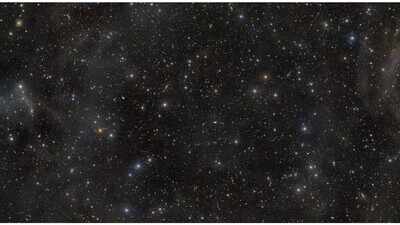
Astronomers have just got their clearest look yet at one of the most studied patches of sky in the world. The Vera C. Rubin Observatory, based in Chile, has released a single stacked image containing more than 500,000 galaxies and over 50,000 stars, captured using the largest digital camera ever built. Here’s all the information on how the photo has been captured and the significance of this cosmic milestone.
How the image was made
The image comes from Rubin’s 3.2-gigapixel (3.2-billion-pixel) LSST Camera, mounted on the observatory’s 8.4-meter Simonyi Survey Telescope. Instead of a single snapshot, the photograph was built by stacking hundreds of individual images on top of each other, layering exposure over exposure until faint, distant light became visible.The result is a single frame which is packed with spiral galaxies with arms, smooth elliptical galaxies, galaxies caught mid-collision and faint red galaxies from the far reaches of the early universe. Only a small number of bright stars from our own Milky Way sit in the foreground, which is actually part of what makes the image so striking.Rubin Observatory is a joint project funded by the US National Science Foundation and the US Department of Energy’s Office of Science.
Why astronomers keep returning to this exact patch of sky
The region captured in this image is known as the COSMOS field. Astronomers have been studying it for more than two decades, starting with observations from the Hubble Space Telescope back in 2003. Since then, researchers have pointed many of the world’s most powerful telescopes at the same patch of sky, gathering data across everything from radio waves to X-rays.What makes COSMOS so useful is its location. It sits away from the crowded plane of our own galaxy, meaning there’s less interference from nearby stars, and dust clouds blocking the view. That gives telescopes an unusually clean line of sight to enormous numbers of distant galaxies. Scientists say that some are so far away that their light has been travelling toward Earth for billions of years. As looking farther into space is also accepted as a means of looking further back in time, this field lets scientists study galaxies at many different points in the universe’s history, essentially within one continuous dataset.
What Rubin adds to the picture
Rubin’s contribution to this field is a mix of depth, wide coverage and repetition. By photographing COSMOS again and again over time, the observatory builds a dynamic record of how the sky itself changes. That’s a key part of Rubin’s broader mission: a ten-year survey called the Legacy Survey of Space and Time, or LSST, designed to create the most detailed, continuously updated record of the universe ever attempted.Due to its scientific importance, future observations are expected to reveal fainter galaxies and sharper details than what’s visible today.Further, this image marks Rubin’s Early Data Preview 2, or EDP2 — the observatory’s first data release built specifically from LSST Camera observations. It combines science validation data collected between April 2025 and January 2026, and covers roughly 3,000 square degrees of night sky, or about one-sixth of the entire visible Southern Hemisphere.Bob Blum, Director of Rubin Observatory at NSF NOIRLab, said the COSMOS image marks just the beginning of what the field will offer. He said that repeated visits to the region over the coming years are expected to uncover large numbers of short-lived cosmic events, such as supernovae, that scientists can follow up on and study in detail.

Leave a Reply