
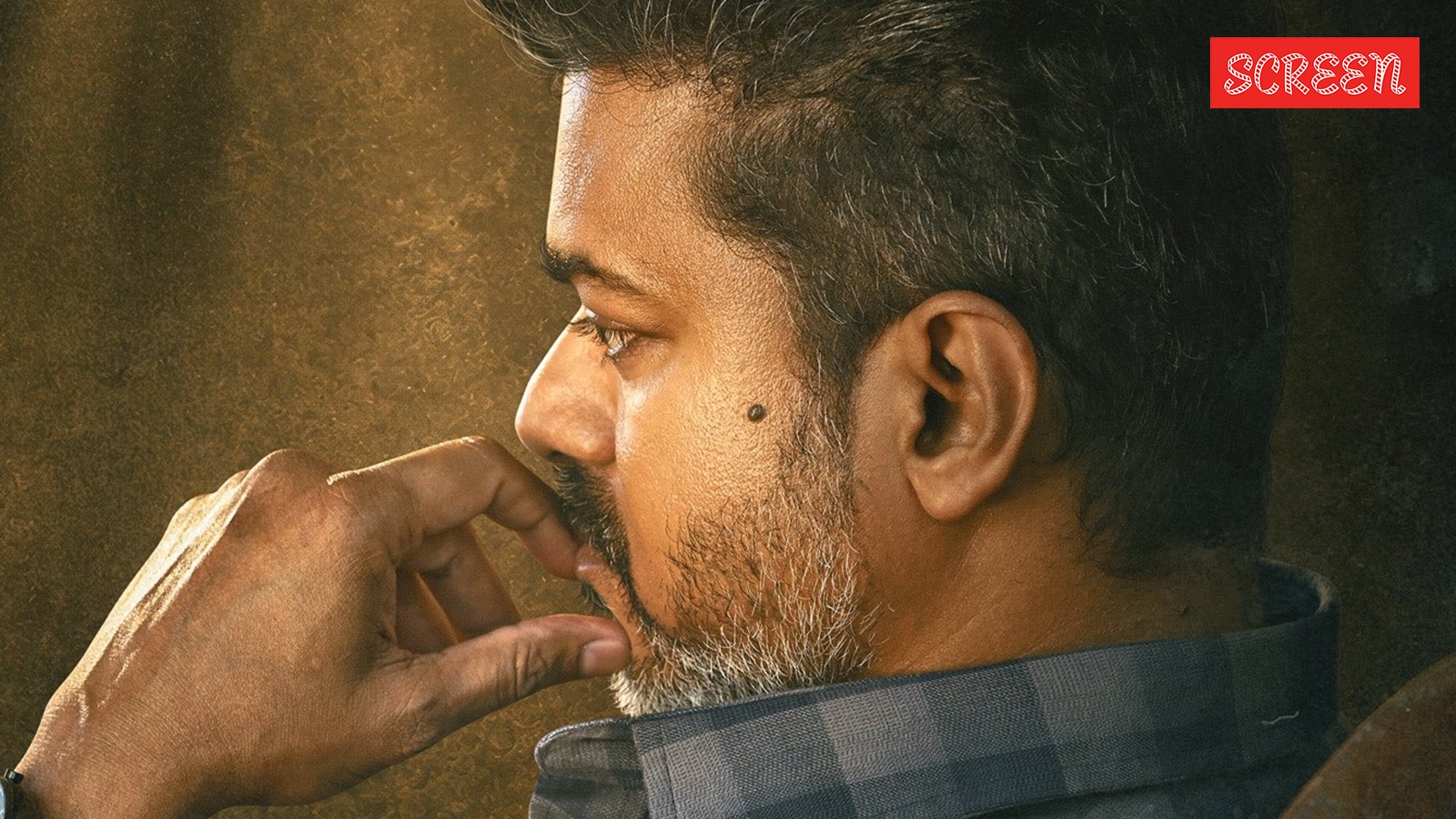
There is a scene where Bobby Deol in Jana Nayagan commands an army in a fictional African civil war. Drones fill the sky above a burning city. Robots engage human soldiers on a dusty battlefield. Explosions light up the frame every few seconds. And none of it looks real. That’s exactly where everything went wrong with Jana Nayagan.
Hear me out: when I say it doesn’t look real, it is not in the way that big-budget action films sometimes stretch believability for the sake of spectacle. It looks fake in the way that a student project looks fake, where the gap between what the filmmakers intended and what ended up on screen is so wide that you stop watching the story and start wondering what went wrong in the production pipeline. That scene sets the norm for the film’s entire second half, where AI-generated crowds, AI-rendered environments and AI-enhanced versions of the lead actors dominate the screen in a way that has turned the film’s visual quality into the single most discussed aspect of its release.
Nobody expected Vijay’s last film to look cheap. Not the fans who waited six months through a censor battle, a court case and a nationwide leak. Not the trade analysts who projected a Rs 100 crore opening day. Not the critics who walked into theatres on July 23 ready to judge the story and the performances. But cheap is exactly what Jana Nayagan looks like for large stretches of its second half.
The first half of Jana Nayagan works because it is real
To understand how badly the second half of Jana Nayagan fails visually, you have to first acknowledge that the first half does not have this problem. The opening stretch of the Vijay film, which broadly follows the emotional template of Anil Ravipudi’s Bhagavanth Kesari, is shot conventionally. Vijay is introduced as a prisoner, and it begins with a jail action sequence that establishes his physicality. The father-daughter dynamic between Vijay’s Thalapathy Vetri Kondan and Mamitha Baiju’s Vijayalakshmi is built through scenes that are shot on real locations with real lighting and real actors occupying real space.
There is no denying that there were small signs of what is coming in the film as it progresses. A background that looks a little too smooth here. An establishing shot of a city that has that unmistakable AI sheen, where the buildings are too clean and the sky is too perfect and the whole thing looks like a travel brochure rather than a place where people actually live. But these are easy to overlook because the story is holding your attention. You are watching a film that, whatever its narrative shortcomings, at least looks like a film.
The second half and the Swasnia problem
The second half of Jana Nayagan is where director H Vinoth departs most significantly from the Bhagavanth Kesari source material. By his own admission, only about 20 percent of the Telugu original’s second half survives in the Tamil version. The rest is Vinoth’s own creation, a political thriller about a villain named Phoenix, played by Bobby Deol, who wants to destabilise Indian democracy through fear, weaponised technology and modern warfare. The ambition is enormous but sadly, the execution is a disaster.
Also Read: Jana Nayagan: Vijay’s propaganda film makes even Sura and Villu look like masterpieces
Story continues below this ad
Phoenix’s backstory is told through a series of flashbacks and exposition sequences that are built almost entirely on AI-generated imagery. His origin involves civil wars in Africa, specifically in a fictional country called the Republic of Swasnia. There are sequences showing Phoenix commanding armies and drones attacking civilian populations. There are robots fighting human soldiers in urban warfare settings. All of this is rendered through AI.
Swasnia does not look like a country, worse it does not even look like a convincing fictional country. The buildings have that uncanny smoothness that AI image generators produce when they are creating architecture without proper reference material. The sky in every Swasnia shot has the same flat, painterly quality that you get when an AI tool generates a “dramatic sky” without understanding how light actually works in a real environment.
If you think this is possibly the worst thing in the film, the war sequences push you off the edge. When drones attack, the drones look like 3D models dropped onto a 2D background. When explosions go off, the fire and smoke do not interact with the environment around them. When soldiers run, some of them move at slightly different speeds than others, a telltale sign of AI-generated motion that has not been properly calibrated to a single frame rate. The robots that Phoenix deploys look like they were pulled from a mobile game, with textures so flat and lighting so inconsistent that they never once feel like they occupy the same physical space as the human actors in the scene.
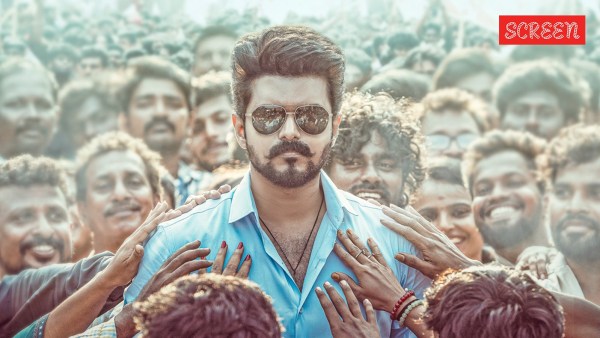 Vijay in a still from his swansong Jana Nayagan, directed by H Vinoth
The AI MGR
Jana Nayagan is loaded with MGR references, and while alliteration and symbolism are fair game in a political action drama, what the film does with them crosses the line from homage into something unintentionally absurd. There is one shot in particular that stayed with me long after the film ended, and not for the right reasons. In the flashback, Vijay’s character moves to punish Prakash Raj. The camera suddenly pans to a portrait of MGR hanging on the wall. The portrait comes alive, and it is a sudden jumpscare. MGR, generated through AI, begins to move and speak from within the frame. He drops a whip into Vijay’s hands, signalling him to use it against the corrupt. The intention is clear: the spirit of MGR is blessing Vijay’s fight against evil. The execution, however, is closer to a horror film than a political statement.
Story continues below this ad
The actors themselves
This is perhaps the most troubling element. In at least a handful of shots, the lead actors appear to have been digitally altered through AI tools. Whether this was a deliberate creative choice, or simply a byproduct of the post-production pipeline is unclear. But it is visible because once you see it, you cannot unsee it.
There are also moments where Vijay’s own face appears slightly off in the VFX-heavy sequences. The skin tone shifts between cuts. The lighting on his face does not match the lighting of the environment behind him. In the scenes shot on real locations, Vijay looks like Vijay. In the AI-rendered environments, he looks like he has been composited into a world that was built separately from him.
What it means for the industry
Jana Nayagan is not the first Indian film to use AI in its production pipeline. There are possibly many films that used AI-assisted tools for background enhancement and crowd replication. But Jana Nayagan is the first major Indian film where the AI usage is so extensive and so visible that it has become the defining criticism of the entire project. It is no longer a background conversation about efficiency and cost-saving. It is the first thing people mention when they talk about the film. For an industry that is watching AI tools evolve rapidly and considering how to integrate them into its own workflows, Jana Nayagan is a cautionary tale in real time.
The technology itself is not the villain here. AI-generated imagery will improve and eventually these tools will get better. The outputs will become more convincing. In five years, it’s entirely possible that the kind of work Jana Nayagan attempted will be achievable at a level where audiences can’t distinguish it from conventional VFX. But that future isn’t here yet. The technology simply wasn’t ready for what Jana Nayagan asked it to do, and a film that embraces tools before they’re ready ultimately feels reckless.
Story continues below this ad
Also Read: Leaked, delayed, censored and still selling out: The curious case of Jana Nayagan
There is also a labour question embedded in this conversation that the industry has been reluctant to address. If AI is being used to replace human VFX artists, crowd extras, background actors and set designers, the cost savings do not just come from efficiency. They come from people losing work. The VFX industry in India employs thousands of artists across studios in Chennai, Hyderabad, Mumbai and Bangalore. If a reported Rs 500 crore production can use AI to bypass that workforce and still deliver a product that audiences will pay to see, the incentive for other productions to do the same becomes obvious. The movie goes beyond the conversation on what happens when the industry decides that “good enough” is good enough, and the people who used to do that work are no longer needed.
The farewell that did not look the part
Vijay has been on screen for 30 years. He has given Tamil cinema Ghilli, Thuppakki, Mersal, Bigil, Master, Leo and dozens of other films that filled theatres and defined eras. His fans have followed him through hit after hit, through controversies and political transitions, through a career that has been as much a cultural force as a commercial one. When he announced that Jana Nayagan would be his last film, the expectation was not just that it would be a good film. The expectation was that it would look like a Rs 500 crore farewell to one of the biggest stars Indian cinema has ever produced.
Sadly, for every Vijay’s film, the audience cared. And for Vijay’s last film, caring was not just about the story or the performances or the politics. It was about whether the film looked like it respected the occasion. Jana Nayagan, for all its ambition, money and good intentions, did not look like it respected the occasion. Not in the second half, or where it mattered most.
Story continues below this ad
A farewell should be the best version of everything a star represents. Jana Nayagan’s second half is the worst version of what AI currently produces. And the distance between those two things is the distance between the film Vijay deserved and the film he got.

Leave a Reply