
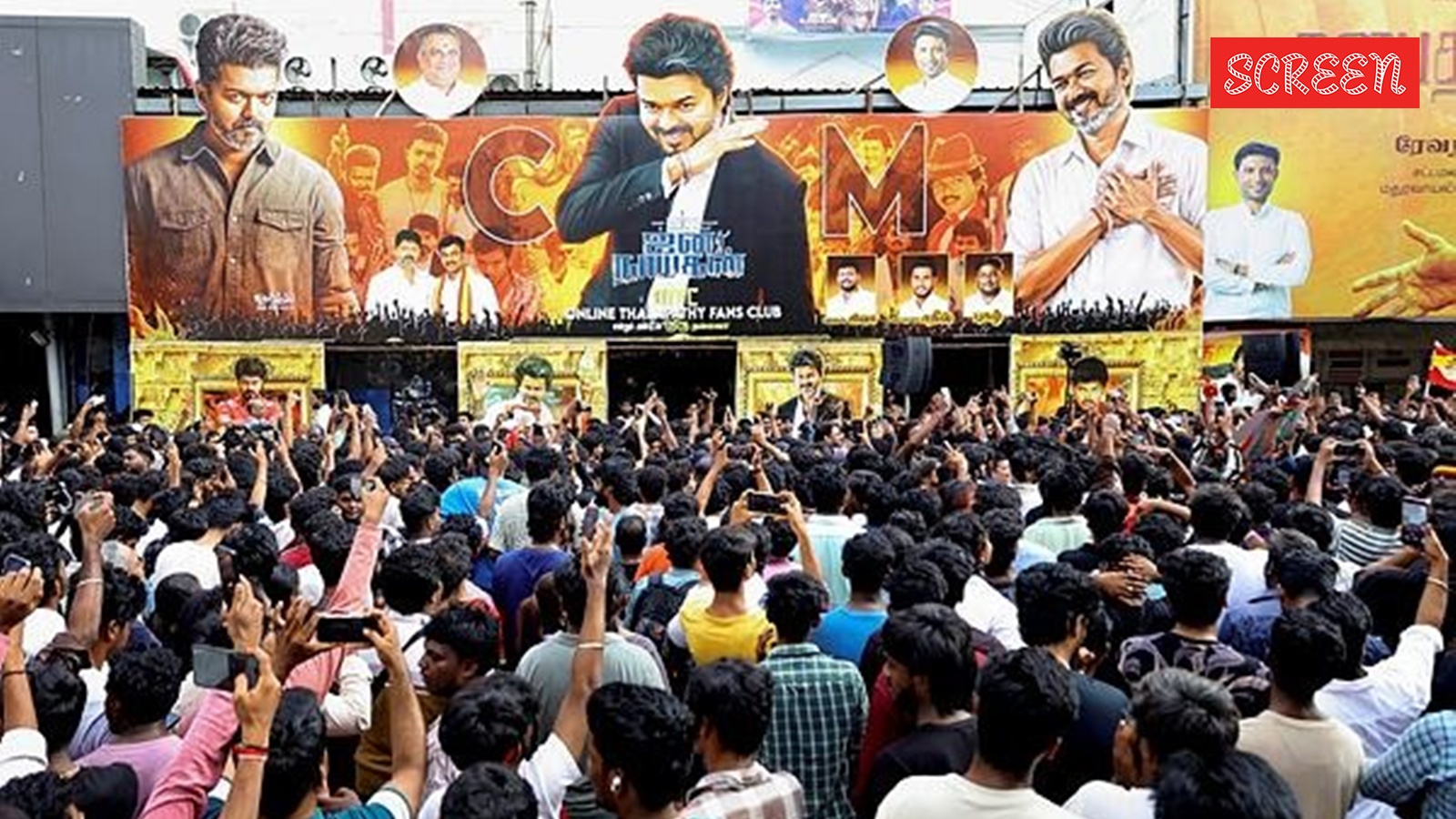
Tamil superstar films have never really been about plots. They are carefully orchestrated public festivals where cinema merely provides the excuse. The screenplay is often only the rope holding together fireworks, punchy dialogues, songs, nostalgia and collective emotion.
Jana Nayagan understands that better than most. The audience inside a packed Chennai theatre on Friday morning – the first day-first show (FDFS) – was not simply watching Vijay’s final film. They were watching their Chief Minister dance, lecture, campaign, comfort grieving families, attack corruption, defend secularism and eventually walk into a fictional Secretariat – while several members of his real Cabinet quietly appeared alongside him.
That alone makes Jana Nayagan unlike anything Indian cinema has seen. The story itself races through prisons, civil wars in fictional Swasnia in Africa, international arms syndicates, terrorism, communal violence, corrupt politicians and psychological trauma. It is gloriously overstuffed.
Yet nobody inside the theatre seemed worried about where the story was heading. They were waiting for the next arrival. The next “blast”, as Vijay’s character himself says in it. The first cheer erupted before Vijay even appeared. His character’s name flashed on screen: “Thalapathy Vetri Kondan.” The theatre shook.
The opening establishes Vijay as something softer than the invincible action hero Tamil cinema often celebrates. He fulfils his dying mother’s last wish inside prison. He comforts a traumatised child, a daughter of his prison officer, before release. He becomes the affectionate uncle, or Sithappa, who quietly shapes a frightened girl’s life after her father dies.
That girl, played by Mamitha Baiju, begins the film paralysed by panic attacks after witnessing horrific violence. Vijay refuses to let fear define her. He repeatedly insists that women should not merely be protected but should grow “like tigers.”
By the climax, Mamitha is no longer the frightened child. She owns one of the film’s fiercest combat sequences herself. It is less a rescue story than an argument that courage can be taught. One of the cleverest political jokes arrives with something as ordinary as a roadside peanut plant.
Story continues below this ad
A convoy stops. An aide casually uproots a peanut plant for the senior politician. The senior politician immediately asks him to plant it back after taking peanuts. The puzzled aide asks why.
The answer comes almost philosophically. Nobody will notice if a few peanuts disappear, but if the plant is not planted back, people will notice. The aide laughs. “If you have such brilliant ideas for corruption, why haven’t you become Chief Minister for ten years?” The politician smiles. “People aren’t revolutionary enough to elect us.”
The screenplay repeatedly slips such political satire between explosions. Later, the principal political villain proudly explains why he believes power naturally belongs to him. “My grandfather was in politics. My father was in politics. Now I am.” The statement lands like a manifesto for hereditary politics itself. The audience understood the target long before the dialogue ended.
Reality repeatedly leaks into fiction. Anirudh Ravichander appears inside a celebratory song. The campaign anthem unfolds amid enormous crowds waving Vijay flags. Then come the surprises.
Story continues below this ad
Water Resources Minister and TVK General Secretary Bussy Anand, the man widely credited with building Vijay’s fan movement into a statewide political organisation, appears in perhaps the film’s most quietly political sequence.
Communal violence has engulfed Tamil Nadu. An armed Hindu mob advances towards a mosque. Instead of joining the attack, Bussy Anand leads the Hindu group that physically shields the mosque from the mob. When the violence subsides, Vijay simply says, “Athanda Tamil Nadu (that is Tamil Nadu).”
Few lines received louder applause. Another Cabinet colleague, Arunraj, also briefly appears during the campaign montage, ceremonially handing Vijay a sword before a massive public rally.
Near the end, three of Tamil cinema’s biggest commercial filmmakers – Atlee, Nelson Dilipkumar and Lokesh Kanagaraj – appear as journalists asking questions to Vijay inside the Secretariat. For a few minutes, Tamil cinema seems to salute the man leaving it.
Story continues below this ad
The movie is even more political. A hooch tragedy followed by police firing unmistakably evokes memories of some of Tamil Nadu’s darkest public tragedies. A grieving woman refuses to leave the Kannagi statue after losing her family. The state burns. A corrupt district strongman openly boasts that governments survive because politicians, not officers, control power.
When Vijay finally appears in a police uniform, the whistles become deafening. The film then delivers one political set-piece after another. During a phone conversation, Vijay casually signals with his fingers that his opponent is “finished”. The gesture immediately reminded the audience of one frequently associated with M K Stalin. Someone shouted “Kolathur” – the constituency that defeated former CM Stalin himself.
Moments later comes perhaps the morning’s most delirious sequence. Under a smiling portrait of M G Ramachandran, Vijay publicly humiliates the corrupt politician. As “Naan Aanaiyittaal” begins playing, MGR’s portrait appears almost to bless the moment. A whip becomes the symbol of justice. It falls from the portrait. Hundreds of viewers abandoned their seats to dance in front of the screen.
The movie also imagines Tamil Nadu collapsing into organised communal violence engineered through fake narratives, IT war rooms and weapons smuggled inside imported toys. The villain repeatedly insists ordinary voters are fools. Vijay rejects the premise. “Some people may vote for the wrong people,” he replies. “But we must change that.”
Santhosa Padratha illa varuththa Padratha theriyala 🥺 any way love you na @actorvijay 🫂 forever ♾️ ni maddum than 🫀 pic.twitter.com/MvZJC0yEqf
— Sai Jegadheesh (@saijegadheeshh) July 23, 2026
Perhaps the film’s most unexpected sequence arrives not during an action scene but at a school annual day function. Instead of patriotic rhetoric, Vijay delivers a lesson on child sexual abuse. He explains “good touch” and “bad touch.” He tells children to report abuse even if it comes from relatives. He tells girls pepper spray is not enough; courage matters too. “Should beat them up,” he says. Women inside the theatre applauded loudly.
Story continues below this ad
Is Jana Nayagan a tightly written screenplay? Not particularly. Does it matter? Perhaps less than one might think. Tamil superstar films have always functioned more as public gatherings than cinematic narratives. But this one carries a historical curiosity no screenplay can manufacture.
How often does an audience watch its sitting CM dance with thousands, see members of his own Cabinet appear inside his fictional political universe, watch three of the industry’s biggest directors question him inside the Secretariat, and then walk out knowing that the man on screen will return the next morning to the real Secretariat? “Is there a change?” they asked. “We have to bring the change,” Vijay replied.
That is no ordinary farewell film. It is politics, cinema, governance and fan culture briefly sharing the same frame – projected not merely on a screen, but onto the political imagination of Tamil Nadu.

Leave a Reply