
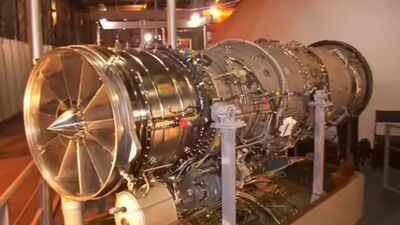
NEW DELHI: Nearly 18 years after India’s indigenous Kaveri jet engine was dropped from the Tejas fighter programme, the project is showing signs of a revival. Defence Minister Rajnath Singh‘s call for DRDO scientists to develop sixth-generation fighter engines within the next five to seven years, recent successful afterburner tests of the Kaveri engine and the government’s renewed push for self-reliance in military aviation have brought the long-delayed programme back into focus.While the original GTX-35VS Kaveri failed to meet the Indian Air Force’s requirements for the Tejas Light Combat Aircraft (LCA), the technologies developed over more than three decades are now expected to support future programmes such as the Advanced Medium Combat Aircraft (AMCA), the Ghatak stealth unmanned combat aerial vehicle and marine gas turbines.
The renewed focus comes as India continues to rely on imported General Electric engines for its frontline fighter fleet while pursuing an indigenous powerplant for next-generation combat aircraft.
Rajnath Singh sets ambitious target
During a visit to DRDO’s Gas Turbine Research Establishment (GTRE) in Bengaluru in February this year, defence minister Rajnath Singh urged scientists to compress decades of aero-engine development into a much shorter timeframe. Describing fighter engine development as one of the most technologically demanding areas of defence research, Rajnath said advanced countries typically require 25 to 30 years to develop new fighter engines.“We must assume that 20 years have already passed and we now have only 5–7 years left.”The minister also called on scientists to look beyond fifth-generation propulsion systems.
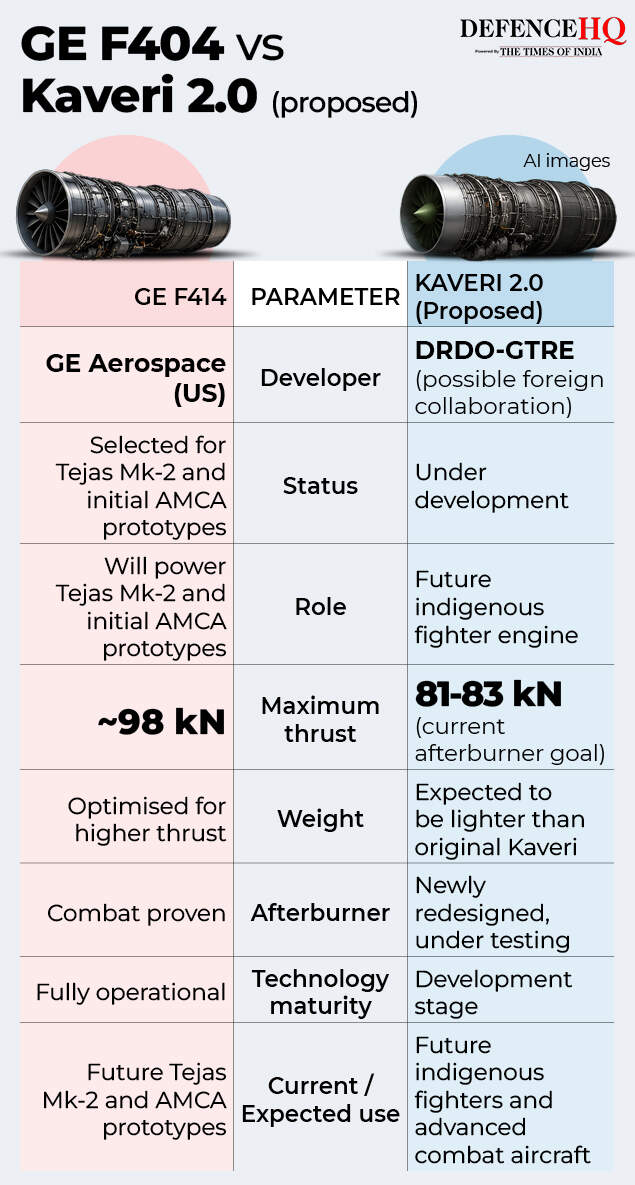
“We are rapidly moving towards the design and development of the Advanced Medium Combat Aircraft (AMCA). We have made numerous attempts in the past to achieve expertise in the field of aero engines. Now, the time has come to complete those efforts. We cannot limit ourselves to only 5th generation engines. We must begin the development of the 6th generation. Research on them is the need of the hour. The use of AI, machine learning and new materials is increasing. We must stay ahead of the curve.”During the visit, Rajnath also witnessed a successful full-afterburner test of the Kaveri engine, which used a newly designed afterburner developed with support from BrahMos Aerospace. The upgraded configuration is aimed at generating around 81-83 kilonewtons (kN) of thrust, bringing it closer to the levels required for future combat aircraft.However, experts caution that matching globally proven fighter engines involves far more than achieving a higher thrust figure.“The recent Kaveri afterburner tests are an encouraging milestone, but thrust alone does not make a modern fighter engine. A combat aircraft engine must deliver high performance consistently over thousands of flying hours while operating in some of the harshest conditions imaginable,” Srijan Pal Singh, author, former Advisor for Policy and Technology to Dr APJ Abdul Kalam, CEO of Homi Lab and Founder of Kalam Centre, told The Times of India.“The biggest challenge is achieving a higher thrust-to-weight ratio without compromising reliability. This requires advances in single-crystal turbine blades, high-temperature materials, thermal barrier coatings, precision manufacturing and efficient cooling technologies. These are the areas where only a handful of countries have mastered the required expertise.”Singh said the engine must undergo extensive endurance testing, high-altitude trials and repeated start-stop cycles, along with the development of a robust Full Authority Digital Engine Control (FADEC) system, before it can be considered comparable to mature fighter engines such as the GE F404 or GE F414.
Why the Kaveri engine was developed
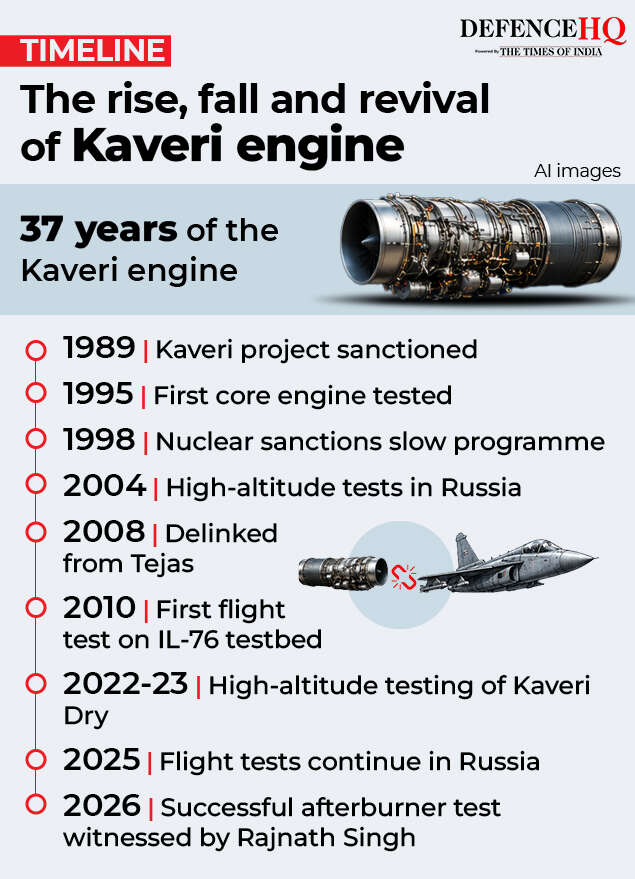
India approved the Kaveri engine programme in 1989 as part of the Light Combat Aircraft project to develop an indigenous afterburning turbofan engine for the Tejas fighter. The programme, led by DRDO’s Gas Turbine Research Establishment (GTRE) in Bengaluru, was initially sanctioned at a cost of Rs 382 crore and was expected to be completed in less than eight years.The plan was for the early Tejas prototypes to fly with imported General Electric engines before production aircraft transitioned to the indigenous Kaveri. However, the programme soon encountered technological challenges that delayed development and ultimately prevented the engine from meeting the Indian Air Force’s operational requirements.
Why Kaveri failed to power Tejas
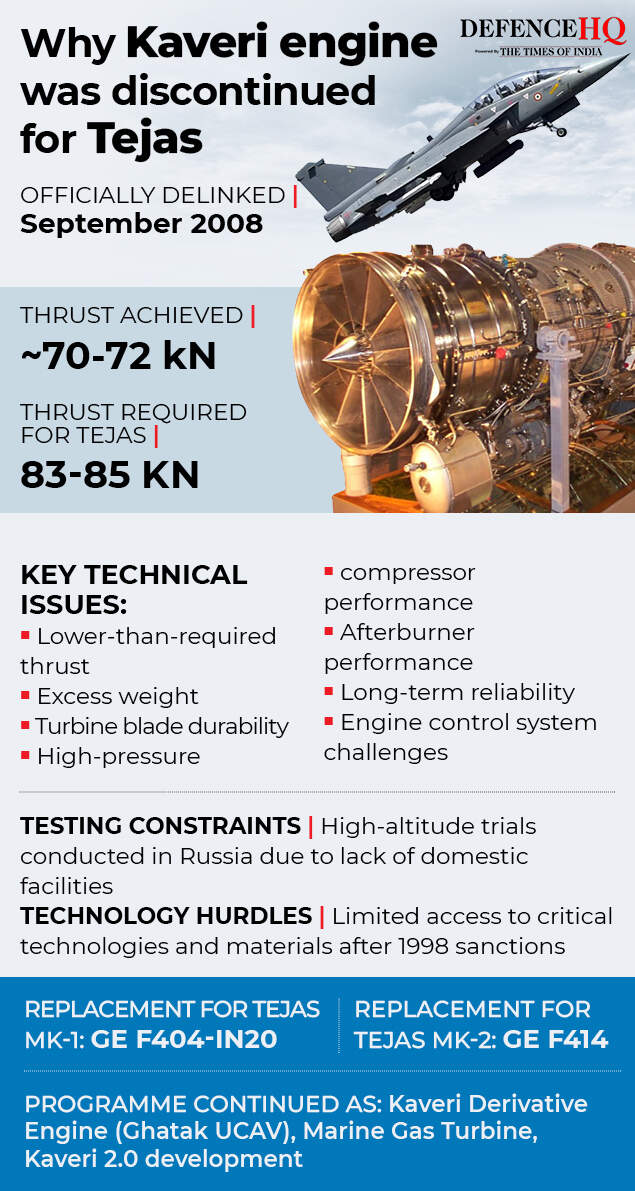
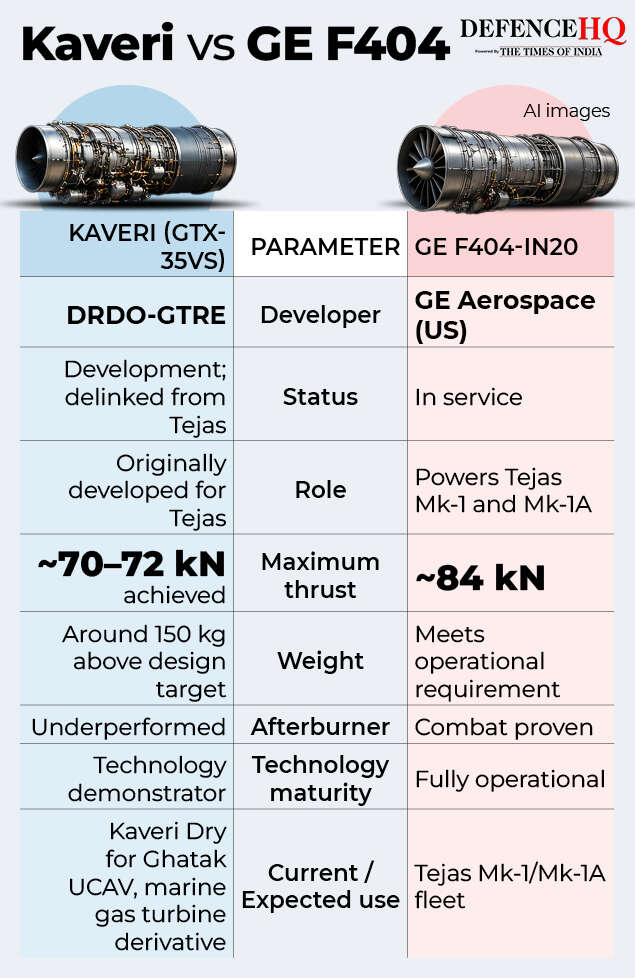
The Kaveri programme fell short of the performance needed for the Tejas. The engine produced around 70-72 kN of afterburning thrust against the 83-85 kN required by the aircraft. It also remained about 150 kg heavier than its design target and faced persistent challenges related to turbine blade durability, compressor performance, afterburner efficiency, engine control systems, reliability and high-altitude operation.Developing a modern fighter engine is widely regarded as one of the most complex technological challenges in aerospace. It requires mastery of high-temperature metallurgy, single-crystal turbine blades, advanced compressor design, precision manufacturing and sophisticated FADEC systems.The programme also faced external setbacks. International sanctions imposed after India’s 1998 nuclear tests restricted access to critical technologies, specialised materials and testing facilities. India also lacked a dedicated high-altitude engine testing facility, forcing several rounds of testing to be conducted in Russia.Successive Comptroller and Auditor General reports highlighted delays in achieving milestones, increasing development costs and technical deficiencies, including excessive engine weight and inadequate thrust. As development delays mounted, the government officially delinked the Kaveri from the Tejas programme in September 2008.Yet, Singh argues that India has closed several technological gaps since then.“India has made real progress since the original programme. Advances in engine design, computational modelling, precision manufacturing and digital engine controls have narrowed several gaps that existed two decades ago, and the dry Kaveri core has consistently delivered close to 49–51 kN in ground and altitude trials, ahead of its earlier target.”He noted that India’s defence metallurgical laboratories have demonstrated single-crystal turbine blade technology and developed domestic titanium and superalloy production capacity. However, he said the challenge now is scaling these capabilities to withstand the temperatures, stresses and production volumes demanded by fighter engines.
“The other major task is proving the engine. A fighter engine must demonstrate reliability across thousands of flying hours in diverse conditions, including flying test bed trials, before it can be cleared for service. That process cannot be shortened.”For future fifth- and sixth-generation fighters, he added, the challenge rises further, requiring engines capable of combining high thrust, low fuel consumption, low weight, long service life, supercruise and adaptive-cycle propulsion.
Kaveri’s second life
The Kaveri programme did not end with its rejection from the Tejas. Instead, it has gradually evolved into a broader indigenous aero-engine effort, with technologies developed over three decades being adapted for unmanned combat aircraft, marine propulsion and future fighter engines.One of its most advanced offshoots is the Kaveri Derivative Engine (KDE), also known as the dry Kaveri, which is being developed to power DRDO’s Ghatak stealth unmanned combat aerial vehicle. Unlike the original fighter engine, the dry variant does not use an afterburner and is designed to generate around 49-51 kN of thrust. The engine has completed altitude testing in Russia and undergone extensive ground validation.
Parallel work is also underway on an upgraded afterburning version, commonly referred to as Kaveri 2.0. The latest full-afterburner trials are aimed at increasing output to 81-83 kN, bringing the engine closer to the thrust class required for future combat aircraft.According to Singh, the revived programme should be viewed less as a restart and more as the culmination of decades of accumulated expertise.“Developing a modern fighter engine is one of the most difficult tasks in aerospace engineering, and even countries with established aviation industries have taken decades to master it.”“The original Kaveri programme did not achieve its intended objective, but it created valuable expertise in engine design, testing, materials, manufacturing and certification. Those capabilities have continued to mature through subsequent research programmes and international collaborations. As a result, the revived Kaveri effort is building on decades of accumulated knowledge rather than starting from scratch.““When India succeeds in developing a reliable, high-performance engine that meets today’s much higher standards, Kaveri 2.0 will be remembered as much more than the revival of an old programme. It will mark the point at which India mastered one of the world’s most complex defence technologies and laid the foundation for future indigenous combat aircraft.”
Why India still depends on GE engines
Despite decades of investment in indigenous engine development, India’s frontline fighter fleet continues to rely heavily on engines supplied by US aerospace major GE Aerospace. The F404 powers the Tejas Mk-1 and Mk-1A, while the F414 has been selected for the Tejas Mk-2 and the initial AMCA prototypes.Recent supply chain disruptions have highlighted the risks of this dependence. Deliveries of F404 engines for the Tejas Mk-1A were delayed by more than a year, slowing aircraft production and prompting HAL to impose contractual penalties on GE Aerospace.
Singh described an indigenous fighter engine as strategically as important as an indigenous fighter aircraft.“An indigenous fighter engine is strategically as important as an indigenous fighter aircraft. The engine is the heart of the platform. Without control over it, a country remains dependent on foreign suppliers for production, upgrades, maintenance and spare parts.”He said the delays in GE F404 deliveries had demonstrated how dependence on overseas suppliers could directly affect aircraft production and force readiness.According to Singh, an indigenous engine would also transform India’s defence exports because aircraft powered by imported engines often require export approvals from the engine supplier.
Link with the AMCA programme
The renewed momentum behind the Kaveri programme coincides with India’s plans to develop the fifth-generation Advanced Medium Combat Aircraft, a project expected to shape the future of the Indian Air Force. The government has shortlisted three private-sector consortia to partner with the Aeronautical Development Agency in building five AMCA prototypes under an initial allocation of Rs 15,000 crore.While the first prototypes are expected to fly with imported GE F414 engines, the long-term objective is to equip the fighter with an indigenous powerplant. To accelerate that effort, the government has launched the National Aero Engine Mission and opened the door for international collaboration in critical engine technologies.Singh sees India’s engine ambitions progressing along two parallel tracks.“The near-term track is Kaveri 2.0, an engine in the 80 kN class currently aimed at unmanned platforms and flying test bed validation, which is where India will build the certification experience it has never had.”“The second is the high-thrust engine in the 110–130 kN class required for later AMCA variants, now the subject of co-development negotiations with a European partner on terms that emphasise full technology transfer and Indian ownership of the intellectual property.”“On the timelines currently under discussion, that engine would see core testing around the turn of the decade, flight testing in the mid-2030s and production readiness towards the latter half of that decade. If both tracks are sustained, India can realistically expect to power its frontline combat aircraft with engines it owns and controls within the next decade, one of the biggest milestones in the country’s aerospace journey.“
Can Kaveri finally succeed?
The original Kaveri engine is unlikely to power frontline Tejas fighters after being delinked from the programme in 2008. However, what began as an engine for a single aircraft has evolved into a broader national effort to master one of the world’s most complex defence technologies.Whether India can field a fully indigenous fighter engine within the next decade remains uncertain. Yet after more than three decades of setbacks, the Kaveri programme is increasingly being viewed not as a failed Tejas engine but as the technological foundation for India’s next generation of military aero engines—and potentially one of the most significant milestones in India’s quest for aerospace self-reliance.

Leave a Reply