
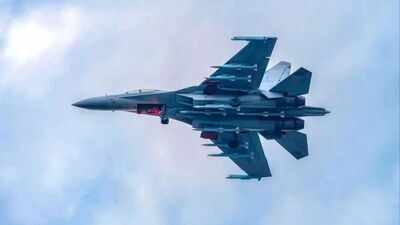
A newly surfaced image of China’s J-16 fighter jet carrying its heaviest publicly seen air-to-air weapons load has drawn the attention of military analysts, with Chinese defence experts describing the configuration as the aircraft’s “Beast Mode.“The rare loadout, featuring 8 PL-15 BVR (Beyond visual range) missiles and 2 P-10 WVR (Within visual range) missiles, is being viewed as a demonstration of the People’s Liberation Army Air Force’s (PLAAF) growing focus on maximising firepower and sustained air-combat capability.According to a recent analysis published in the Chinese military magazine Ordnance Science and Technology, the configuration represents an evolution in the J-16’s tactical role, transforming it into a high-capacity “missile truck” capable of supporting long-range aerial warfare.The Shenyang J-16 is one of the People’s Liberation Army Air Force’s (PLAAF) most advanced non-stealth combat aircraft and a cornerstone of China’s modern fighter fleet.Developed by the Shenyang Aircraft Corporation, the twin-engine, twin-seat, 4.5-generation multirole fighter is derived from the Russian Su-30MKK but incorporates extensive indigenous upgrades, including an Active Electronically Scanned Array (AESA) radar, advanced avionics, electronic warfare systems and Chinese-made WS-10 turbofan engines.According to the China aerospace studies institute (CASI), the aircraft’s combination of long range, high payload and advanced sensors enables it to undertake air dominance, ground attack, maritime strike and suppression of enemy air defence (SEAD) missions.The aircraft measures around 21 metres in length with the maximum take-off weight of about 35 tonnes. Powered by two WS-10B afterburning turbofan engines, the J-16 is capable of speeds exceeding Mach 2, with a combat radius of around 1,500 kilometres. The J-16 has 12 external hardpoints and carry up to 8 tonnes of payload on them.China has also developed the J-16D, a specialised electronic warfare (EW) and suppression of enemy air defences (SEAD) variant comparable in concept to the US navy’s EA-18G Growler.The centrepiece of the J-16’s “Beast Mode” configuration is the PL-15, China’s most advanced operational beyond-visual-range (BVR) air-to-air missile.According to the International Institute for Strategic Studies (IISS), the PL-15 has an estimated engagement range of around 200 kilometres. To achieve that range it uses dual-pulse solid-fuel rocket motor which reignites during the terminal phase of flight, providing additional energy and manoeuvrability to improve its kill probability against fast or evasive targets at long range.Complementing the PL-15 is the PL-10, China’s latest-generation short-range, within-visual-range air-to-air missile designed for dogfighting. The missile employs an imaging infrared (IIR) seeker, high off-boresight targeting capability and thrust-vector control, allowing it to engage highly manoeuvrable targets from extreme angles when paired with a helmet-mounted sight.PLAAF growing powerPeople’s liberation army air force (PLAAF), which has rapidly evolved from operating largely ageing Soviet-era aircraft to fielding one of the world’s most modern combat air fleets.According to IISS, China has accelerated the induction of advanced fighters since 2016, with modern combat aircraft now replacing legacy platforms at an unprecedented pace.China’s progress in overcoming one of its longstanding technological weaknesses, the development of indigenous high-performance military turbofan engines. The successful integration of the WS-10 engine across frontline fighters marks a major milestone in Beijing’s efforts to reduce dependence on foreign technology and build a self-reliant aerospace industry.Beyond individual aircraft, the PLAAF is also strengthening the enabling capabilities needed for sustained long-range operations. According to the IISS, China is expanding its fleet of Y-20 heavy transport aircraft and YY-20 aerial refuelling tankers, significantly improving the air force’s ability to project power over greater distances and sustain combat aircraft during extended missions.

Leave a Reply