
India has its largest-ever working-age population, offering a once-in-a-generation opportunity to drive economic growth.
India’s population story begins with the world’s biggest crowd, but that’s just the opening chapter!Home to more than 1.4 billion people, India had long overtaken China to become the world’s most populous country. Now, the demographic journey is no longer just about size, rather about where people are moving, how they’re living, how long they’re living.Now, while China is aging at a rapid pace, India is in the prime of its demographic youth.The country has its largest-ever working-age population, offering a once-in-a-generation opportunity to drive economic growth. But the demographic clock is already ticking.Families are having fewer children, cities are expanding, and several states are beginning to grey. What happens when this young nation starts growing older? Where are families moving? Why are birth rates falling? And can India create enough jobs before its demographic window begins to close?Here are 10 charts that decode India’s changing population story — and what it means for the decades ahead.
India’s population tale
India’s population growth over the past seven decades has been nothing short of extraordinary. Back in 1955, the country was home to around 388 million people. By 2000, it crossed the one-billion mark and has added more than 400 million people since then.Today, India is home to over 1.4 billion people, making it the world’s most populous country.But the era of rapid population growth is gradually coming to an end.According to the UN Population Fund’s (UNFPA) 2025 State of World Population Report, India’s population is expected to peak at around 1.7 billion before beginning to decline roughly 40 years from now.According to projections,India’s population will reach around 1.52 billion by 2036, although the pace of growth is expected to slow further as fertility rates continue to decline.Unlike previous decades, future population growth will be driven less by high birth rates and more by population momentum, the large number of young people entering their reproductive years, even as families choose to have fewer children.
India vs China: The age divide
India’s biggest advantage isn’t just how many people it has, it’s how young they are.With a median age of just 28 years, India is among the youngest major economies in the world. Younger populations tend to have more people entering the workforce, fewer retirees to support, and a longer runway for economic growth.Around 67% of Indians are in the working-age group (15–64 years), 26% are below 15, and only 7% are aged 65 or above. Compare that with the US, where nearly 17% of people are over 65, and Europe, where the share is over 21%. As many developed economies grapple with ageing populations and labour shortages, India still has a large and growing pool of young workers.While India has overtaken China in total population, the two countries are now on very different demographic paths. India remains a young nation, with nearly 65% of its people below the age of 35, while China’s population is aging rapidly.That youth advantage matters far beyond the labour market. A younger population means more people to work, innovate, start businesses and spend, boosting everything from manufacturing and services to housing, technology and consumer demand. If supported by enough jobs and better skills, this demographic dividend could become one of India’s biggest long-term economic strengths.
India’s baby pause
One of the biggest demographic shifts in India is happening quietly: families are getting smaller.In 1960, an average Indian woman had 5.92 children over her lifetime. That number stayed close to six through the early 1960s before beginning a steady decline.Today, according to the latest Sample Registration System (SRS) report, India’s fertility rate has fallen to 1.9 children per woman, below the replacement level of 2.1, the level needed to keep the population stable over the long run.This shift reflects decades of progress. Better education for women, improved healthcare, easier access to contraception, rapid urbanisation, rising incomes and changing aspirations have made smaller families the new normal.But here’s the twist: India’s population is still growing.The reason is population momentum.Earlier generations had larger families, creating a huge pool of young adults who are now reaching their childbearing years. So even though each family is having fewer children, the sheer number of people becoming parents keeps the population rising.That’s why India is still expected to add around 1.3 crore people in 2026 through natural increase, the largest annual increase by any country. But with fertility now below replacement level, the pace of growth is slowing, and over the coming decades, India’s population is expected to stabilise before eventually beginning to decline.
The great fertility divide
National averages tell only part of the story as fertility rates also depend on where you live across the country.States like Bihar, Uttar Pradesh, Madhya Pradesh and Rajasthan continue to record relatively higher fertility levels, while Delhi, Kerala, Tamil Nadu and West Bengal are among the states where families are much smaller.A big reason behind this gap is education, especially women’s education. The pattern is hard to miss: the more years women spend in school, the fewer children they tend to have. The fertility rate is 3.2 among illiterate women, but falls to 1.8 for literate women, dropping steadily with every higher level of education and reaching 1.6 among graduates.Put simply: more time in classrooms often means fewer cradles at home.Better healthcare, easier access to contraception, rising incomes, urbanisation and changing aspirations have also transformed family size. As women gain more opportunities, they are increasingly able to decide if and when they want to have children, making parenthood more of a choice than an expectation.At the same time, the country’s crude birth rate has nearly halved, from 36.9 births per 1,000 people in 1971 to 18.3 in 2024.Nearly two out of every three babies born in 2024 were first-born children, while very few were the fourth child or beyond. In other words, one- and two-child families are now the norm in India, while larger families are becoming increasingly rare.These differences will shape India’s future.States with higher fertility are likely to add more workers in the years ahead, while those with lower fertility will see their populations age faster, putting greater pressure on healthcare, pensions and social support systems.
Billion hands ready to build
Even as birth rates fall, India’s workforce is only getting bigger.According to the economic survey, the share of people in the working-age group is expected to rise to 68.9% of the population by 2030, the highest in India’s history. By then, India will have around 1.04 billion working-age people, cementing its position as the world’s largest talent pool.
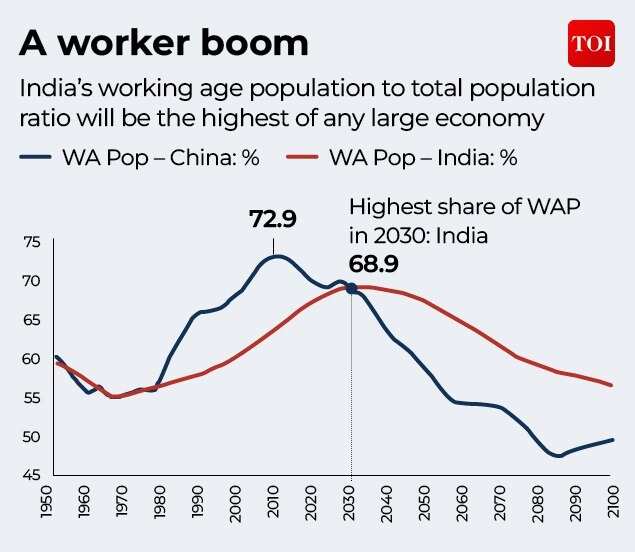
India’s working age population
In fact, nearly one in every four new workers entering the global workforce over the next decade (24.3%) is expected to come from India, at a time when many developed economies are battling ageing populations and labour shortages, EY has predicted.This isn’t happening overnight. India’s working-age population has been steadily expanding, from 735 million in 2011 to a projected 988.5 million by 2036, according to government population projections.The country is also entering its “sweet spot” demographically. As the number of working-age people rises and birth rates fall, the dependency ratio, the number of children and elderly people supported by every 100 working-age adults, is expected to hit a historic low. A lower dependency ratio means more people earning, fewer people depending, giving the economy a better chance to grow faster.But this window won’t stay open forever.With fertility now below replacement level and people living longer, India’s population will gradually begin to age.The number of people aged 60 and above is projected to more than double, from about 101 million in 2011 to nearly 227 million by 2036.At the same time, the number of children below 15 is expected to fall from 374 million to 306 million, reflecting smaller families and longer life expectancy.In 2024, 66.4% of the population was of working age (15–59 years), while 24% were below 15 and 9.7% were aged 60 and above, giving the country a large workforce to drive economic growth.However, a young population alone doesn’t guarantee prosperity. India’s demographic dividend will pay off only if it can create enough quality jobs, equip young people with future-ready skills and bring more women into the workforce. Otherwise, this once-in-a-generation opportunity could slip away.
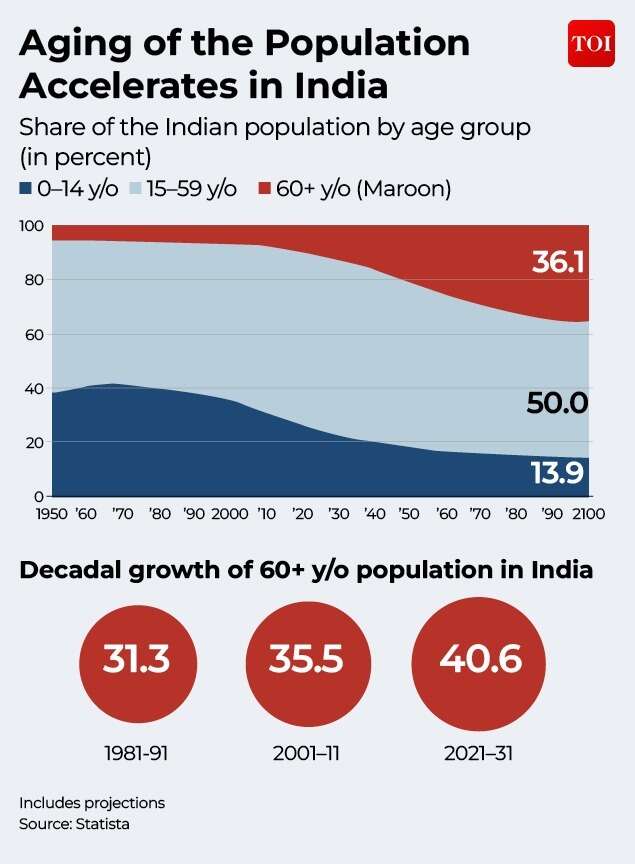
Accelerating ageing population in India
Which state is aging first?
But how long will the country stay young? According to estimates, not longer!While the country continues to enjoy a large working-age population, its senior citizen population is rising at one of the fastest rates in the world.The India Ageing Report estimates that around 149 million Indians were aged 60 and above in 2022, accounting for 10.5% of the population. By 2036, that share is expected to rise to around 15%, meaning one in every seven Indians will be a senior citizen. The trend is set to accelerate further, with the elderly population projected to cross 347 million by 2050, or nearly one in every five Indians.India is expected to add almost 200 million senior citizens in less than three decades, marking one of the fastest ageing transitions in the world.
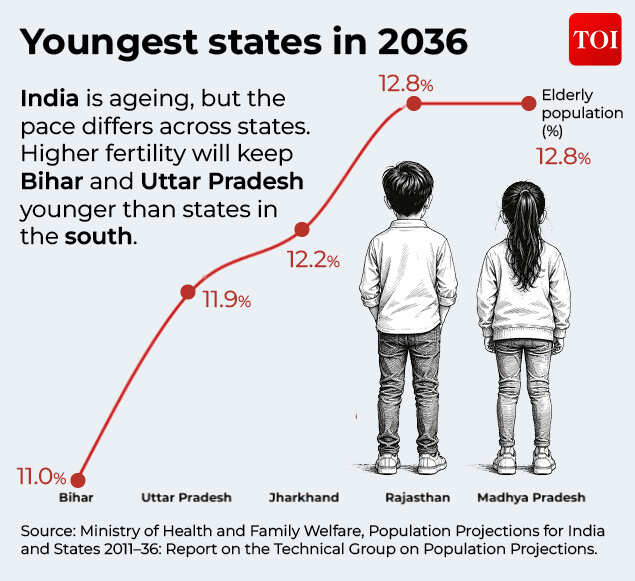
Youngest states in 2036
But this transition won’t look the same across India. Kerala is expected to remain the country’s oldest state, with the share of people aged 60 and above rising from 13% in 2011 to nearly 23% by 2036.It is followed by Tamil Nadu, Himachal Pradesh, Andhra Pradesh and Punjab, where ageing is progressing much faster than the national average. These states already have age profiles that increasingly resemble those of many developed countries.In contrast, Bihar, Uttar Pradesh and several other northern and eastern states are expected to remain younger for longer because fertility rates are relatively higher. In Uttar Pradesh, for example, the elderly share is projected to rise from 7% in 2011 to around 12% by 2036, a much slower pace than in Kerala.
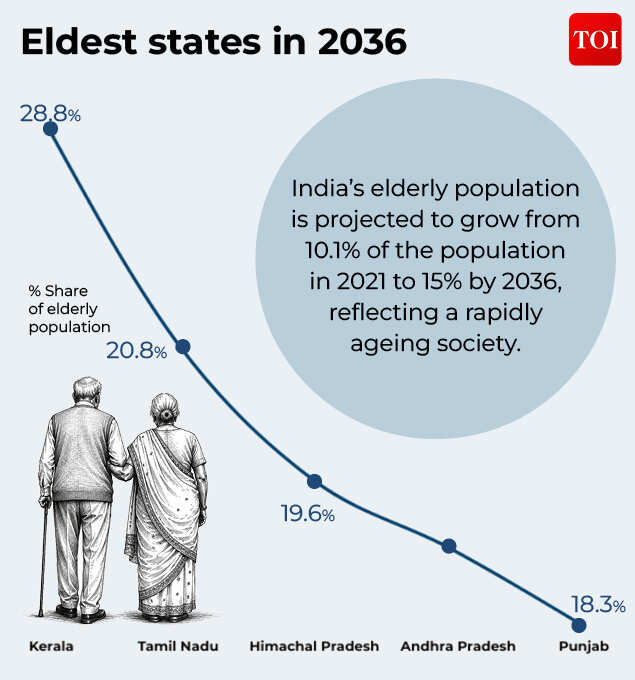
Projected eldest states in India by 2026
The reason behind this divide is simple: people are living longer while having fewer children. Better healthcare has increased life expectancy, while falling fertility has steadily reduced the number of births, gradually pushing up India’s median age.This shift will reshape policy priorities. Younger states will continue to focus on schools, skills and job creation, while aging states will increasingly need better healthcare, long-term care, stronger pension systems, social security and age-friendly infrastructure.The takeaway is clear: India’s demographic dividend comes with an expiry date. The country has a limited window to turn its young population into an economic advantage while preparing for the challenges of an ageing society.
Village-to-city shuffle
India is still largely rural, but its urban population has been growing steadily for decades.Back in 1960, more than 82% of Indians lived in villages, while just 17.9% called towns and cities home. Since then, India’s urban footprint has expanded year after year. The share of people living in cities rose to 19.7% in 1970, 23.5% in 1980, 25.6% in 1990, 27.6% in 2000, 30.9% in 2010, 34.1% in 2020, 35.1% in 2023, 35.4% in 2024 and an estimated 35.7% in 2025.As cities have grown, the rural share has steadily shrunk, from 82.1% in 1960 to 64.3% in 2025. Villages still house the majority of Indians, but the gap is narrowing every year.And this is only the beginning. More than 40% of Indians will live in urban areas by 2030, making the country a nation of cities. That also means greater demand for housing, transport, healthcare, water supply and other urban infrastructure.One of the biggest forces driving this shift is migration.
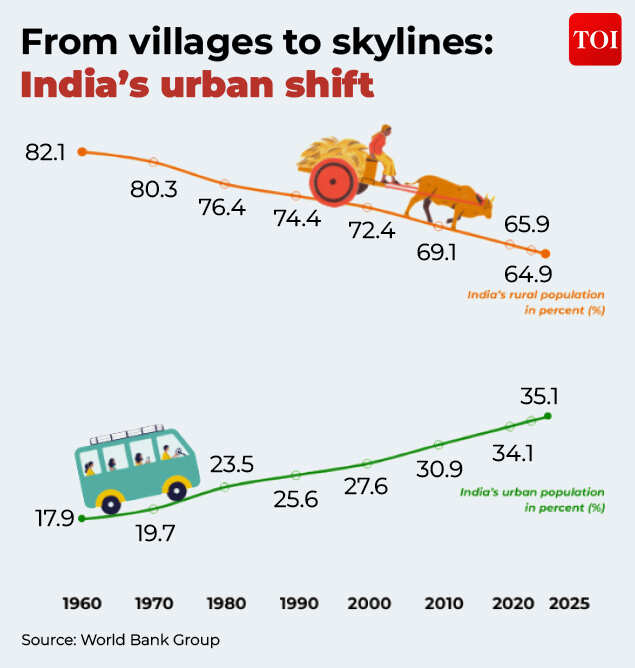
India’s urban shift
According to the Periodic Labour Force Survey (2020–21), 55% of internal migrants moved from one rural area to another. Another 18.9% moved from villages to cities, largely in search of jobs and better opportunities. Around 15.9% shifted between cities, while 10.2% moved from urban to rural areas.The numbers show that villages still account for the largest share of migration, but cities continue to attract millions with the promise of better jobs, education and higher incomes. In short, India’s urban story isn’t just about growing cities, it’s about millions of people chasing bigger dreams.
India’s unemployment puzzle
India’s demographic dividend will only deliver results if enough jobs are created.For much of the past three decades, the unemployment rate remained remarkably stable, hovering around 7.5%. It stood at 7.64% in 1991 and fluctuated within a narrow range through the 1990s and 2000s, remaining between 7.5% and 7.7% for almost three decades.The pandemic briefly disrupted this trend. The unemployment rate rose to 7.86% in 2020, before easing to 6.38% in 2021.Since then, the labour market has improved significantly. Unemployment dropped to 4.82% in 2022, the lowest level in more than three decades, before falling further to 4.17% in both 2023 and 2024. It is estimated to edge up slightly to 4.22% in 2025 and 5.1% by March 2026.While these numbers suggest improving employment conditions, India’s biggest challenge is not just creating jobs, but creating enough high-quality and productive jobs for the millions of young people entering the workforce every year.As India’s working-age population continues to expand through the next decade, employment generation, skilling and higher female labour force participation will determine whether the country fully capitalises on its demographic advantage.
What comes next
The next chapter is not just about how many more people there will be, but about how India supports them through every stage of life.The country is now moving towards a new reality of smaller families, longer lives, growing cities and a population that is slowly getting older. This means balancing two very different challenges at the same time: creating opportunities for its young workforce while preparing for an ageing society.The road ahead will need stronger healthcare, social security, housing and urban infrastructure.At the same time, India’s biggest advantage is still its youth.With one of the youngest populations among major economies, the country has a unique chance to drive growth through jobs, innovation, rising incomes and consumer demand.The real test will be turning this demographic advantage into lasting progress, by creating quality jobs, improving skills, increasing women’s participation in the workforce and building cities that can keep pace with changing needs.The bottom line? India’s future will not be decided by how many people it has, but by how well it turns its people into its biggest strength.

Leave a Reply