
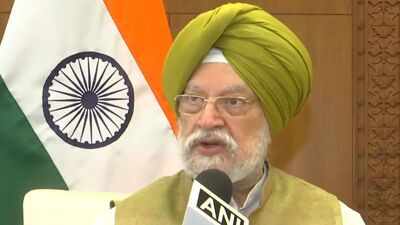
NEW DELHI: Oil minister Hardeep Singh Puri on Tuesday dismissed claims circulating on social media over India’s E20 ethanol-blended petrol programme, calling them a ‘misinterpretation’ and said that there was no evidence to support concerns about the fuel’s performance in compatible vehicles.His remarks came amid an ongoing debate over E20 petrol, with some social media posts and consumer complaints alleging reduced mileage, engine damage and speculation that the government could soon increase the ethanol blending level beyond 20 per cent.Speaking to reporters, Puri said the concerns being raised about E20 were based on misinformation rather than evidence.“It is a misinterpretation and I don’t want to use stronger words. There are 20 crore two-wheelers on the road and 20 lakh four-wheelers using this fuel. The automobile manufacturers, as well as the people who service these vehicles, all say there is no difficulty. Why this sudden interest?”He said that India had already been using E15 fuel for over three years and E20 fuel had been rolled out nationwide since April last year without any widespread issues.“We have been using E15 for the last three and a half years. We have been on E20 since April of last year. From April 2025 to April 2026, it has already been one year, and we are now another five months beyond that.”The government has repeatedly defended the programme, saying it is backed by scientific studies and extensive testing. It has also clarified that any move towards higher ethanol blends, such as E25, would be taken only after detailed testing and consultations with stakeholders.Puri also addressed speculation that the government was preparing to introduce petrol with a higher ethanol content. He said tests on E25 fuel were still under way and no decision would be taken until the findings were reviewed with automobile manufacturers and other stakeholders.“If someone is suggesting E25, we have made it clear that we are conducting tests. Those tests will take time. Once the reports are available, we will evaluate them. Then we will discuss the findings with the stakeholders and the automobile manufacturers.”He added that vehicle manufacturers had expressed confidence in E20-compatible vehicles and that consumers were also accepting the fuel.“After all, I neither manufacture the cars nor the fuel. The car manufacturers are comfortable with E20. Each one of them has made a statement to that effect. Consumers also appreciate the product.”Puri also said the rollout of E85 fuel had only recently begun and would take time because additional fuel stations and supporting infrastructure would need to be developed.
Why E20 is in the spotlight
The controversy around E20 has intensified in recent weeks after nationwide availability of the fuel and the notification of fuel standards for higher ethanol blends, including E22, E25, E27 and E30, triggered speculation that the government planned to further increase mandatory blending.Many vehicle owners, particularly those using older vehicles manufactured before April 2023, have reported lower fuel efficiency and expressed concerns about possible long-term effects on engines and vehicle components.The government and automobile manufacturers, however, have maintained that studies conducted by the Automotive Research Association of India (ARAI), Indian Oil Corporation and the Society of Indian Automobile Manufacturers (SIAM) found no significant engine durability or performance issues with E20 fuel. They have acknowledged that non-E20-compliant vehicles may experience a marginal reduction in mileage, while some older rubber components could require earlier replacement.
Government has repeatedly defended ethanol programme
The Centre has issued several clarifications in recent days rejecting claims that E20 damages engines, voids vehicle warranties or poses environmental risks.It has also denied reports claiming Bhutan rejected India’s E20 petrol, saying no proposal to export the fuel had ever been made.According to the government, the ethanol blending programme has helped reduce crude oil imports, save foreign exchange, lower carbon emissions and increase farmers’ income. India achieved its target of 20 per cent ethanol blending ahead of schedule and officials say any future increase in blending levels will be based on scientific evidence and consultations with industry stakeholders.

Leave a Reply