
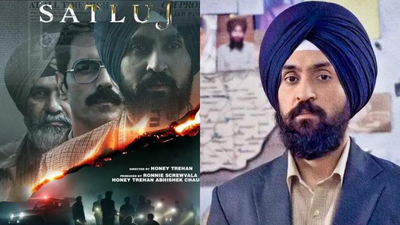
AMRITSAR: The recent ban on the Punjabi film Satluj, which reportedly portrays alleged extrajudicial killings by police during Punjab’s militancy years, has reopened painful memories for families who claim they lost their loved ones in enforced disappearances and fake encounters.Several relatives of the alleged victims told The Times of India that the film should not have been banned. They believe it highlights a painful chapter of Punjab’s history that deserves to be acknowledged rather than suppressed.Many recalled that their family members were allegedly picked up by police for questioning and never returned home. In numerous cases, they said, the families were never handed over the bodies for cremation. Some learnt about the deaths only through newspaper reports, word of mouth, or after being told that their relatives had been killed in an encounter or had died during interrogation. Several families said they still preserve old newspaper clippings as the only record of what happened to their loved ones.Many of these families pursued legal battles for years. They pointed out that investigations by the Central Bureau of Investigation (CBI) and subsequent court proceedings led to the conviction of several police personnel in some cases. However, they said the convictions came decades later, after irreparable loss had already been suffered. Several also claimed they never received compensation and continue to feel that justice remains incomplete.“There can never be justice for what we lost,” was the common sentiment expressed by the families, who unanimously said Satluj should be screened across the country so that younger generations understand what many innocent families claim they endured during those turbulent years.Jaswinder Singh of Amritsar alleged that his maternal grandfather, Sulakhan Singh, 84, and his father, Sukhdev Singh, were picked up by police from Ghanupur Main Bazaar in 1992. Sulakhan Singh had retired as vice-principal of Government Senior Secondary School, Lopoke.According to Jaswinder, his maternal grandfather had participated in the freedom movement and was jailed in Lahore after taking part in the Moga Morcha against British rule.“He was a true patriot,” he said.Jaswinder claimed police frequently visited their home looking for his elder brother, Baljinder Singh, who was allegedly involved in militancy. He said his grandfather, who had earlier served in the police department, would argue with police teams whenever they came, but on one occasion they allegedly took away both his grandfather and father to Sarhali police station. On November 2, 1992, the family was informed that both had allegedly died during interrogation and that their bodies had been disposed of in the Harike canal.Bhupinder Kaur, whose father, Palwinder Singh, was allegedly picked up by police from Rawalpindi village near Phagwara in 1993, said she was too young to understand what had happened at the time. According to her relatives, her father had gone to cut fodder and later to feed cattle when police allegedly took him away, saying they only wanted to question him.“Later we came to know that he had been killed in an encounter,” she alleged.Bhupinder further alleged that her mother, Jaswinder Kaur, was tortured by police and sustained severe burn injuries. She said the family fought the case in court for nearly 35 years despite severe financial hardship, during which her brother passed away. She alleged that police repeatedly threatened her mother to withdraw the case, but she refused.“At least our voices should be heard across the country so people know what happened during those days,” she said.Hira Singh of Tarn Taran alleged that his 18-year-old younger brother, Gurnam Singh alias Pali, was picked up by police in 1992 on the pretext of questioning.He said the village sarpanch and panchayat members repeatedly approached the police station to inquire about him but received no clear answers. After persistent efforts, police allegedly allowed their mother to meet him in custody. A few days later, however, the family learnt that he had been killed in what police described as an encounter.“It was a fabricated story,” Hira Singh alleged.He said that while four policemen were accused and three were eventually sentenced to life imprisonment, the verdict came decades later.“That is not justice. At least someone tried to bring out the truth, but now even a film on the issue has been stopped,” he said.Baldev Singh of village Sanghna alleged that his father, Surjit Singh, 45, was picked up by police in 1992 for questioning and never returned.He recalled that during those years, it was difficult even to persuade village sarpanches and panchayat members to accompany family members to police stations because of the prevailing atmosphere of fear.“We would hire an auto or tempo for the sarpanch and panchayat members and request them with folded hands to help us inquire about my father,” he said.Baldev said it was only after human rights activist Jaswant Singh Khalra began investigating disappearances in Punjab that the family learnt about his father’s alleged killing. He claimed his father was falsely implicated despite being an ordinary villager.“Those were the days when anyone wearing a turban could be branded a militant,” he alleged.He added that although Hindu families in the village had received threats during that period, his father always reassured them and urged them not to leave the village.Satwant Singh Manak of Talwandi Bhai in Ferozepur alleged that his father, Chanan Singh, a police constable, was brutally tortured during police interrogation after he pursued legal action against alleged police excesses.Satwant said police frequently visited their home looking for him after he had left for Uttar Pradesh. He alleged that he had given statements against several policemen accused of extrajudicial killings. In 1994, police allegedly abandoned his father in a severely tortured condition at a railway station. Local residents who recognised him took him home, where he later succumbed to his injuries.Shiva Khatri, a Hindu resident of Tarn Taran, alleged that his uncle, Gulshan Kumar, was picked up by police in 1993. The family, he said, was never informed of the reasons. Later, they learnt that police had registered a case accusing Gulshan Kumar and four others of vehicle robberies.“The five men did not even know one another, yet police portrayed them as associates,” he alleged.According to Shiva, the family later came to know that all five had been killed in an alleged encounter.For these families, the debate surrounding Satluj is about much more than a film. They say it is about preserving the memory of those who disappeared, ensuring their stories are heard across India, and allowing future generations to confront a painful chapter of Punjab’s history that, in their view, should not be forgotten.

Leave a Reply