
SpaceX made a blockbuster debut on the Nasdaq on Friday, with its shares surging 19 per cent and pushing the company’s valuation beyond $2 trillion. The rally elevated SpaceX to the position of the sixth-largest publicly traded company in the United States and helped make founder Elon Musk the world’s first trillionaire.Investor demand was strong from the outset, fuelled by enthusiasm for Musk’s expanding business interests in space technology, satellite communications and artificial intelligence. More than 510 million shares changed hands during the session, representing roughly $84 billion in trading activity.Despite the excitement, SpaceX remains unprofitable and generates significantly less revenue than several technology companies with comparable market valuations.
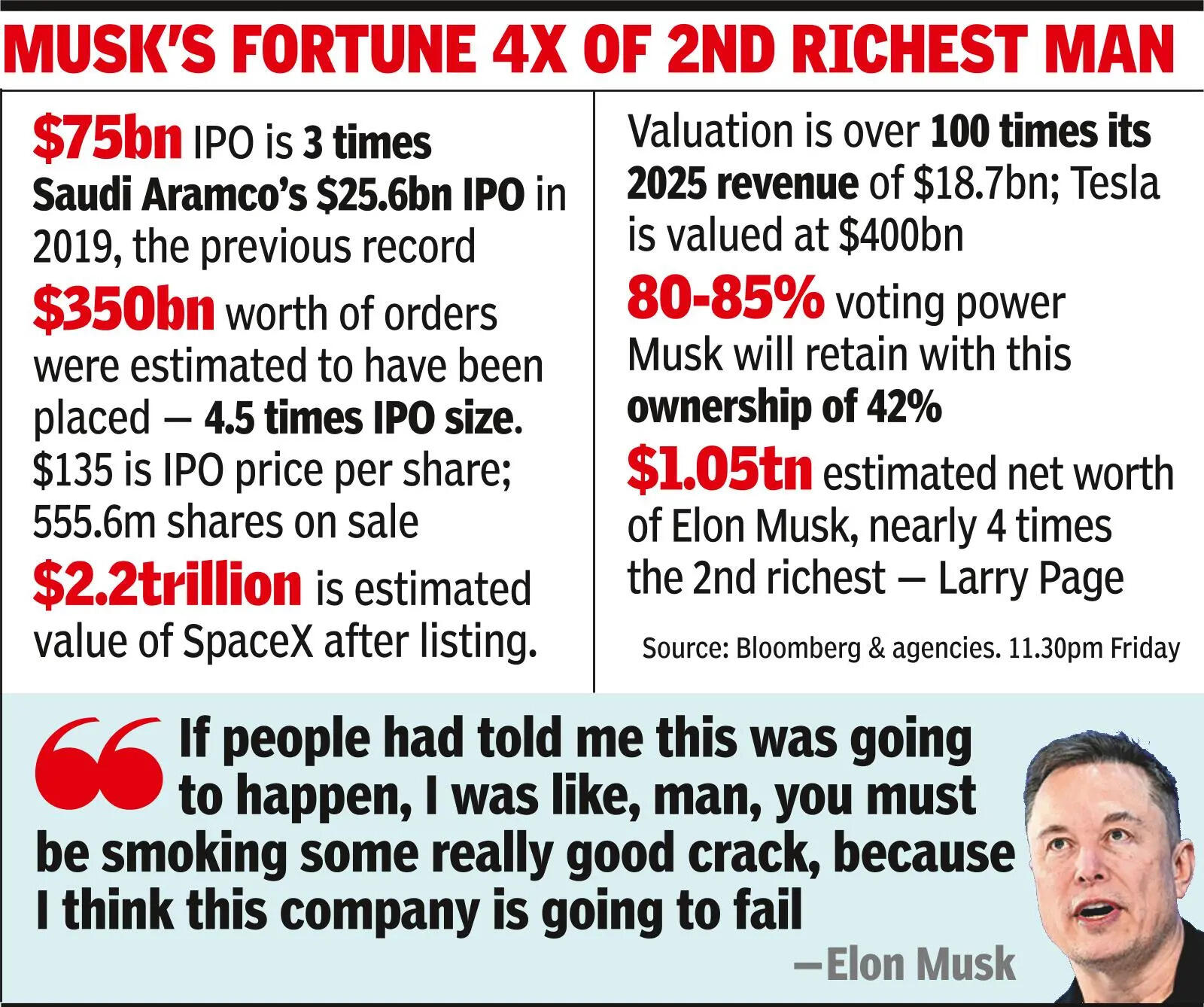
Musk’s fortune 4X of 2nd richest man
The listing proceeded without major disruptions, in contrast to some high-profile public offerings of the past. Trading began late on Friday morning and the stock eventually closed at $160.95 per share, giving the company a market capitalisation of approximately $2.1 trillion.That valuation places SpaceX ahead of Broadcom and above Tesla, Musk’s electric vehicle company. Amazon, valued at around $2.6 trillion, remains the next-largest company ahead of SpaceX.According to Forbes, Musk’s combined stakes in SpaceX and Tesla have lifted his net worth to an estimated $1.1 trillion.
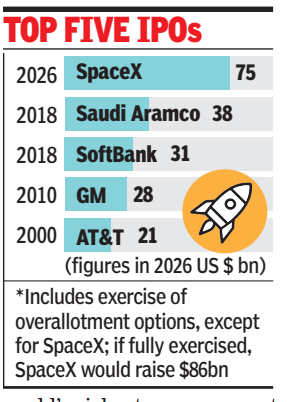
Top 5 IPOs
Explaining the decision to take SpaceX public, Musk said the company requires substantial funding to support its long-term projects, including space-based satellites, orbital data centres and the eventual establishment of a human settlement on Mars.He marked the start of trading by participating in Nasdaq’s ceremonial opening bell from Starbase in South Texas, the company’s primary launch and development site.During the event, Musk reiterated his vision “to make life multiplanetary.”“Not just a few astronauts, I mean literally you,” Musk said. “Whoever you are watching this, SpaceX wants to be able to take you to the moon, take you to Mars and ultimately beyond.”Musk’s reputation for ambitious technological achievements, alongside his history of bold predictions and delayed timelines, helped generate significant interest in the offering. According to Jay Ritter, a professor at the University of Florida’s Warrington College of Business, the average company going public between 1980 and 2025 recorded a first-day gain of around 7 per cent, far below SpaceX’s debut performance.Both institutional and retail investors rushed to buy shares priced at $135 before trading began. The company raised $75 billion through the offering, surpassing the previous IPO record set by Saudi Aramco in 2019.Beyond its plans for a large-scale settlement on Mars, SpaceX has outlined broader ambitions that include creating additional human outposts in space, launching enormous orbital data centres and competing with leading artificial intelligence firms such as Anthropic and OpenAI.To achieve those goals, however, the company will require substantial additional capital. Between the beginning of 2025 and March 31, 2026, Space Exploration Technologies Corp., the formal name of SpaceX, reported losses of $8.7 billion despite growth in its rocket launch and satellite businesses.

Leave a Reply