
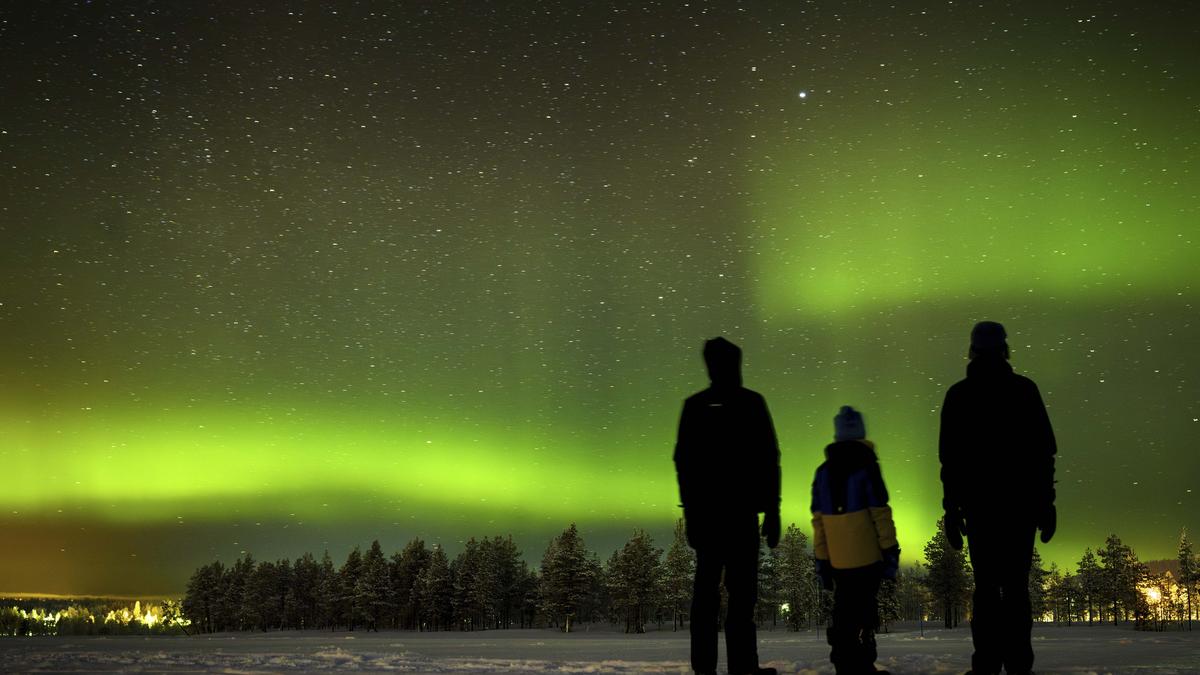
‘Aurora Borealis’, more popularly called ‘northern lights’, is expected to be visible in India on June 8, 2026. A massive solar storm is expected to make the beautiful phenomenon, commonly seen in Nordic countries such as Switzerland and Finland, a reality in the country.
When and where to watch auroras?
The auroras are expected to be visible in the higher regions of India, including parts of Kashmir, the upper Himalayas of Uttarakhand, and the picturesque Pangong Tso lake and Hanle regions of Ladakh.
The solar storm will begin before Monday midnight (June 8,2026) and will peak between 11.30 pm IST tonight to 2.30 a.m. IST Tuesday (June 9, 2026).
Will metro cities witness the northern lights?
Delhi, Bengaluru, Chennai, Kolkata, Mumbai and other major cities of India are not expected to see aurora because of light pollution and their general location on the globe.
What are auroras? Are they actual lights in the sky?
Auroras are formed because solar storms give out huge bursts of electrically charged particles called ions, which either disperse into space or become captured in the Earth’s magnetic field and subsequently, into the atmosphere. Here, the ions collide with oxygen and nitrogen atoms in the atmosphere. This, in turn, releases energy, which causes a glowing light around the poles, or an aurora.
A celestial ballet: How are the Northern Lights formed?
Why are they called northern lights?
The phenomenon is called ‘northern lights’ because they are concentrated around the North Pole or the magnetic pole in Earth’s northern hemisphere. They are frequently seen in Norway, Sweden, Finland, Iceland, Canada, Alaska, and Greenland.
‘Aurora Borealis’ is the scientific name for these lights in the night sky in the northern hemisphere. The ones in the southern hemisphere are called ‘Aurora Australis’ or ‘southern lights.’
What will be the auroras’ colour in India and why?
The auroras that may be visible from India will be crimson or red in colour. This is because India is located further from the poles and people will be looking at a region of the sky where oxygen emissions glow red as atoms react directly to the incoming energy of the Sun.

Leave a Reply