
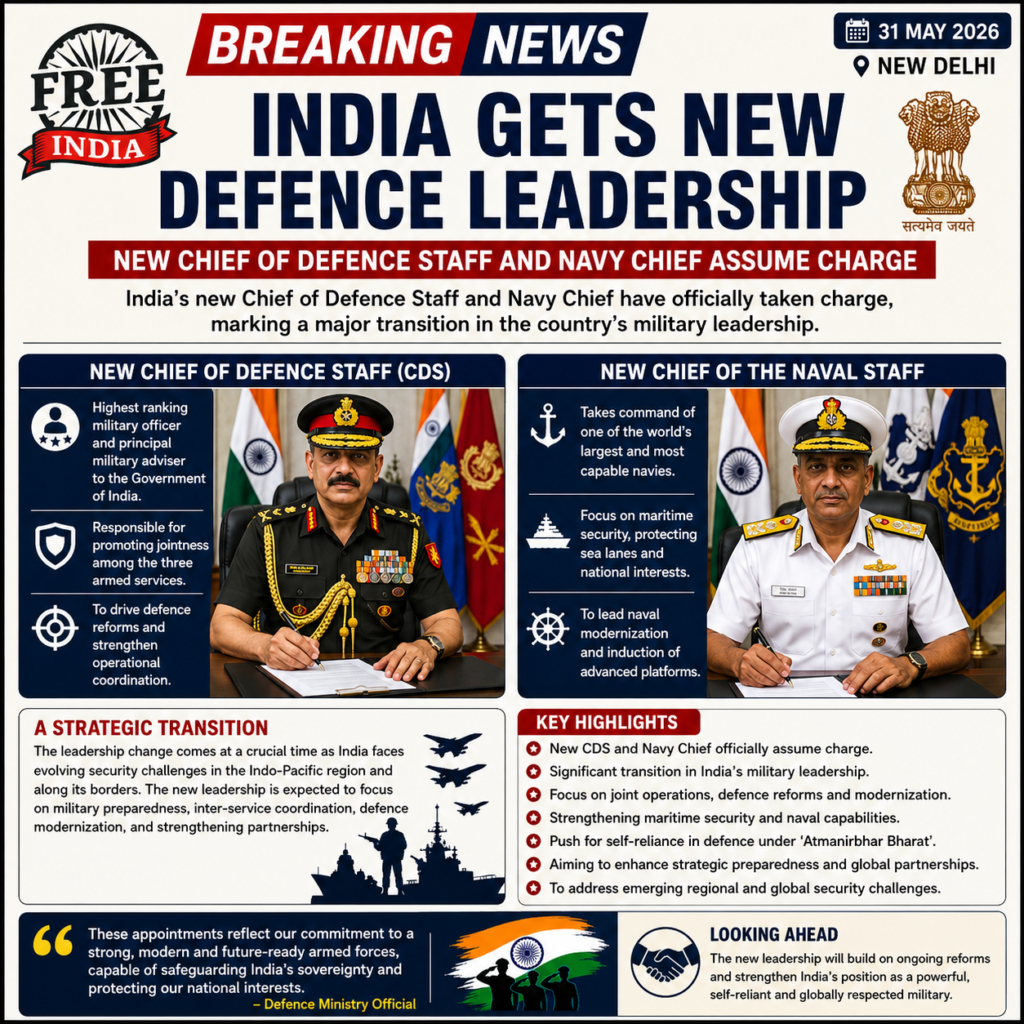
India has entered a new phase in its military administration with the appointment of a new Chief of Defence Staff (CDS) and a new Chief of the Naval Staff (Navy Chief). The leadership transition marks an important development for the country’s armed forces at a time when national security, modernization, and strategic preparedness remain key priorities.
The newly appointed officers officially assumed their responsibilities following formal ceremonies attended by senior defence officials, military commanders, and government representatives. The appointments are expected to play a crucial role in shaping India’s future defence strategy and strengthening coordination among the Army, Navy, and Air Force.
The Chief of Defence Staff serves as the highest-ranking military officer in the country and acts as the principal military adviser to the Government of India. The CDS is responsible for promoting jointness among the three armed services, improving operational coordination, and overseeing long-term military reforms. The position has become increasingly significant as India continues to modernize its defence infrastructure and enhance its capabilities across multiple domains, including land, sea, air, cyber, and space.
Meanwhile, the new Navy Chief takes command of one of the world’s largest naval forces. The Indian Navy plays a critical role in safeguarding the country’s maritime interests, protecting vital sea lanes, and ensuring security across the Indian Ocean Region. Under the new leadership, the Navy is expected to continue its modernization efforts, including the induction of advanced warships, submarines, naval aircraft, and indigenous defence technologies.
Defence analysts believe the appointments come at a crucial time as India faces evolving security challenges in the Indo-Pacific region and along its borders. Strengthening maritime security, enhancing military readiness, and expanding defence cooperation with international partners are expected to remain key focus areas for the new leadership.
The transition also aligns with India’s broader vision of achieving greater self-reliance in defence production under the “Atmanirbhar Bharat” initiative. Both leaders are expected to oversee major modernization projects aimed at reducing dependence on foreign military equipment and boosting indigenous defence manufacturing.
Government officials have expressed confidence that the new military leadership will continue to build upon recent reforms while ensuring that the armed forces remain prepared to address emerging threats. The appointments are viewed as an important step in maintaining continuity, stability, and strategic direction within India’s defence establishment.
As the new CDS and Navy Chief begin their tenure, attention will focus on their approach to military modernization, joint operational planning, regional security cooperation, and the implementation of long-term defence reforms designed to strengthen India’s position as a major global military power.
Key Highlights
- New Chief of Defence Staff (CDS) and Navy Chief officially assume charge.
- Marks a significant transition in India’s military leadership.
- CDS to oversee joint military planning and defence reforms.
- Navy Chief to lead maritime security and naval modernization efforts.
- Focus expected on military readiness, modernization, and indigenous defence production.
- Leadership change comes amid evolving regional and global security challenges.
- Defence experts expect continued emphasis on strategic preparedness and inter-service coordination.

Leave a Reply