
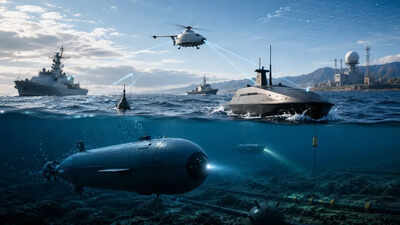
NEW DELHI: Unmanned Underwater Vehicles (UUVs) encompass both autonomous platforms that navigate and act without real-time human control and remotely operated systems piloted from a surface ship or shore station. Once niche tools for scientific sampling and oilfield inspection, these systems now play an expanding role across naval operations and civilian sectors. From seabed surveillance to mine warfare, UUVs and their surface counterparts are reshaping the maritime battlespace and the peacetime economy that depends on the oceans.Navies worldwide are investing heavily in unmanned maritime systems because these platforms deliver stealth, persistence and risk reduction in ways manned platforms cannot. They can loiter for days or months, covertly gather intelligence, and operate in contested littorals where sending sailors or submarines would be hazardous. Their presence complicates an adversary’s calculus: a distributed network of unmanned vessels and vehicles can act as deterrents and force multipliers, monitoring chokepoints, protecting seabed infrastructure such as cables and pipelines, and denying access to hostile forces without escalating to overt kinetic confrontation. In strategic terms, unmanned systems extend maritime domain awareness and create layered defences that are harder to neutralise than a single large asset.
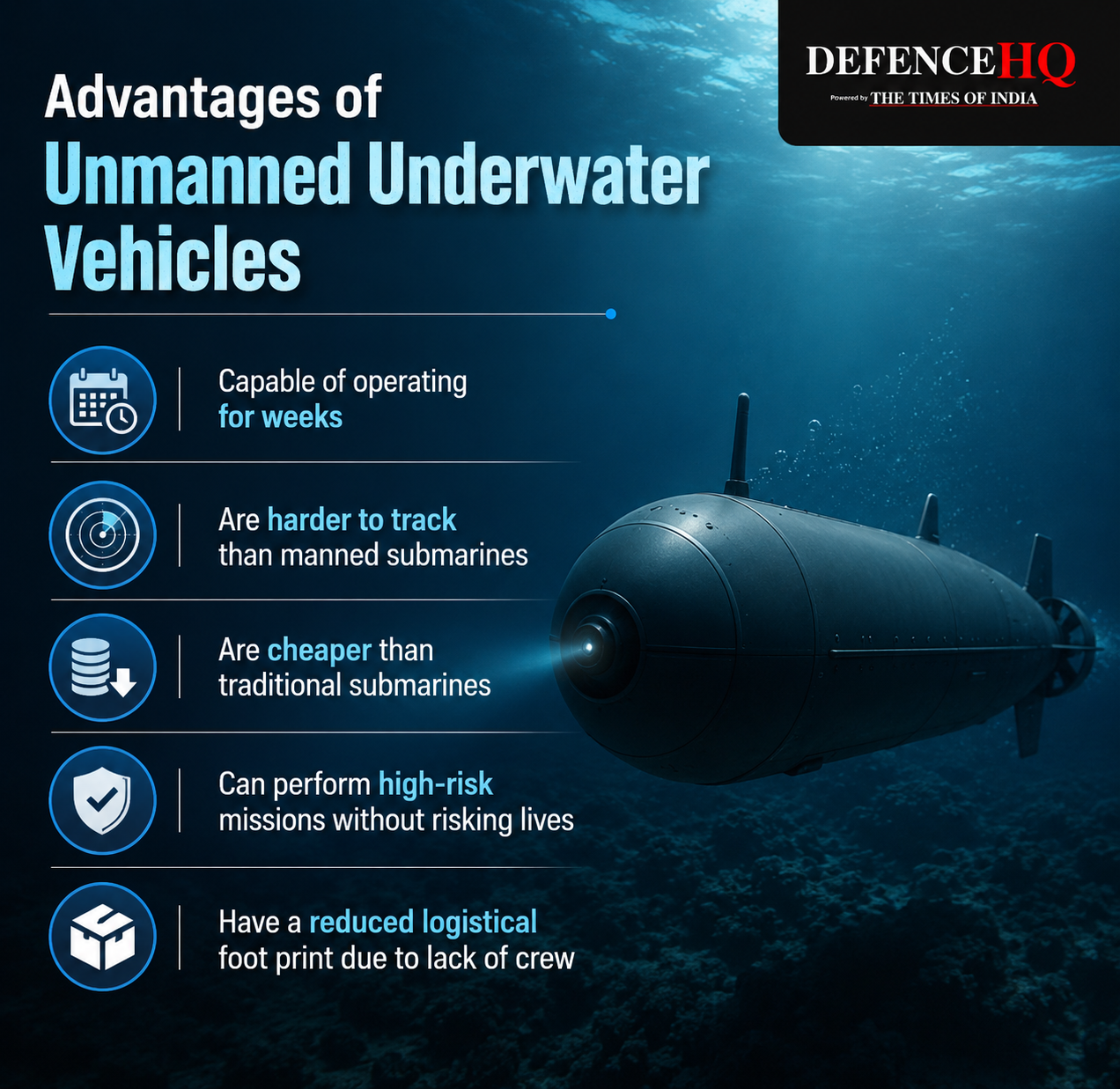
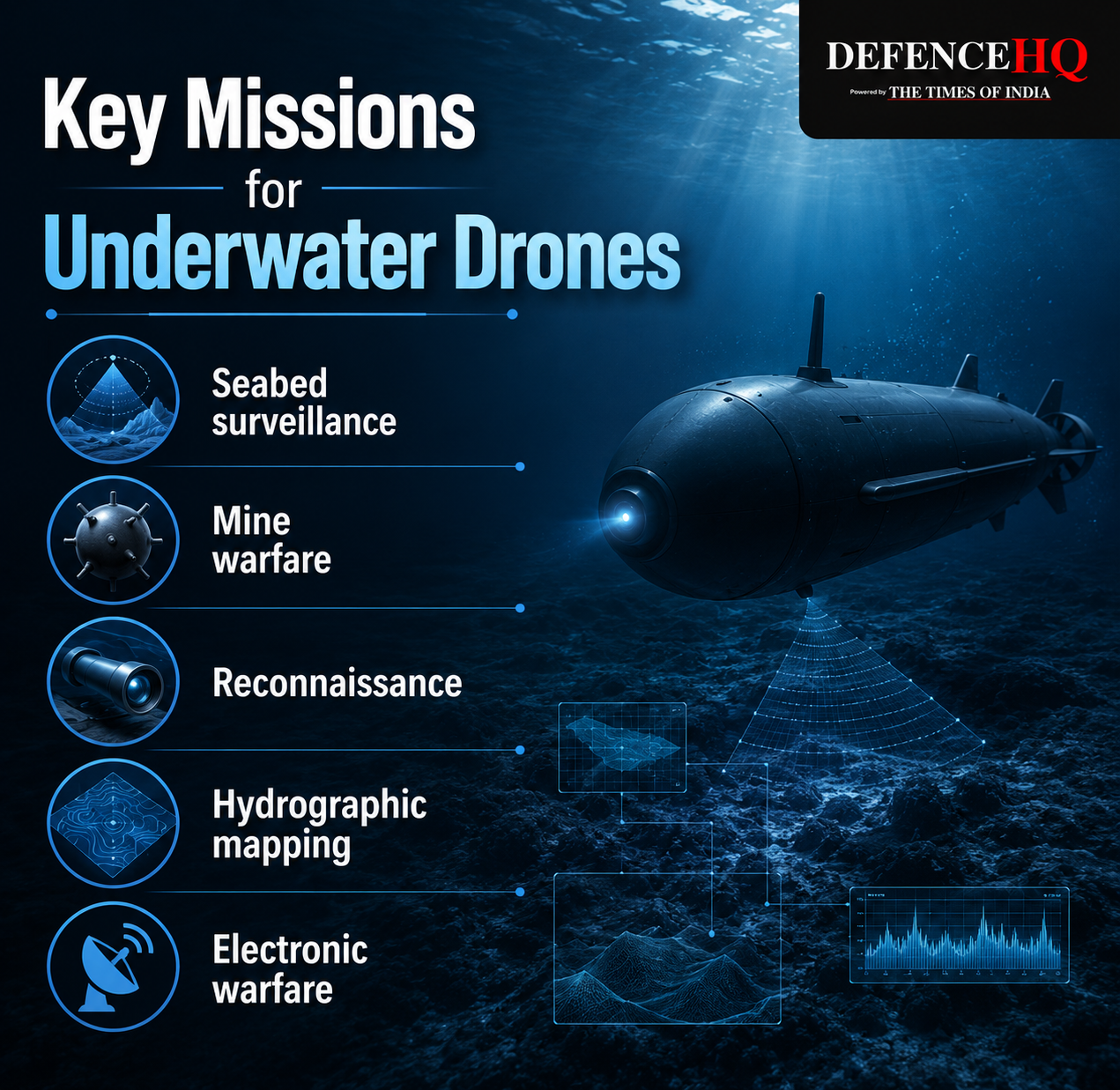
Technically, these systems bring several strengths that make them attractive for both military and civilian missions. Endurance is a defining advantage: modern designs, especially extra-large UUVs and larger unmanned surface vessels (USVs), can sustain long missions measured in weeks or months, enabling persistent presence far from support vessels. Payload flexibility allows a single hull to carry diverse sensor suites, including sonar arrays, synthetic aperture sonar and magnetometers, alongside mission modules such as mines, electronic warfare packages or environmental sensors for oceanography. Stealth is another key benefit: many unmanned platforms operate with a much lower acoustic and electromagnetic signature than manned submarines, making detection and attribution more difficult. Cost efficiency matters as well: unmanned systems range from relatively inexpensive expendable units to sophisticated but still far cheaper platforms than nuclear or large diesel-electric submarines, enabling attritable deployment strategies. Examples such as Boeing’s Orca XLUUV and experimental systems like Russia’s Surrogat illustrate modular payload architectures and long-duration autonomy, demonstrating how a single platform can switch roles from surveillance to logistics or mine emplacement with minimal reconfiguration.Operationally, unmanned systems are being integrated into a wide spectrum of missions that reshape planning and execution. Persistent surveillance is foundational: unmanned vehicles can monitor seabed cables, undersea pipelines and maritime approaches, providing continuous data on vessel movements, acoustic signatures and environmental conditions. In mine warfare, unmanned systems offer both offensive and defensive options, covertly deploying mines in denied areas or conducting mine countermeasure sweeps using high-resolution sonar to detect and classify threats without exposing crews. Reconnaissance is another critical role: forward-deployed unmanned assets can scout choke points, map seabed topography and feed tactical data to surface and subsurface commanders, enabling safer transit for manned units. Beyond strictly military tasks, these platforms have dual-use applications: they support disaster response by mapping wreckage or assessing underwater damage after storms; they advance oceanographic research through long-term environmental monitoring; and they assist resource exploration by surveying seabed mineral deposits and fish stocks. This operational versatility makes unmanned systems force multipliers in both conflict and peacetime missions.
Integration into existing force structures, however, is not automatic. The integration of unmanned surface vessels into Indian naval concepts of operations represents a structural shift in maritime warfare. India needs not only to acquire unmanned surface vessels in large numbers but also to integrate them coherently into the existing force structure to complement major surface combatants. If pursued in isolation, unmanned surface vessels may become peripheral assets with limited strategic effect. If integrated coherently, they can enhance maritime domain awareness, strengthen deterrence and provide decision-makers with a wider spectrum of calibrated options. The question, therefore, is not whether unmanned surface vessels matter, but whether institutional adaptation can keep pace with technological change.To guide industry partners in synchronising their development efforts with the requirements of the Indian Navy, Swavlamban 2.0 was released by the Prime Minister on October 4, 2023, at the NIIO seminar. The document has served as a tool for industry partners to bolster the Government of India’s Atmanirbhar Bharat initiative. By the end of 2023, approvals from the Ministry of Defence had been obtained for several unmanned systems under the Make category, including SAVIOR, a semi-submersible autonomous vessel for intelligence, operations and reconnaissance; CASCADE-ASW, a compact autonomous surface craft for all-domain anti-submarine warfare; and ASW Wavegliders. Following the government push, there has been a surge in investment in research and development and the development of USVs in India. Sagar Defence’s USV Matangi completed a 1,000-mile autonomous journey in 2024 from Karwar to Thoothukudi. Garden Reach Shipbuilders and Engineers delivered the Jaldoot USV to the Naval Science and Technological Laboratory in December 2024. Bharat Electronics Limited has developed a solar-powered, zero-emission USV designed for hydrographic surveying, coastal surveillance and potentially logistics and kamikaze roles. Various other stakeholders are independently developing USVs in line with requirements projected by Naval Headquarters. These initiatives illustrate a national approach that couples procurement approvals with indigenous development, testing and operational experimentation to ensure that unmanned systems are not merely acquired but operationally useful.Operational realities in the Indian maritime environment impose specific design and doctrinal constraints. “By contrast, the western coast of India is characterised by long, open coastlines and expansive sea areas, where USVs operating in open waters would face significantly higher risks of detection, tracking and neutralisation,” an Indian Navy source observes, noting that “the Arabian Sea experiences comparatively rougher sea states, higher swell patterns and severe monsoonal conditions for extended periods each year. These conditions impose demanding requirements on hull design, propulsion reliability, sensor stability and command-and-control links. Achieving acceptable endurance while simultaneously preserving low observability and stealth in such conditions remains a non-trivial design and operational problem, particularly for smaller USV classes.” That assessment underscores why one-size-fits-all procurement is impractical: platform classes, hull forms and mission profiles must be tailored to regional sea states and threat environments.Communications and data handling are equally critical. “Operating USVs would require high bandwidth to ensure no data latency with the control station,” a navy source has stated, arguing that a typical architecture involving a high-throughput mesh topology and satellite relays must be developed alongside robust data automation and analysis. High-bandwidth links are essential for real-time control, sensor fusion and rapid decision cycles, yet they also create vulnerabilities: satellite relays can be jammed or intercepted, and mesh networks must be resilient to node loss and cyber intrusion. Balancing the need for timely data with the imperative of survivability will shape both hardware choices and operational concepts.As the number of unmanned systems grows, command, control and human-machine interfaces become a limiting factor unless addressed proactively. “With the increasing number of unmanned systems, there is a pressing need for a Unified Platform Management System that provides a single console for the operation of all unmanned systems within the local area,” an Indian Navy source stated. Such a system would centralise mission planning, health monitoring, tasking and data exploitation, reducing cognitive load on operators and enabling coordinated swarm behaviours. Without unified management, disparate control stations and proprietary interfaces risk creating stovepipes that undermine the very force multiplication unmanned systems promise.Challenges remain beyond communications and integration. Underwater command and control is constrained by physics: acoustic links are low-bandwidth and vulnerable to detection or jamming, while surfacing for satellite relay compromises stealth. Adversaries are developing counter-UUV and counter-USV measures, from passive detection arrays and anti-drone nets to active capture and neutralisation systems, that could blunt effectiveness. Legal and ethical concerns also persist: seabed warfare, covert emplacement of mines and operations in exclusive economic zones raise questions under the Law of the Sea and norms of engagement, complicating rules of engagement and escalation control. Reliance on autonomous decision-making introduces risks around reliability, unintended escalation and accountability when systems make lethal or politically sensitive choices.Technological and industrial implications are profound. Advances in battery chemistry, fuel cells and hybrid propulsion extend mission endurance, while improvements in machine learning and onboard processing enable more sophisticated target recognition and adaptive mission planning. The industrial base is shifting as traditional shipbuilders partner with technology firms and startups to produce modular, software-defined platforms. Supply chains for specialised components, including pressure-tolerant electronics, high-fidelity sonar and robust communication buoys, are becoming strategic assets themselves, with national security implications for export controls and domestic manufacturing resilience. For India, the emphasis on indigenous design and Make category approvals aims to build a domestic ecosystem that can sustain long-term operational needs and reduce dependence on foreign suppliers.Unmanned underwater and surface systems represent a capability that bridges military necessity and technological innovation, offering navies and civilian operators new ways to sense, shape and secure the maritime domain. As oceans become increasingly contested economically, environmentally and militarily, these systems will define the next frontier of maritime power, forcing planners to rethink doctrine, law and industrial strategy to harness their potential while managing the attendant risks.

Leave a Reply