
A: The solar wind is a stream of charged particles flowing outwards from the sun. As the solar wind nears the magnetic field of a planet, it becomes compressed near the magnetic boundaries. This creates a difference in pressure, or pressure gradient, that squeezes the charged particles along the magnetic field, away from the stream. As a result, closer to the stream is an area with a lower density of charged particles. This is called the Zwan-Wolf effect.
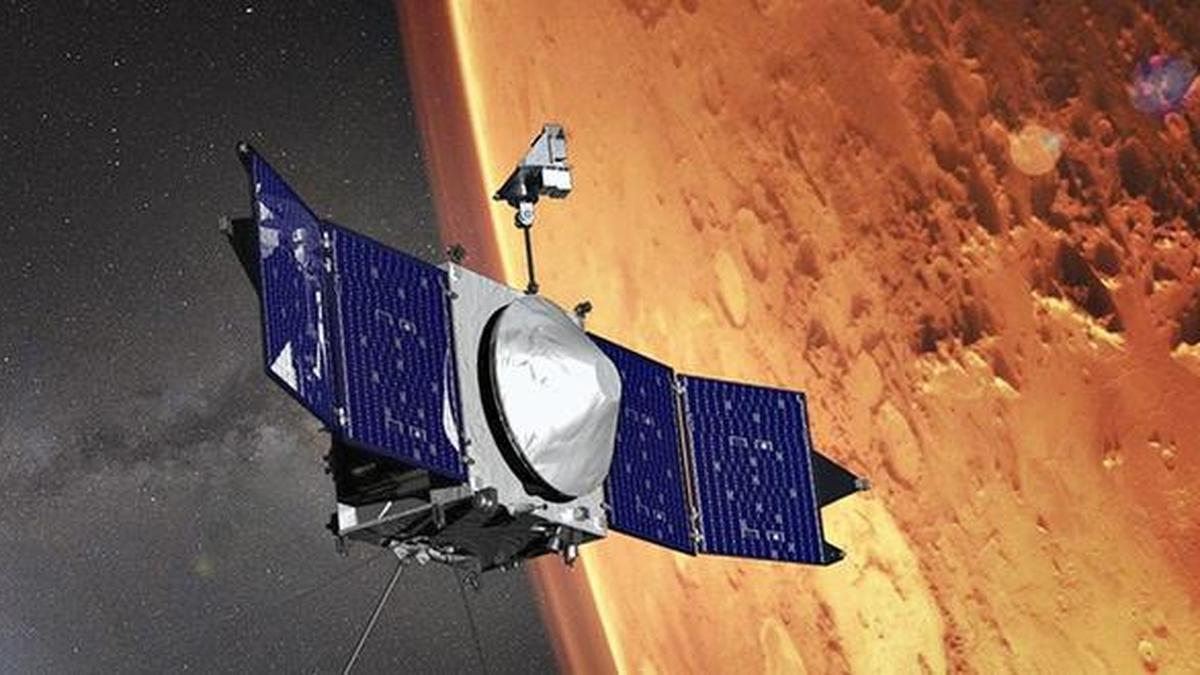
In a new study published in Nature Communications, researchers from France, the U.K., and the U.S. used the NASA MAVEN spacecraft to find evidence of the Zwan-Wolf effect at Mars. The finding is important because Mars does not have a strong, global magnetic field like the earth. The researchers did say in their paper that the Zwan-Wolf effect is likely continuously active at Mars but that it might be too weak most of the time to be detectable by other scientific instruments.
MAVEN had recorded the data containing the effect in December 2023, when a powerful solar storm called a coronal mass ejection struck Mars. The event created intense magnetic structures in Mars’s magnetic field that moved downwards into the planet’s ionosphere. These structures squeezed the charged particles in the ionosphere towards the planet’s unlit side, reducing the local density of the particles by around 50%.
According to the researchers, the findings indicate that even “unmagnetised” planets like Mars can experience complex magnetic phenomena like the Zwan-Wolf effect.

Leave a Reply