
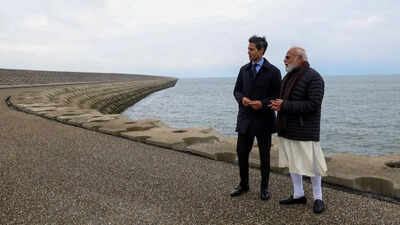
NEW DELHI: Prime Minister Narendra Modi’s visit to the iconic Afsluitdijk dam in the Netherlands during his official trip has drawn attention to a lesser-discussed but strategically important issue for India: long-term water management and climate resilience.Accompanied by Dutch Prime Minister Rob Jetten, PM Modi visited the massive barrier dam that has protected the Netherlands from floods for decades while also helping manage freshwater storage, inland waterways and renewable energy generation.The visit was not merely symbolic. According to India’s ministry of external affairs, the Afsluitdijk project has direct relevance to Gujarat’s ambitious Kalpasar Project, a proposed mega freshwater reservoir and dam system across the Gulf of Khambhat that has been under study for decades.In a post on X, PM Modi highlighted the importance of Dutch expertise in water engineering.“An area in which the Netherlands has done pioneering work is water management. The entire international community can learn a great deal from this. This morning I had the chance to visit the Afsluitdijk and gain insight into the key features of this project. I am grateful to Prime Minister Rob Jetten for accompanying me here. We are committed to bringing modern technology to India, designed to assist with irrigation, flood protection, and the expansion of the inland waterway network,” PM Modi said.MEA spokesperson Randhir Jaiswal also described the visit as an opportunity for deeper Indo-Dutch cooperation in climate resilience, water technology and sustainable infrastructure.“A symbol of engineering excellence and innovation! Accompanied by PM Rob Jetten of the Netherlands, PM @narendramodi visited the iconic Afsluitdijk Dam, a symbol of Dutch excellence in water management, flood protection and freshwater storage. The visit highlighted the relevance of Dutch expertise for India’s Kalpasar Project in Gujarat, which aims to create a freshwater reservoir and dam near the Gulf of Khambhat,” Jaiswal posted on X.
What is the Afsluitdijk?
The Afsluitdijk is one of the Netherlands’ most famous engineering projects and a central pillar of the country’s centuries-long battle against water.Originally completed around 80 years ago, the 32-kilometre-long barrier dam separates the North Sea from the IJsselmeer freshwater lake and protects large parts of the low-lying Netherlands from severe flooding.The structure also serves economic and environmental functions, including freshwater storage, navigation, transport connectivity and renewable energy generation.Now undergoing a major modernisation programme often referred to as “Afsluitdijk 2.0”, the project is being redesigned to withstand storms expected only once every 10,000 years.The upgraded system includes reinforced locks, improved water discharge systems, fish migration corridors and renewable energy technologies involving tidal flows, freshwater-saltwater interaction, solar and wind power.Dutch authorities estimate the modernisation project will cost around €800 million.The Afsluitdijk also demonstrates how flood defence infrastructure can serve multiple functions simultaneously. Apart from protecting against rising sea levels and storms, the project supports inland transport, tourism, cycling infrastructure and long-term freshwater security.
Why India is interested
India’s growing interest in Dutch water engineering comes amid increasing concerns over climate change, urban flooding, water scarcity and extreme weather events.Several Indian states, particularly coastal and drought-prone regions, are facing simultaneous risks of water shortages, salinity intrusion and flood disasters.For Gujarat, the proposed Kalpasar Project represents an attempt to address multiple challenges through a single mega infrastructure system.The project envisages constructing a 30-kilometre dam across the Gulf of Khambhat to create what could become the world’s largest freshwater reservoir in a marine environment.The reservoir would store around 10 billion cubic metres of freshwater sourced from rivers including the Narmada, Mahi, Sabarmati and Dhadar.The stored water would then be used for irrigation, drinking water supply and industrial requirements, especially in water-stressed regions of Saurashtra and parts of South Gujarat.The project also proposes a 10-lane transport corridor over the dam, reducing travel distances between Saurashtra and South Gujarat by more than 200 kilometres.In its earlier conception, the project also included a massive tidal power generation component, though that element has since been removed from the revised design.
The scale of the Kalpasar vision
The Kalpasar Project has been discussed in Gujarat since the 1970s and remains one of India’s most ambitious proposed water infrastructure plans.The idea was originally conceptualised after the Gulf of Khambhat was identified as a potential site for tidal energy generation in 1975. Over time, the focus shifted more toward freshwater storage, flood control, transport and irrigation.The revised plan now involves three major components.The first is the main Kalpasar dam connecting Bhavnagar district to Bharuch district across the Gulf of Khambhat.The second is the Bhadbhut barrage on the Narmada river near Bharuch, aimed at preventing saltwater intrusion while diverting freshwater into the reservoir system.The third is a massive canal network linking the barrage and reservoir while distributing water across Saurashtra.The project’s estimated cost has steadily increased over the years and is now estimated at around Rs 85,000-90,000 crore.If found technically and environmentally feasible, experts estimate construction alone could take between 12 and 15 years, while the entire project timeline may stretch close to two decades.
Why the Dutch model matters
The Netherlands offers India a real-world example of how large-scale water infrastructure can integrate flood defence, freshwater management, transportation and renewable energy into a single long-term strategy.Unlike many countries, the Dutch have centuries of experience living below sea level and managing constant flood threats.Much of the country’s modern identity has been shaped by large engineering systems involving dams, dikes, storm surge barriers, canals and pumping stations.For India, especially states vulnerable to coastal flooding and salinity intrusion, Dutch expertise could become increasingly relevant.The Kalpasar Project faces major engineering, environmental and ecological challenges. Studies are still examining issues related to marine ecosystems, sedimentation, fisheries impact, navigation routes and long-term environmental sustainability.Even after decades of planning, many feasibility studies remain incomplete.By July 2019, only 25 out of 43 feasibility studies related to ecological, environmental, social and financial impacts had been completed, while several others remained pending.No final environmental clearance has yet been granted for the main Kalpasar dam project.The Dutch experience with balancing environmental protection and water engineering could therefore offer valuable lessons for India as it evaluates the long-term viability of Kalpasar.
Climate change and the future of water infrastructure
PM Modi’s Afsluitdijk visit also reflects a broader global shift in how governments are approaching climate adaptation infrastructure.Rising sea levels, unpredictable monsoons, glacier melt, extreme rainfall and prolonged droughts are forcing countries to rethink traditional water management systems.For India, the challenge is particularly complex because it faces both flooding and water scarcity simultaneously across different regions.Projects like Kalpasar represent attempts to build long-term water storage and climate resilience infrastructure at massive scale. But they also raise difficult environmental and financial questions.The Netherlands’ approach demonstrates that future infrastructure systems may increasingly need to combine flood defence, freshwater security, renewable energy, transport and ecological management rather than treating them separately.That appears to be one of the key messages behind PM Modi’s highly symbolic visit to the Afsluitdijk.The visit ultimately highlighted that India’s interest in the Dutch model is not only about engineering. It is also about preparing for a future where climate resilience and water security could become central pillars of national infrastructure planning.

Leave a Reply