
Till a decade ago, betel leaves grown from Sholavandan in Madurai district were exported to the USA and U.K. and among other countries. However, today, the plight of the farmers’ was miserable that most of them are facing ‘red’ and were unable to stop the rising losses due to multiple factors.
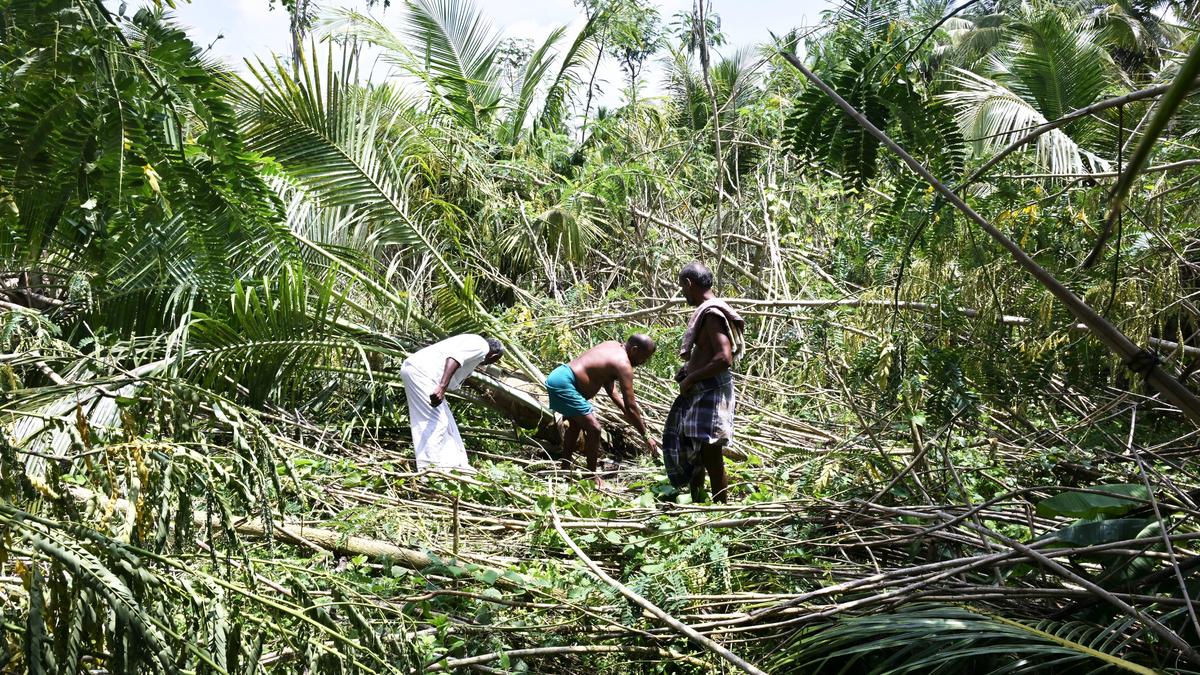
Very recently, on a sunny day, the farmers’ in Mannadimangalam raising betel leaves were in for a shock. A strong wind accompanied by unseasonal rainfall for about an hour completely turned their fate. The entire “kodikaal” was uprooted in the wind and the fields were inundated with knee deep water. The furious nature punished them so much that the financial loss was unbearable.
Almost two months have gone since the gale hit and the farmers’ are still waiting with a hope that the government would consider giving them some tangible relief, said Maranattan, a farmer and added that officials did visit the storm hit fields, but they were yet to get a favourable response.
The betel leaf cultivation is entirely different from that of other traditional crops such as paddy and coconut, farmers said and that the cost of cultivation itself would be huge that they joined in small groups and raised betel leaves. There will be work almost everyday and for the first harvest, it takes almost eight months and the second harvest may be done at the end of 15th month and so on.
If properly grown, betel leaves raised would fetch a whopping ₹15 lakh per acre for which the farmers’ collectively have to work for 24 to 30 months to achieve the earnings through two-three harvests, he said.
In Mannadimangalam alone, close to 75 acres of betel leaves raised and ready for harvest had been washed away. “All the money invested and the hard labour into it is all gone waste… he said with pain and hoped that the government helped them in this hour of crisis”.
If the woes of betel leaf farmers’ were bad, the problems faced by coconut and paddy farmers appeared worse. Sholavandan, which was once known as the ‘delta region’ as a majority of them cultivated double crop appears deserted and disoriented. The production and the productivity would be high in normal circumstances. The yield of each and every produce from the block too was very high, said Rajendran of Mettumadai.
However, things have changed for bad now.
With weather not cooperating and workers’ too were in shortage, the expenses had doubled. To raise any crop like betel leaves or coconut or paddy, the cost of production had gone up that the returns were not only meagre, but also uncertain with unpredictable rains.
Though the officials have taken the soil for testing and inspected the fields, they said that there wouldn’t be any relief from the government as the gale was a natural disaster and rains were unseasonal. There was no fault from them and that it was a natural calamity, said Paramasivam in Jayamangalam.
A farmer, N Ramasamy in Sholavandan, who retired from the Department of Agriculture, said that he has been cultivating in his family lands in Alankottaram for many decades. The hailstones hit the paddy crops that none of the farmers’ in the neighbouring villages could escape from the loss.
Apart from the paddy, at least 4,000 standing plantain crops ready for harvest were also uprooted in the hailstorm and many coconut trees were damaged. In many cases, the destruction was heavy that they had to start afresh, he added.
Recalling the harrowing experience, he said, the rain stopped only after three days. The continuous and widespread rain accompanied with gale sealed the fate of the farmers in this block. The speed was so high that many coconut trees too were damaged. It was simply unpredictable and unstoppable, he stressed.
Loss of paddy at DPCs
The farmers said that the direct procurement or purchase centres (DPC) which had purchased paddy from them were also at a loss. After procuring, the produce which were left in the open at the DPCs got soaked in the unseasonal rain.
The officials said that in the midst of the general election, they functioned with minimum workforce. As senior officers were tied up with the poll duty and model code of conduct was in force, the staff available were unable to take any decisions in such a crisis.
As a result, the paddy bags, which could not be transported to the go-downs in the nearby vicinity due to lack of space, they had gone waste, the officials admitted and added that hence payment could not be released to the farmers.
Now, the farmers’ who have been facing hardships have neither got the returns for the produce sold to the government nor they would be receiving it as the goods were destroyed in the rains. Caught in a quagmire, many small and marginal farmers are under severe stress.
Former Additional Director (Agriculture) S Kanagaraj said that the government should focus on enhancing infrastructural facilities. For instance, the storage go-downs should be built closer to the DPCs. Wherever, the density of paddy cultivation was high, the TNCSC (Tamil Nadu Civil Supplies Corporation) may examine modalities to have the facilities in place with proper roofing which would save time and money in transportation.
A senior official in the Department of Agriculture in Chennai told The Hindu that they had released Rs 290 crore as compensation in December 2025 to the farmers’ who lost their crops due to gale, unseasonal rain from the State Disaster Response Fund. Likewise, in the subsequent rainfall too, the then CM M K Stalin had ordered a relief of Rs 20,000 per acre to the farmers whose crops had submerged in the unpredicted rainfall.
Though he was unable to confirm about the relief for the farmers in Madurai district now, the official said that the new government has just assumed office. Probably, the ryots may have to wait for a few more months as the ministry has to forward the proposal to the Chief Minister C Joseph Vijay, who may have to discuss with the Finance Ministry before taking a final call.
The wait is going to be long this time too and the farmers’ may have to keep their fingers crossed until then.

Leave a Reply